. 2015 Oct:5:8-15.
doi: 10.1016/j.cobeha.2015.06.005. Epub 2015 Jul 2.

Neuroethological studies of fear, anxiety, and risky decision-making in rodents and humans

Affiliations

Neuroethological studies of fear, anxiety, and risky decision-making in rodents and humans

Dean Mobbs et al. Curr Opin Behav Sci. 2015 Oct.

Abstract

Prey are relentlessly faced with a series of survival problems to solve. One enduring problem is predation, where the prey's answers rely on the complex interaction between actions cultivated during its life course and defense reactions passed down by descendants. To understand the proximate neural responses to analogous threats, affective neuroscientists have favored well-controlled associative learning paradigms, yet researchers are now creating semi-realistic environments that examine the dynamic flow of decision-making and escape calculations that mimic the prey's real world choices. In the context of research from the field of ethology and behavioral ecology, we review some of the recent literature in rodent and human neuroscience and discuss how these studies have the potential to provide new insights into the behavioral expression, computations, and the neural circuits that underlie healthy and pathological fear and anxiety.


Figures
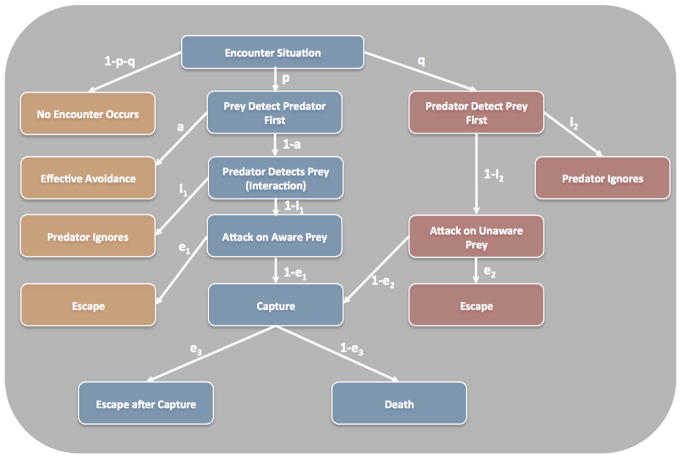
Fig. 1
Fig. 1
Lima and Dill’s Predator-Prey Model. Flow chart displaying the permutations of a predator-prey encounters. The symbols signify the conditional probabilities of each step of the pathway. a= avoid; e = escape; i = ignore; p=probability that the prey detects the predator first; q = probability that the predator detects the prey first [11].
Fig 2
Fig 2
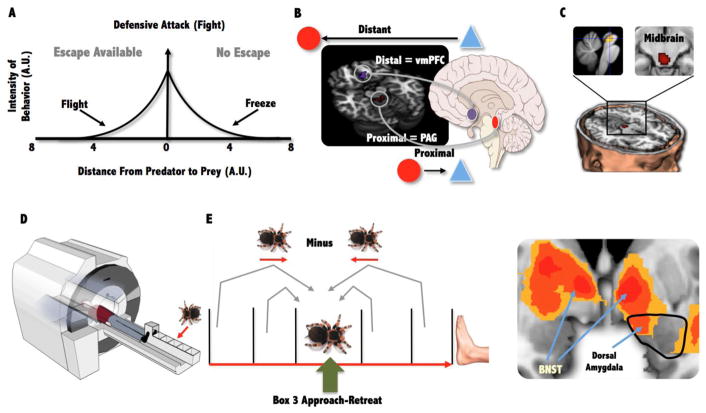
(A) The Blanchard model proposing that physical distance to threat and escape (flight) availability evokes distinct defensive response. (B) The AET showing the neural switches between the vmPFC and PAG associated with distal and proximal threat and midbrain activity correlated with panic-related motor errors. (C) Experimental set up for oscillating tarantula task and (D) an example of monitoring the threats movement showing that as the Tarantula move closure based on it previous position compared to moving further away from a closure position there was increased activity in the dorsal amygdala and bilateral BNST.
Fig. 3
Fig. 3
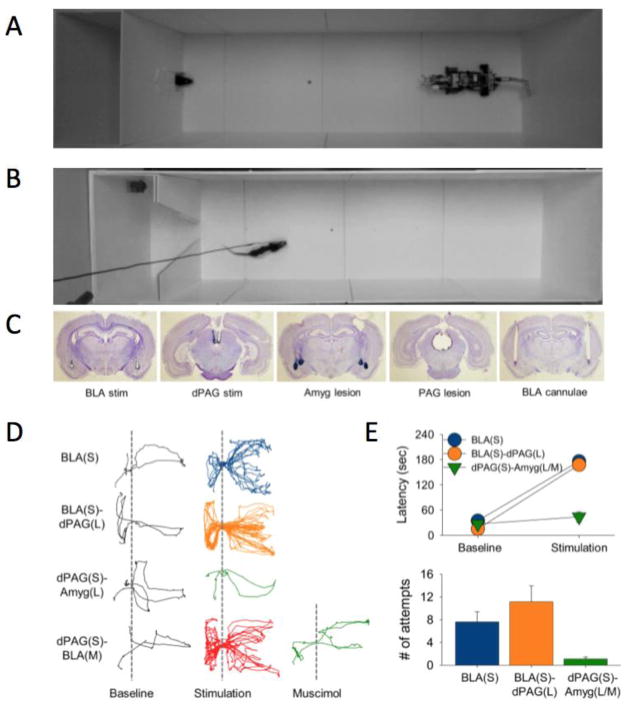
(A) A foraging rat facing a ‘predatory’ robot. Each time the rat approached the food pellet, the looming motion of the robot caused the rat to flee into the safety of the nest. Animals were unable to procure pellet located beyond certain distance but were able to retrieve pellet placed closed to the nest. (B) Same experimental design except either the amygdala or the dPAG is stimulated in naïve rats as they came near the pellet. Both amygdala and dPAG stimulation always elicited fleeing response in animals regardless of the pellet location. (C) Histology photographs show the tip locations for stimulation electrode and guide cannulae, and the extent of lesions. (D) Representative track plots from a rat with basolateral amygdala (BLA) stimulation, a PAG-lesioned rat with BLA stimulation, a BLA-lesioned rat with dPAG stimulation, and BLA-inactivated rat with dPAG stimulation. (E) Group mean (±SEM) latency to procure pellet (180 s = unsuccessful), and group mean (±SEM) number of times animals approached the pellet during the 180 s allotted time.

References

    1. Spalding DA. Flight not an Acquisition. Nature. 1873;8:289.
    1. Lorenz K, TIinbergen N. Taxis und Instinkthandlung in der Eirollbewegung der Graugans, I. Zeitschr für Tierpsych. 1938;2:1–29.
    1. Schiff W, Caviness JA, Gibson JJ. Persistent fear responses in rhesus monkeys to the optical stimulus of “looming” Science. Science. 1962;136:982–983. - PubMed
    1. Yilmaz MaMM. Rapid innate defensive responses of mice to looming visual stimuli. Curr Biol. 2013;23:2011–2015. - PMC - PubMed
    1. Westneat DEaFCW. Evolutionary Behavioral Ecology. Oxford University Press; 2010.

LinkOut - more resources