


Features of Adult Hyperammonemia Not Due to Liver Failure in the ICU
- PMID: 29985210
- PMCID: PMC6095817
- DOI: 10.1097/CCM.0000000000003278
Features of Adult Hyperammonemia Not Due to Liver Failure in the ICU
Abstract
Objectives: To evaluate the epidemiology of hyperammonemia unrelated to liver failure in the critical care setting.
Design: Retrospective case series.
Setting: Critically ill patients admitted to ICUs at Mayo Clinic, Rochester, MN (medical ICU, two mixed medical-surgical ICUs, coronary care unit, or the cardiosurgical ICU) between July 1, 2004, and October 31, 2015.
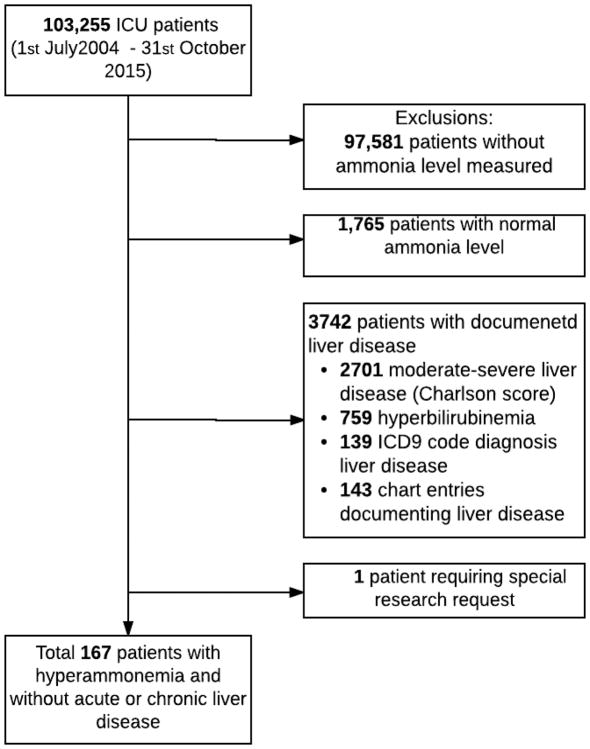
Patients: Adult critically ill patients with hyperammonemia not related to acute or chronic liver failure. We excluded patients with diagnosis of moderate or severe liver disease, hyperbilirubinemia, and patients who denied the use of their medical records.
Interventions: None.
Measurements and main results: Of 3,908 ICU patients with hyperammonemia, 167 (4.5%) had no evidence of acute or chronic liver failure. One-hundred one patients (60.5%) were male with median age of 65.7 years (interquartile range, 50-74.5 yr) and median serum ammonia level of 68 µg/dL (interquartile range, 58-87 µg/dL). Acute encephalopathy was present in 119 patients (71%). Predisposing conditions included malnutrition 27 (16%), gastric bypass six (3.6%), total parenteral nutrition four (2.4%); exposure to valproic acid 17 (10%); status epilepticus 11 (6.6%), high tumour burden 19 (11.3%), and renal failure 82 (49.1%). Urea cycle defects were diagnosed in seven patients (4.1%). Hospital mortality was high (30%), and median ammonia level was higher among the nonsurvivors (74 vs 67 µg/dL; p = 0.05). Deaths were more likely in hyperammonemic patients who were older (p = 0.016), had greater illness severity (higher Acute Physiology and Chronic Health Evaluation III score, p < 0.01), malignancy (p < 0.01), and solid organ transplantation (p = 0.04), whereas seizure disorder was more common in survivors (p = 0.02). After adjustment, serum ammonia level was not associated with increased mortality.
Conclusions: Hyperammonemia occurs in a substantial minority of critically ill patients without liver failure. These patients have a poor prognosis, although ammonia level per se is not independently associated with mortality. Serum ammonia should be measured when risk factors are present, such as nutritional deficiencies and protein refeeding, treatment with valproic acid, high tumour burden, and known or suspected urea cycle abnormalities.
Figures
References
-
- LaBuzetta JN, Yao JZ, Bourque DL, et al. Adult nonhepatic hyperammonemia: A case report and diferential diagnosis. Amer J Med. 2010;123:885–891. - PubMed
-
- Walker V. Severe hyperammonaemia in adults not explained by liver disease. Annals Of Clinical Biochemistry. 2012;49(Pt 3):214–228. - PubMed
-
- Kiberenge RK, Lam H. Fatal hyperammonemia after repeat renal transplantation. Journal Of Clinical Anesthesia. 2015;27(2):164–167. - PubMed
-
- Davies SM, Szabo E, Wagner JE, et al. Idiopathic hyperammonemia: a frequently lethal complication of bone marrow transplantation. Bone Marrow Transplantation. 1996;17(6):1119–11125. - PubMed
Publication types
MeSH terms
Grants and funding
LinkOut - more resources
Full Text Sources
Other Literature Sources
