


Trends Over Time for Adolescents Enrolling in HIV Care in Kenya, Tanzania, and Uganda From 2001-2014
- PMID: 29985263
- PMCID: PMC6396029
- DOI: 10.1097/QAI.0000000000001796
Trends Over Time for Adolescents Enrolling in HIV Care in Kenya, Tanzania, and Uganda From 2001-2014
Abstract
Background: The data needed to understand the characteristics and outcomes, over time, of adolescents enrolling in HIV care in East Africa are limited.
Setting: Six HIV care programs in Kenya, Tanzania, and Uganda.
Methods: This retrospective cohort study included individuals enrolling in HIV care as younger adolescents (10-14 years) and older adolescents (15-19 years) from 2001-2014. Descriptive statistics were used to compare groups at enrollment and antiretroviral therapy (ART) initiation over time. The proportion of adolescents was compared with the total number of individuals aged 10 years and older enrolling over time. Competing-risk analysis was used to estimate 12-month attrition after enrollment/pre-ART initiation; post-ART attrition was estimated by Kaplan-Meier method.
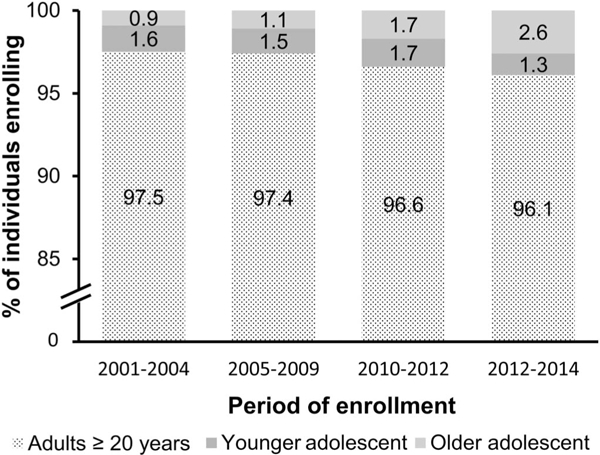
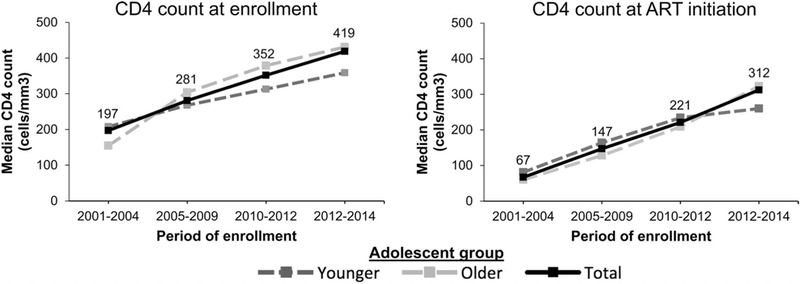
Results: A total of 6344 adolescents enrolled between 2001 and 2014. The proportion of adolescents enrolling among all individuals increased from 2.5% (2001-2004) to 3.9% (2013-2014, P < 0.0001). At enrollment, median CD4 counts in 2001-2004 compared with 2013-2014 increased for younger (188 vs. 379 cells/mm, P < 0.0001) and older (225 vs. 427 cells/mm, P < 0.0001) adolescents. At ART initiation, CD4 counts increased for younger (140 vs. 233 cells/mm, P < 0.0001) and older (64 vs. 323 cells/mm, P < 0.0001) adolescents. Twelve-month attrition also increased for all adolescents both after enrollment/pre-ART initiation (4.7% vs. 12.0%, P < 0.001) and post-ART initiation (18.7% vs. 31.2%, P < 0.001).
Conclusions: Expanding HIV services and ART coverage was likely associated with earlier adolescent enrollment and ART initiation but also with higher attrition rates before and after ART initiation. Interventions are needed to promote retention in care among adolescents.
Conflict of interest statement
The authors have no funding or conflicts of interest to disclose.
Figures
References
-
- World Health Organization; Global Update on HIV Treatment 2013: Results, Impact and Opportunities. Geneva, Switzerland: WHO; 2013. Available at: http://www.who.int/hiv/pub/progressreports/update2013/en/. Accessed April 10, 2017.
-
- Republic of Kenya Ministry of Health. Kenya’s Fast Track to End HIV Amongst Adolescents and Young People. National AIDS Control Council; 2015. Available at: http://www.lvcthealth.org/online-library?format=raw&task=download&fid=55. Accessed April 10, 2017.
-
- United Nations Children’s Fund. The AIDS Epidemic Continues to Take a Staggering Toll, Especially in Sub-Saharan Africa. New York, USA: UNICEF; 2016. Available at: http://data.unicef.org/hiv-aids/global-trends.html. Accessed September 11, 2016.
-
- Idele P, Gillespie A, Porth T, et al. Epidemiology of HIV and AIDS among adolescents: current status, inequities, and data gaps. J Acquir Immune Defic Syndr. 2014;66(suppl 2):S144–S153. - PubMed
-
- United Nations Children’s Fund. Global HIV Database. New York, NY: UNICEF; 2014. Available at: http://data.unicef.org/topic/hivaids/global-regional-trends/. Accessed September 11, 2016.
Publication types
MeSH terms
Substances
Grants and funding
LinkOut - more resources
Full Text Sources
Other Literature Sources
Medical
Research Materials
