


Visual discrimination of polymorphic nestlings in a cuckoo-host system
- PMID: 29985476
- PMCID: PMC6037703
- DOI: 10.1038/s41598-018-28710-5
Visual discrimination of polymorphic nestlings in a cuckoo-host system
Abstract
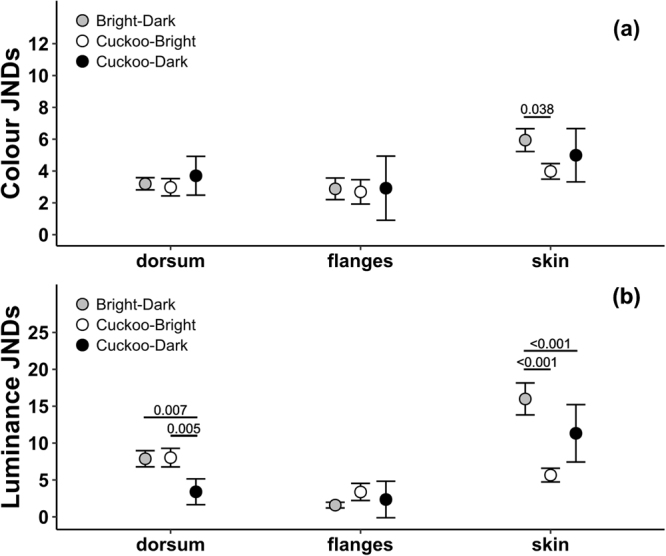
Mimicry by avian brood parasites favours uniformity over variation within a breeding attempt as host defence against parasitism. In a cuckoo-host system from New Caledonia, the arms race resulted in both host (Gerygone flavolateralis) and parasite (Chalcites lucidus) having nestlings of two discrete skin colour phenotypes, bright and dark. In our study sites, host nestlings occurred in monomorphic and polymorphic broods, whereas cuckoo nestlings only occurred in the bright morph. Irrespective of their brood colour, host parents recognised and ejected parasite nestlings but never ejected their own. We investigated whether host parents visually recognised their own nestlings by using colour, luminance and pattern of multiple body regions. We found that the parasite mimicked multiple visual features of both host morphs and that the visual difference between host morphs was larger than the difference between the parasite and the mimicked host morph. Visual discrimination alone may result in higher chances of recognition errors in polymorphic than in monomorphic host broods. Host parents may rely on additional sensorial cues, not only visual, to assess nestling identity. Nestling polymorphism may be a trace of evolutionary past and may only have a marginal role in true-recognition of nestlings in the arms race in New Caledonia.
Conflict of interest statement
The authors declare no competing interests.
Figures


References
-
- Davies NB. Cuckoo adaptations: trickery and tuning. J. Zool. 2011;284:1–14. doi: 10.1111/j.1469-7998.2011.00810.x. - DOI
-
- Tanaka KD. Polymorphism in avian brood parasitism: a coevolutionary perspective. Ornith. Sci. 2016;15:133–140. doi: 10.2326/osj.15.133. - DOI
-
- Honza M, Šicha V, Procházka P, Ležalová R. Host nest defense against a color-dimorphic brood parasite: great reed warblers (Acrocephalus arundinaceus) versus common cuckoos (Cuculus canorus) J. Ornith. 2006;147:629–637. doi: 10.1007/s10336-006-0088-y. - DOI
-
- Trnka A, Trnka M, Grim T. Do rufous common cuckoo females indeed mimic a predator? An experimental test. Biol. J. Linn. Soc. 2015;116:134–143. doi: 10.1111/bij.12570. - DOI
Publication types
MeSH terms
Grants and funding
- 2012/05/E/NZ8/02694/Narodowe Centrum Nauki (National Science Centre)/International
- 2016/23/B/NZ8/03082/Narodowe Centrum Nauki (National Science Centre)/International
- 2012/05/E/NZ8/02694/Narodowe Centrum Nauki (National Science Centre)/International
- 2016/23/B/NZ8/03082/Narodowe Centrum Nauki (National Science Centre)/International
- 2012/05/E/NZ8/02694/Narodowe Centrum Nauki (National Science Centre)/International
- 2016/23/B/NZ8/03082/Narodowe Centrum Nauki (National Science Centre)/International
- 24-4578/Japan Society for the Promotion of Science (JSPS)/International
- 24770028/Japan Society for the Promotion of Science (JSPS)/International
- 23255004/Japan Society for the Promotion of Science (JSPS)/International
- SFR 11-54/Rikkyo University/International
LinkOut - more resources
Full Text Sources
Other Literature Sources
Miscellaneous
