A Double-Blind Placebo-Controlled Trial of Omega-3 Fatty Acids as a Monotherapy for Adolescent Depression
- PMID: 29985566
- PMCID: PMC6625364
- DOI: 10.4088/JCP.17m11596
A Double-Blind Placebo-Controlled Trial of Omega-3 Fatty Acids as a Monotherapy for Adolescent Depression
Abstract
Objective: Reports are mixed on the efficacy of omega-3 fatty acids (O3FA) for the treatment of major depressive disorder (MDD), with only limited data in adolescents. The present trial aimed to investigate systematically the efficacy of O3FA as a monotherapy, compared to a placebo, in adolescents with MDD. Secondarily, we explored O3FA effects on anhedonia, irritability, and suicidality-all key features of adolescent MDD.
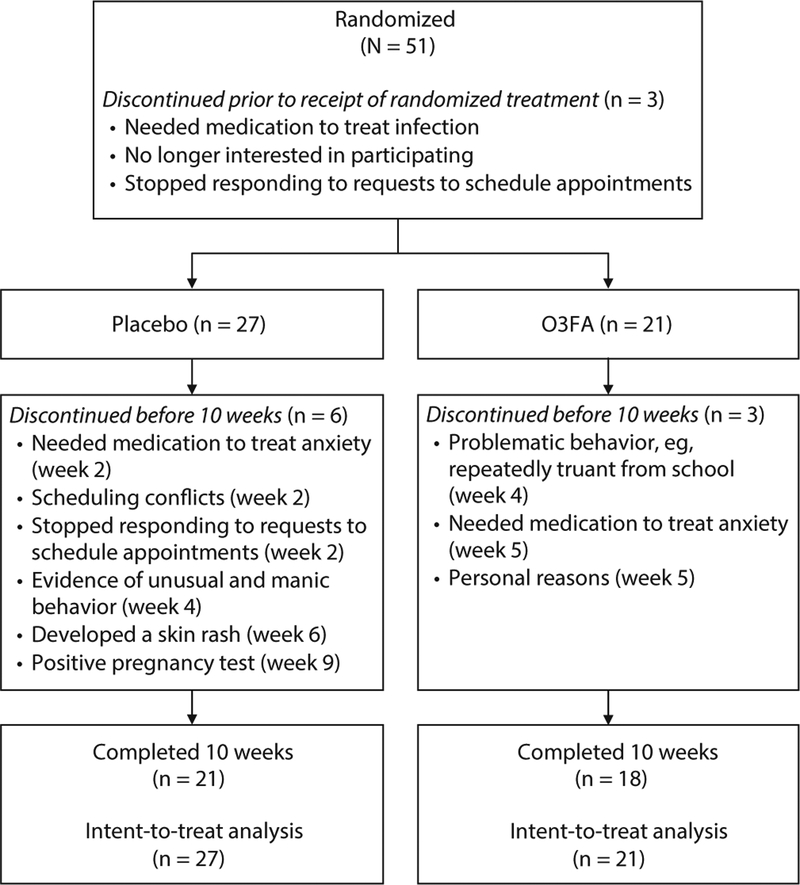
Methods: Fifty-one psychotropic medication-free adolescents with DSM-IV-TR diagnoses of MDD (aged 12-19 years; 57% female) were randomized to receive O3FA or a placebo for 10 weeks. Data were collected between January 2006 and June 2013. O3FA and a placebo were administered on a fixed-flexible dose titration schedule based on clinical response and side effects. The initial dose of 1.2 g/d was increased 0.6 g/d every 2 weeks, up to a maximum of 3.6 g/d. Clinician-rated and self-rated depression severity, along with treatment response, served as primary outcome measures. Additionally, we examined O3FA effects on depression-related symptoms, including anhedonia, irritability, and suicidality. Treatment differences were analyzed via intent-to-treat analyses.
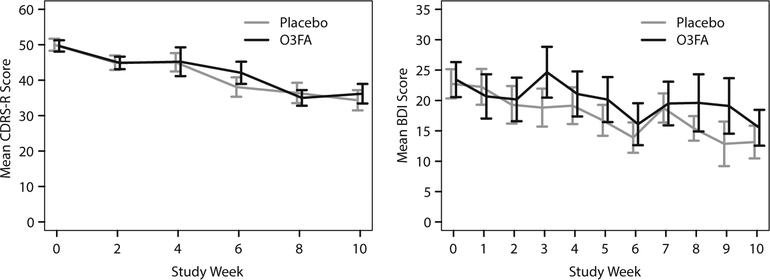
Results: O3FA were not superior to a placebo on any clinical feature, including depression severity and levels of anhedonia, irritability, or suicidality. Additionally, response rates were comparable between treatment groups. Within-treatment analyses indicated that both treatments were associated with significant improvement in depression severity on self- (O3FA: t = -4.38, P < .001; placebo: t = -3.52, P = .002) and clinician (O3FA: t = -6.47, P < .001; placebo: t = -8.10, P < .001) ratings.
Conclusions: In adolescents with MDD, O3FA do not appear to be superior to placebo.
Trial registration: ClinicalTrials.gov identifier: NCT00962598.
© Copyright 2018 Physicians Postgraduate Press, Inc.
Conflict of interest statement
Figures
References
-
- Asarnow JR, Baraff LJ, Berk M, et al. Pediatric emergency department suicidal patients: two-site evaluation of suicide ideators, single attempters, and repeat attempters. J Am Acad Child Adolesc Psychiatry. 2008;47(8):958–966. - PubMed
-
- March J, Silva S, Petrycki S, et al. Fluoxetine, cognitive-behavioral therapy, and their combination for adolescents with depression: Treatment for Adolescents With Depression Study (TADS) randomized controlled trial. JAMA. 2004;292(7):807–820. - PubMed
-
- Bradley KL, McGrath PJ, Brannen CL, et al. Adolescents’ attitudes and opinions about depression treatment. Community Ment Health J. 2010;46(3):242–251. - PubMed
-
- Jaycox LH, Asarnow JR, Sherbourne CD, et al. Adolescent primary care patients’ preferences for depression treatment. Adm Policy Ment Health. 2006;33(2):198–207. - PubMed
-
- Libby AM, Brent DA, Morrato EH, et al. Decline in treatment of pediatric depression after FDA advisory on risk of suicidality with SSRIs. Am J Psychiatry. 2007;164(6):884–891. - PubMed
Publication types
MeSH terms
Substances
Associated data
Grants and funding
LinkOut - more resources
Full Text Sources
Other Literature Sources
Medical