


National survey of intracavitary brachytherapy for intact uterine cervical cancer in Japan
- PMID: 29986113
- PMCID: PMC6054170
- DOI: 10.1093/jrr/rry035
National survey of intracavitary brachytherapy for intact uterine cervical cancer in Japan
Abstract
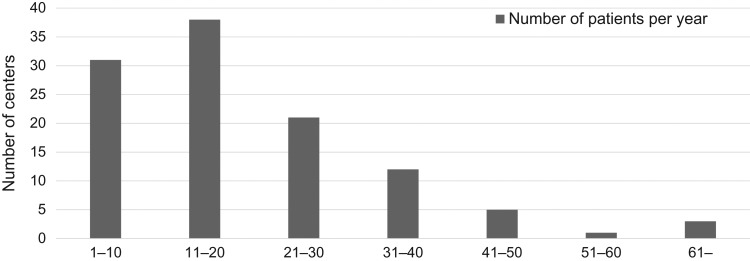
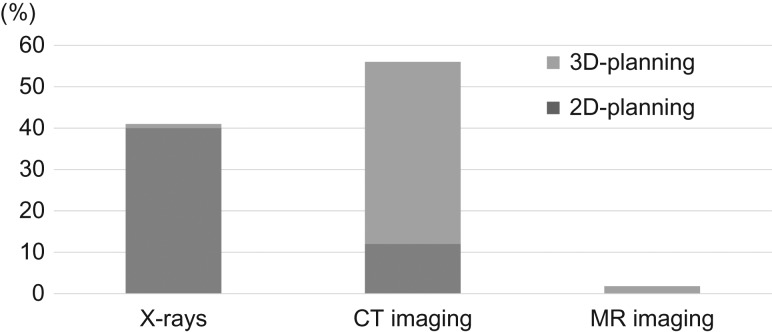
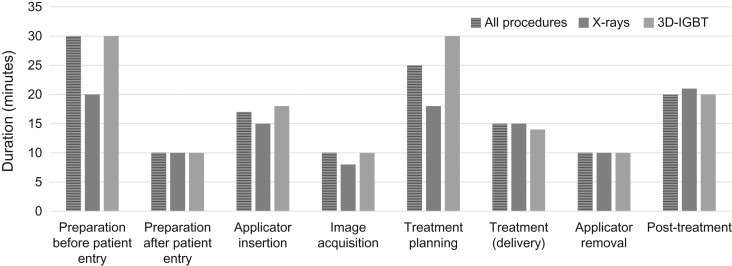
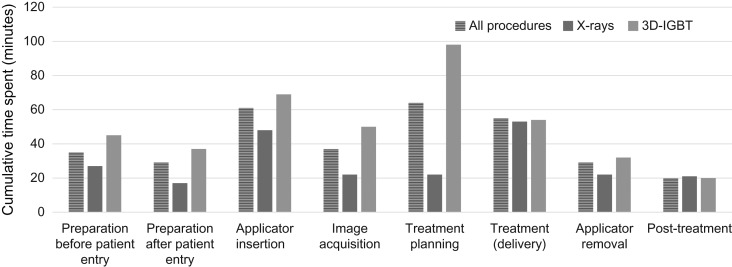
To review the current status of, and labor expended for (in terms of time required), intracavitary brachytherapy (ICBT) in definitive radiotherapy/chemoradiotherapy for cervical cancer patients, two national surveys were performed. The first survey was conducted between July and August 2016 and consisted of a questionnaire of 12 items regarding ICBT procedures for cervical cancer, which was sent to 173 centers installed with high-dose-rate remote after-loading brachytherapy systems. Between November and December 2016, another survey was performed in 79 centers to evaluate labor required for ICBT procedures in terms of time spent and number of staff involved. In the first survey, the response rate was 77% of the 173 centers. ICBT was performed for cervical cancer in 118 (89%) centers. Imaging modalities used after applicator insertion were X-ray alone in 46 (40%), computed tomography in 69 (60%) and magnetic resonance imaging in 5 (4%) centers. Three-dimensional (3D) planning was performed in 55 centers (48%). Fifty-five (70%) centers responded to the second survey regarding ICBT-mandated labor. The median cumulative duration of the entire ICBT procedure was 330 min (the sum of the times spent by each staff member) and was longer in the 3D image-guided brachytherapy (3D-IGBT) (405 min) than in the X-ray group (230 min). This trend was significant for the specific processes of image acquisition and treatment planning, especially for radiation oncologists. In definitive radiotherapy/chemoradiotherapy for cervical cancer patients, 3D-IGBT use has been gradually spreading in Japan. The present survey revealed that ICBT, especially 3D-IGBT, requires substantial labor and time from staff.
Figures
References
-
- Cancer Information Service. Cancer Statistics in Japan; table download https://ganjoho.jp/reg_stat/statistics/dl/index.html#incidencehttp://plaza.umin.ac.jp/~jsog-go/ (4 January 2018, date last accessed).
-
- Japan Society of Obstetrics and Gynecology Gynecologic Tumor Committee (in Japanese). http://plaza.umin.ac.jp/~jsog-go/ (4 January 2018, date last accessed).
-
- National Comprehensive Cancer Network Cervical Cancer (2018) NCCN Clinical Practice Guidelines in Oncology https://www.nccn.org/professionals/physician_gls/pdf/cervical.pdf (4 January 2018, date last accessed).
-
- Ebina Y, Yaegashi N, Katabuchi H et al. . Japan Society of Gynecologic Oncology guidelines 2011 for the treatment of uterine cervical cancer. Int J Clin Oncol 2015;20:240–8. - PubMed
-
- Gill BS, Lin JF, Krivak TC et al. . National Cancer Database analysis of radiation therapy consolidation modality for cervical cancer: the impact of new technological advancements. Int J Radiat Oncol Biol Phys 2014;90:1083–90. - PubMed
MeSH terms
LinkOut - more resources
Full Text Sources
Other Literature Sources
Medical
