


A Cost-Effective IoT System for Monitoring Indoor Radon Gas Concentration
- PMID: 29986540
- PMCID: PMC6069144
- DOI: 10.3390/s18072198
A Cost-Effective IoT System for Monitoring Indoor Radon Gas Concentration
Abstract
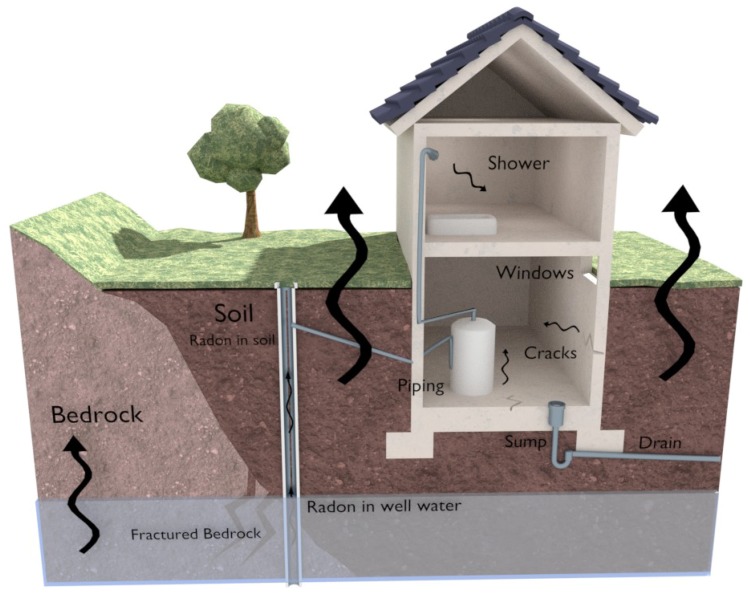
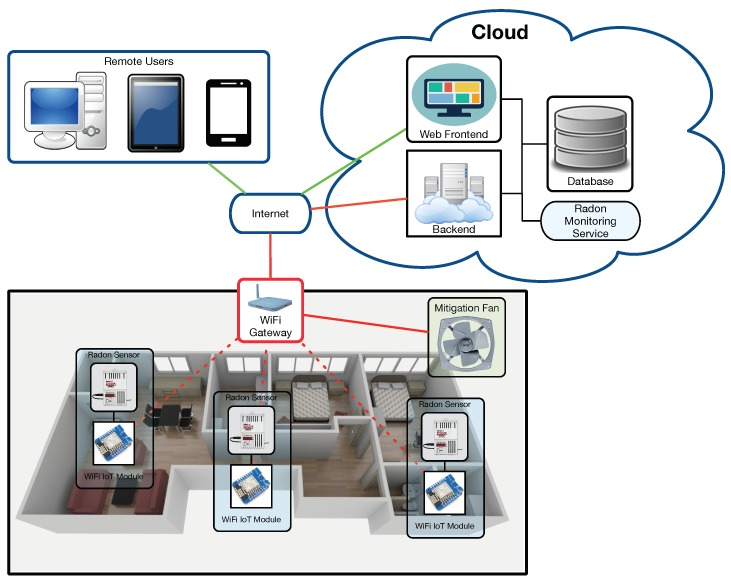
Radon is a noble gas originating from the radioactive decay chain of uranium or thorium. Most radon emanates naturally from the soil and from some building materials, so it can be found in many places around the world, in particular in regions with soils containing granite or slate. It is almost impossible for a person to detect radon gas without proper tools, since it is invisible, odorless, tasteless and colorless. The problem is that a correlation has been established between the presence of high radon gas concentrations and the incidence of lung cancer. In fact, the World Health Organization (WHO) has stated that the exposure to radon is the second most common cause of lung cancer after smoking, and it is the primary cause of lung cancer among people who have never smoked. Although there are commercial radon detectors, most of them are either expensive or provide very limited monitoring capabilities. To tackle such an issue, this article presents a cost-effective IoT radon gas remote monitoring system able to obtain accurate concentration measurements. It can also trigger events to prevent dangerous situations and to warn users about them. Moreover, the proposed solution can activate mitigation devices (e.g., forced ventilation) to decrease radon gas concentration. In order to show its performance, the system was evaluated in three different scenarios corresponding to representative buildings in Galicia (Spain), a region where high radon gas concentrations are common due to the composition of the soil. In addition, the influence of using external hardware (i.e., WiFi transceivers and an embedded System-on-Chip (SoC)) next to the radon gas sensor is studied, concluding that, in the tested scenarios, they do not interfere with the measurements.
Keywords: IoT; WSN; domotics; home automation; radon; sensors; smart home; wireless sensor networks.
Conflict of interest statement
The authors declare no conflict of interest. The founding sponsors had no role in the design of the study; in the collection, analyses or interpretation of data; in the writing of the manuscript; nor in the decision to publish the results.
Figures
References
-
- United Nations Science Committee on the Effects of Atomic Radiation . Ionizing Radiation: Sources and Biological Effects. United Nations Science Committee on the Effects of Atomic Radiation; New York, NY, USA: 1982.
-
- Wilkenin M. Radon in the Environment. Elsevier; Amsterdam, The Netherlands: 1990.
-
- Baskaran M. Radon: A Tracer for Geological, Geophysical and Geochemical Studies. Springer; Cham, Switzerland: 2016.
-
- World Nuclear Organization Nuclear Radiation and Health Effects. [(accessed on 1 June 2018)]; Available online: http://www.world-nuclear.org/information-library/safety-and-security/rad....
-
- World Health Organization . WHO Handbook on Indoor Radon: A Public Health Perspective. WHO Press; Geneva, Switzerland: 2009. - PubMed
LinkOut - more resources
Full Text Sources
Other Literature Sources
