. 2018 Aug 1;38(31):6854-6863.
doi: 10.1523/JNEUROSCI.2976-17.2018. Epub 2018 Jul 9.

Adult Neurogenesis Conserves Hippocampal Memory Capacity

Affiliations

Adult Neurogenesis Conserves Hippocampal Memory Capacity

Md Jahangir Alam et al. J Neurosci. .

Abstract

The hippocampus is crucial for declarative memories in humans and encodes episodic and spatial memories in animals. Memory coding strengthens synaptic efficacy via an LTP-like mechanism. Given that animals store memories of everyday experiences, the hippocampal circuit must have a mechanism that prevents saturation of overall synaptic weight for the preservation of learning capacity. LTD works to balance plasticity and prevent saturation. In addition, adult neurogenesis in the hippocampus is proposed to be involved in the down-scaling of synaptic efficacy. Here, we show that adult neurogenesis in male rats plays a crucial role in the maintenance of hippocampal capacity for memory (learning and/or memory formation). Neurogenesis regulated the maintenance of LTP, with decreases and increases in neurogenesis prolonging or shortening LTP persistence, respectively. Artificial saturation of hippocampal LTP impaired memory capacity in contextual fear conditioning, which completely recovered after 14 d, which was the time required for LTP to decay to the basal level. Memory capacity gradually recovered in parallel with neurogenesis-mediated gradual decay of LTP. Ablation of neurogenesis by x-ray irradiation delayed the recovery of memory capacity, whereas enhancement of neurogenesis using a running wheel sped up recovery. Therefore, one benefit of ongoing adult neurogenesis is the maintenance of hippocampal memory capacity through homeostatic renewing of hippocampal memory circuits. Decreased neurogenesis in aged animals may be responsible for the decline in cognitive function with age.SIGNIFICANCE STATEMENT Learning many events each day increases synaptic efficacy via LTP, which can prevent the storage of new memories in the hippocampal circuit. In this study, we demonstrate that hippocampal capacity for the storage of new memories is maintained by ongoing adult neurogenesis through homoeostatic renewing of hippocampal circuits in rats. A decrease or an increase in neurogenesis, respectively, delayed or sped up the recovery of memory capacity, suggesting that hippocampal adult neurogenesis plays a critical role in reducing LTP saturation and keeps the gate open for new memories by clearing out the old memories from the hippocampal memory circuit.

Keywords: adult neurogenesis; hippocampus; learning and memory; memory capacity; synaptic plasticity.


Figures

Figure 1.
Figure 1.
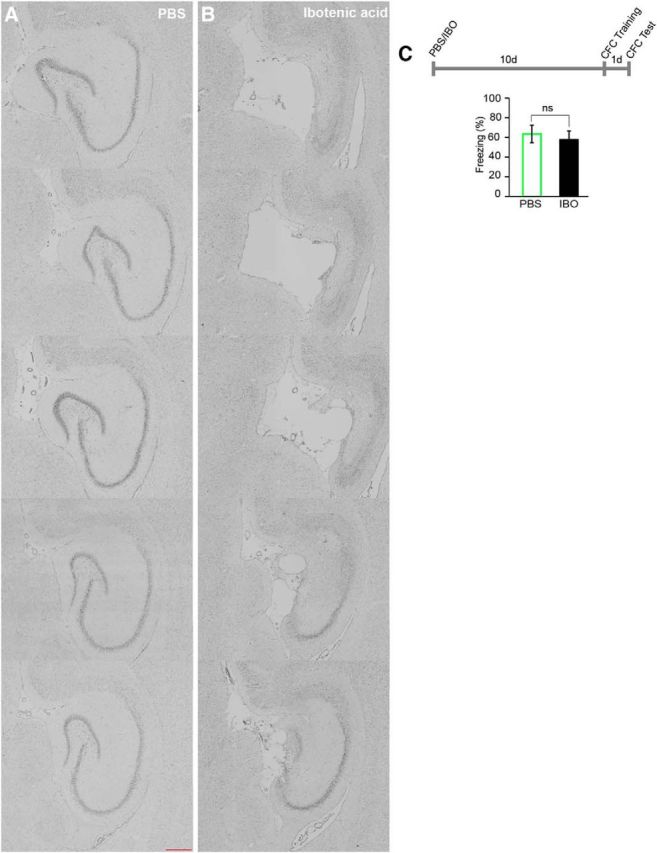
Unilateral IBO injection had no effect on hippocampal learning. A, B, Images showing the sequential horizontal hippocampal sections from the dorsal to the ventral part of the hippocampus from PBS-injected (A) and IBO-injected (B) rats after cresyl violet staining. Scale bar, 200 μm. C, Experimental schedule and average freezing response observed in PBS- and IBO-injected rats during test sessions for the CFC task (unpaired t test, p = 0.66, t9 = 0.44; IBO, n = 6; PBS, n = 5 rats).
Figure 2.
Figure 2.
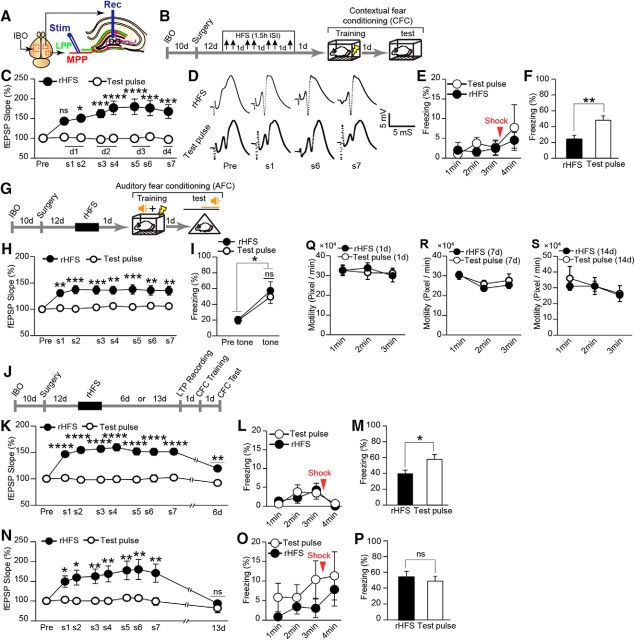
Recovery from hippocampal LTP saturation correlates with the memory capacity for CFC. A, Schematic illustration showing experimental setup for IBO injection and electrode implantation (for detailed information regarding the coordinates of the IBO injection, see Table 1). MPP, Medial perforant path; LPP, lateral perforant path; Rec, recording electrode; Stim, stimulating electrode. B, Experimental schedule for the effect of rHFS. Top arrows indicate the stimulation session. C, Saturation of hippocampal LTP. The normalized values for the fEPSP slope for rHFS (n = 9) and test pulse (n = 7) rats [(two-way ANOVA, p = 0.0009, F1,14 = 17.58, rHFS vs test pulse (s1, p = 0.1; s2, p = 0.01; s3, p = 0.0008; s4, p < 0.0001; s5, p < 0.0001; s6, p = 0.0001; s7, p = 0.0002), Bonferroni corrected for multiple comparisons)]. s, Session. D, Example traces of evoked fEPSP responses. Pre, Before rHFS. E, Freezing time during the training session (rHFS, n = 9; test pulse, n = 7 rats; two-way ANOVA, p = 0.5589, F1,14 = 0.3584). F, Average freezing response during the test session (rHFS, n = 9; test pulse, n = 7 rats; unpaired t test, p = 0.0051, t14 = 3.31). G, Experimental schedule for AFC. H, Normalized values for the fEPSP slope in rHFS and test pulse rats (n = 9 rats/group; two-way ANOVA, p = 0.001, F1,16 = 16.11, Bonferroni corrected for multiple comparisons). I, Freezing response before tone (pre) and during tone period (tone; n = 9 rats/group) in the AFC test (paired t test, rHFS pre-tone vs tone, p = 0.01, t8 = 3.18; test pulse pre-tone vs tone, p = 0.01, t8 = 3.19; unpaired t test, rHFS tone vs test pulse tone, p = 0.58, t16 = 0.56). J, Experimental schedule to check the gradual decay of synaptic efficacy and recovery of learning capacity. K, LTP partially decayed after 6 d (two-way ANOVA, p < 0.0001, F1,15 = 63.82; rHFS d6 vs test pulse d6, p = 0.0012; Bonferroni corrected for multiple comparisons). L, Freezing time during the training session (two-way ANOVA, p = 0.8422, F1,15 = 0.0410; test pulse, n = 9; rHFS, n = 8 rats). M, Incomplete recovery of learning capacity (unpaired t test, p = 0.03, t15 = 2.29) 7 d after the last HFS (test pulse, n = 9; rHFS, n = 8 rats). N, LTP returned to the baseline level 13 d after rHFS (two-way ANOVA, p = 0.0065, F1,14 = 10.18; rHFS d13 vs test pulse d13, p > 0.99; Bonferroni corrected for multiple comparisons). O, Freezing time during the training session (two-way ANOVA, p = 0.2778, F1,14 = 1.275; n = 8 rats/group). P, Recovery of learning capacity (unpaired t test, p = 0.60, t14 = 0.53, n = 8 rats/group). QS, Motility of the rHFS- and test pulse-treated rats on day 1 (Q, two-way ANOVA, p = 0.91, F1,14 = 0.01; rHFS, n = 9; test pulse, n = 7 rats), day 7 (R, two-way ANOVA, F1,15 = 0.37, p = 0.55; rHFS, n = 8; test pulse, n = 9 rats), and day 14 (S, two-way ANOVA, p = 0.74, F1,14 = 0.11; n = 8 rats/group) after the last HFS. *p < 0.05, **p < 0.01, ***p < 0.001, ****p < 0.0001; ns, not significant.
Figure 3.
Figure 3.
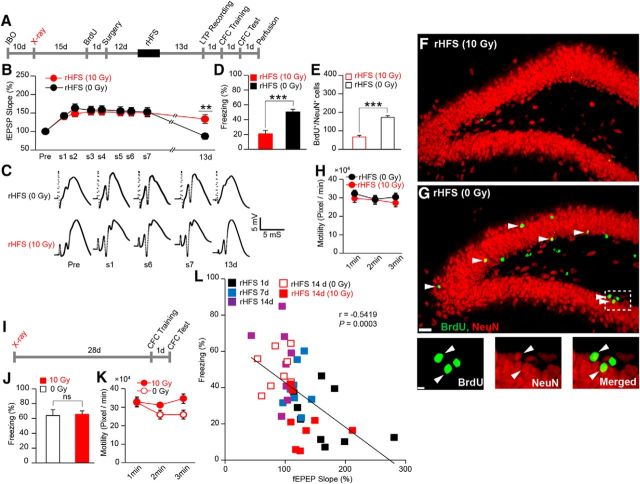
Adult hippocampal neurogenesis regulates the recovery from rHFS-induced impairment of CFC. A, Experimental schedule. B, LTP maintenance in nonirradiated (0 Gy) and x-ray-irradiated (10 Gy) rats [two-way ANOVA, p = 0.91, F1,14 = 0.01; rHFS (10 Gy) 13 d vs rHFS (0 Gy) 13 d, unpaired t test, p = 0.006, t14 = 3.23, n = 8 rats/group]. C, Example traces of evoked fEPSP responses. Pre, Before rHFS. D, Freezing response during the test session (unpaired t test, p = 0.0002, t14 = 4.87, n = 8 rats/group). E, Reduced neurogenesis in the rHFS-irradiated rats (n = 3 rats/group, unpaired t test, p = 0.0009, t4 = 8.77). F, G, Hippocampal coronal sections. Scale bar, 200 μm. Arrowheads indicate BrdU+/NeuN+ double-positive cells. G, Bottom, magnified images from rHFS (0 Gy): BrdU (left), NeuN (middle), and merged (right). Scale bar, 50 μm. H, Effect of rHFS and x-ray irradiation on the motility of the animals 14 d after the last HFS (two-way ANOVA, p = 0.37, F1,15 = 0.83; n = 8 rats/group). I, Experimental schedule for the effect of x-ray on CFC. J, Freezing response at test (10 Gy, n = 8; 0 Gy, n = 7 rats; unpaired t test, p = 0.84, t13 = 0.19). K, Effect of x-ray irradiation on the general activity of the animals 28 d after x-ray irradiation (two-way ANOVA, p = 0.07, F1,13 = 3.64; 10 Gy, n = 8; 0 Gy, n = 7 rats). L, Correlation of LTP and learning ability (Pearson correlation test, r = −0.5419, p = 0.0003). Each dot represents data from an individual animal. *p < 0.05, **p < 0.01, ***p < 0.001; ns, not significant.
Figure 4.
Figure 4.
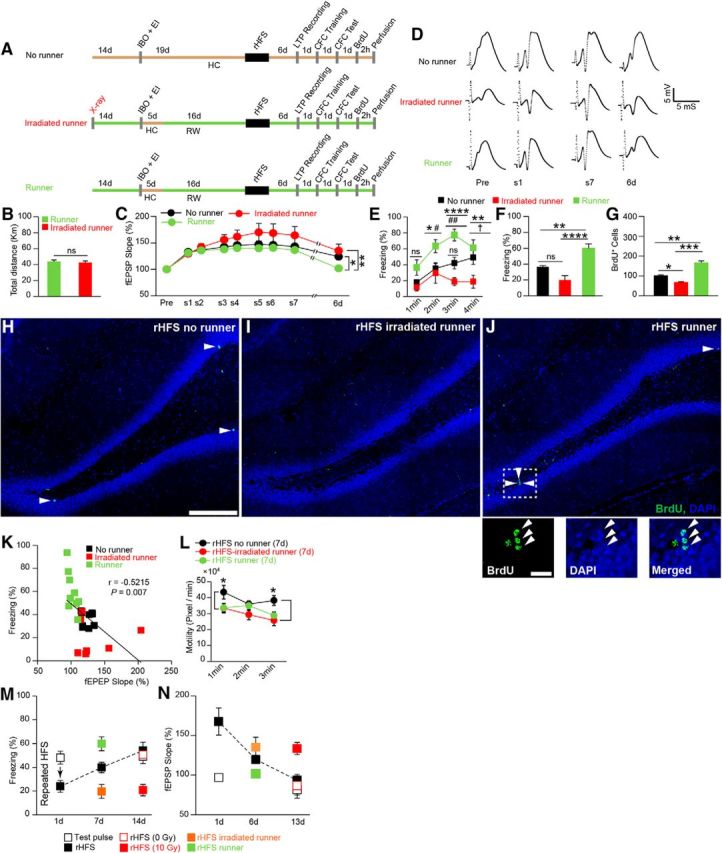
Adult hippocampal neurogenesis accelerates the recovery of rHFS-induced memory impairment. A, Experimental schedule. Green or ochre bars indicate housed with (running wheel, RW) or without (HC) a running wheel, respectively. IBO + EI, IBO injection and electrode implantation. B, Total distance traveled (runner, n = 9; irradiated runner, n = 7 rats; unpaired t test, p = 0.72, t14 = 0.36). C, LTP maintenance [two-way ANOVA, p = 0.07, F2,22 = 2.89 (one-way ANOVA, p = 0.005, F2,22 = 6.54, Fisher's LSD post hoc test, runner 6 d vs nonrunner 6 d, p = 0.02; runner 6 d vs irradiated runner 6 d, p = 0.002), nonrunner, n = 9; runner, n = 9; irradiated runner, n = 7 rats]. D, Example traces of evoked fEPSP responses. Pre, Before rHFS. E, F, Time courses of freezing (E, two-way ANOVA, p < 0.0001, F2,22 = 17.04, Tukey's multiple-comparisons test) and average freezing responses (F, one-way ANOVA, p < 0.0001, F2,22 = 17.0, Tukey's multiple-comparisons test) during CFC test (nonrunner, n = 9; runner, n = 9; irradiated runner, n = 7 rats). G, Proliferation of the new neurons (n = 3 rats/group, one-way ANOVA, p = 0.0001, F2,6 = 58.1, Tukey's multiple-comparisons test). HJ, Hippocampal coronal sections from a nonrunner (H), an irradiated runner (I), and a runner rats(J). Scale bar, 100 μm. Arrowheads indicate BrdU-positive cells. J, Bottom, Magnified images. Scale bar, 50 μm. BrdU (left), DAPI (middle), and merged (right) images. K, Correlation of hippocampal LTP and learning ability (Pearson's correlation test, r = −0.5215, p = 0.0075). Each dot represents data from an individual animal. L, Effect of x-ray irradiation and running wheel on the general activity of the animals 6 d after the last HFS induction (two-way ANOVA, p = 0.01, F2,22 = 5.26, rHFS nonrunner vs rHFS runner, 1 min, p = 0.046, rHFS nonrunner vs rHFS-irradiated runner, 3 min, p = 0.014, Tukey's multiple-comparisons test; rHFS nonrunner, n = 9; rHFS runner, n = 9; rHFS-irradiated runner, n = 7 rats). M, N, Summary of the behavioral (M) and LTP (N) results from Figures 2, 3, and 4. *p < 0.05, **p < 0.01, ***p < 0.001, ****p < 0.0001, ns, not significant, #p = 0.03, ##p = 0.004 (runner vs nonrunner), †p = 0.02 (nonrunner vs irradiated runner).
Figure 5.
Figure 5.
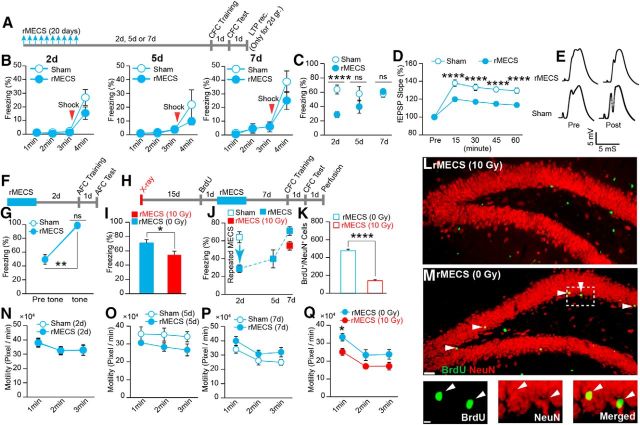
Adult hippocampal neurogenesis facilitates recovery from rMECS-induced impairment of CFC. A, Experimental schedule. Top arrows indicate the MECS induction. B, Freezing time during the training session. (left: rMECS-2d group, two-way ANOVA, p = 0.1200, F1,24 = 2.599, n = 13 rats/group; middle: rMECS-5 d group, two-way ANOVA, p = 0.4028, F1,11 = 0.7571, rMECS, n = 7; sham, n = 6 rats; right: rMECS-7d group, two-way ANOVA, p = 0.3691, F1,23 = 0.8394 rMECS, n = 15; sham, n = 10 rats). C, Mean freezing response during the test. rMECS-2d groups (unpaired t test, p < 0.0001, t24 = 4.72, n = 13 rats/group), 5 d groups (unpaired t test, p = 0.20, t11 = 1.33, rMECS, n = 7; sham, n = 6 rats), or 7 d groups (unpaired t test, p = 0.58, t23 = 0.55, rMECS, n = 15; sham, n = 10 rats) after the last MECS. D, LTP induction in PP–DG synapses after CFC (two-way ANOVA, p = 0.0002, F1,15 = 25.04, Bonferroni corrected, sham, n = 7; rMECS, n = 10 rats). E, Example traces of evoked fEPSP responses recorded before (pre) and after (post) tetanization. F, Experimental schedule for AFC. G, Averaged freezing response before tone (pre) and during (tone) tone period (Wilcoxon matched-pairs signed-rank test; rMECS pre-tone vs tone, p = 0.003, sham pre-tone vs tone, p = 0.002; rMECS tone vs sham tone, Mann–Whitney test, p = 0.19, Mann–Whitney U = 29; sham, n = 10; rMECS, n = 9 rats). H, Experimental schedule for CFC. I, Freezing response during the CFC test (unpaired t test, p = 0.02, t18 = 2.41, n = 10 rats/group). J, Summary of the behavioral results. K, Number of BrdU+/NeuN+ double-positive cells (n = 4 rats/group, unpaired t test, p < 0.0001, t6 = 16.99). L, M, Hippocampal coronal section from rMECS-irradiated rats (L) and rMECS-nonirradiated rats (M). Scale bar, 200 μm. Arrowheads indicate BrdU+/NeuN+ double-positive cells. Magnified images from an rMECS-nonirradiated rat (M; bottom); BrdU (left), NeuN (middle), and merged (right). Scale bar, 50 μm. NQ, Motility of the sham- or rMECS-treated animals on 2 d (N, two-way ANOVA, p = 0.99, F1,24 = 5.6e–006; n = 13 rats/group), 5 d (O, two-way ANOVA, p = 0.09, F1,11 = 3.40, rMECS, n = 7; sham, n = 6), and 7 d (P, two-way ANOVA, p = 0.09, F1,23 = 2.96, rMECS, n = 15; sham, n = 10) from the last MECS. Q, Effect of rMECS and x-ray irradiation on the motility of the animals during their training session 7 d after the last MECS (two-way ANOVA, p = 0.0067, F1,18 = 9.37, rMECS irradiated vs rMECS nonirradiated, 1 min, p = 0.03, Bonferroni corrected, n = 10 rats/group). *p < 0.05, **p < 0.01, ***p < 0.001, ****p < 0.0001; ns, not significant.

References

    1. Aimone JB, Wiles J, Gage FH (2009) Computational influence of adult neurogenesis on memory encoding. Neuron 61:187–202. 10.1016/j.neuron.2008.11.026 - DOI - PMC - PubMed
    1. Altman J, Das GD (1965) Autoradiographic and histological evidence of postnatal hippocampal neurogenesis in rats. J Comp Neurol 124:319–335. 10.1002/cne.901240303 - DOI - PubMed
    1. Bernier BE, Lacagnina AF, Ayoub A, Shue F, Zemelman BV, Krasne FB, Drew MR (2017) Dentate gyrus contributes to retrieval as well as encoding: evidence from context fear conditioning, recall, and extinction. J Neurosci 37:6359–6371. 10.1523/JNEUROSCI.3029-16.2017 - DOI - PMC - PubMed
    1. Buzsáki G, Moser EI (2013) Memory, navigation and theta rhythm in the hippocampal-entorhinal system. Nat Neurosci 16:130–138. 10.1038/nn.3304 - DOI - PMC - PubMed
    1. Castro CA, Silbert LH, McNaughton BL, Barnes CA (1989) Recovery of spatial learning deficits after decay of electrically induced synaptic enhancement in the hippocampus. Nature 342:545–548. 10.1038/342545a0 - DOI - PubMed

Publication types

MeSH terms

LinkOut - more resources