


A review of Morlet wavelet analysis of radial profiles of Saturn's rings
- PMID: 29986913
- PMCID: PMC6048577
- DOI: 10.1098/rsta.2018.0046
A review of Morlet wavelet analysis of radial profiles of Saturn's rings
Abstract
Spiral waves propagating in Saturn's rings have wavelengths that vary with radial position within the disc. The best-quality observations of these waves have the form of radial profiles centred on a particular azimuth. In that context, the wavelength of a given spiral wave is seen to change substantially with position along the one-dimensional profile. In this paper, we review the use of Morlet wavelet analysis to understand these waves. When signal to noise is high and the cause of the wave is well understood, wavelet analysis has been used to solve for wave parameters that are diagnostic of local disc properties. Waves that are not readily perceptible in the spatial domain signal can be clearly identified. Furthermore, filtering in wavelet space, followed by the reverse wavelet transform, has been used to isolate the part of the signal that is of interest. When the cause of the wave is not known, comparing the phases of the complex-valued wavelet transforms from many profiles has been used to determine wave parameters that cannot be determined from any single profile. When signal to noise is low, co-adding wavelet transforms while manipulating the phase has been used to boost a wave's signal above detection limits.This article is part of the theme issue 'Redundancy rules: the continuous wavelet transform comes of age'.
Keywords: Saturn system; planetary rings; wavelet transform.
© 2017 The Author(s).
Conflict of interest statement
We declare we have no competing interests.
Figures
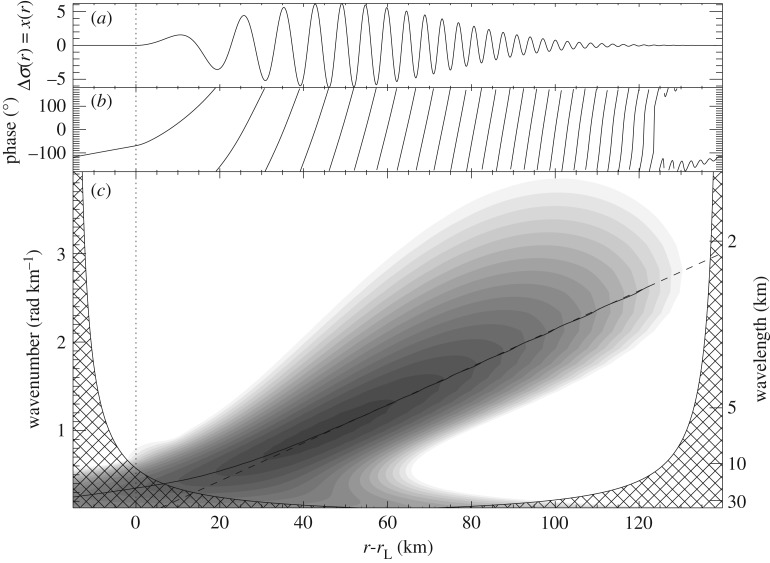
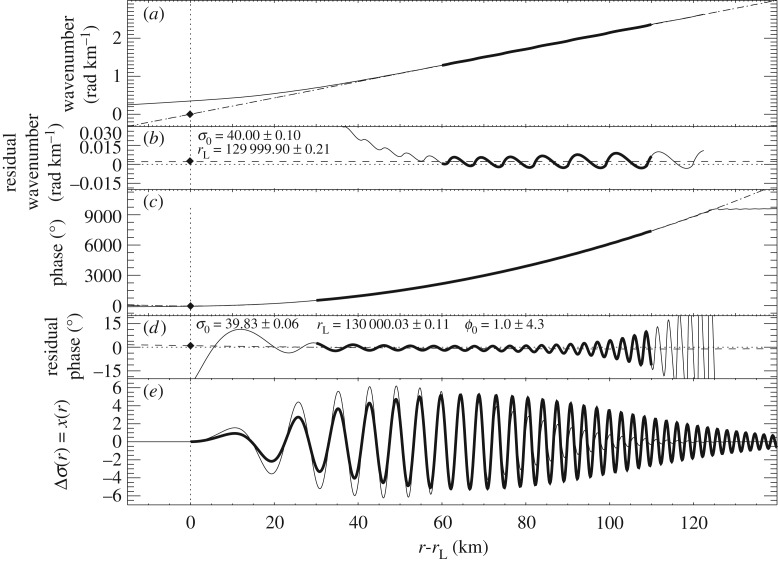
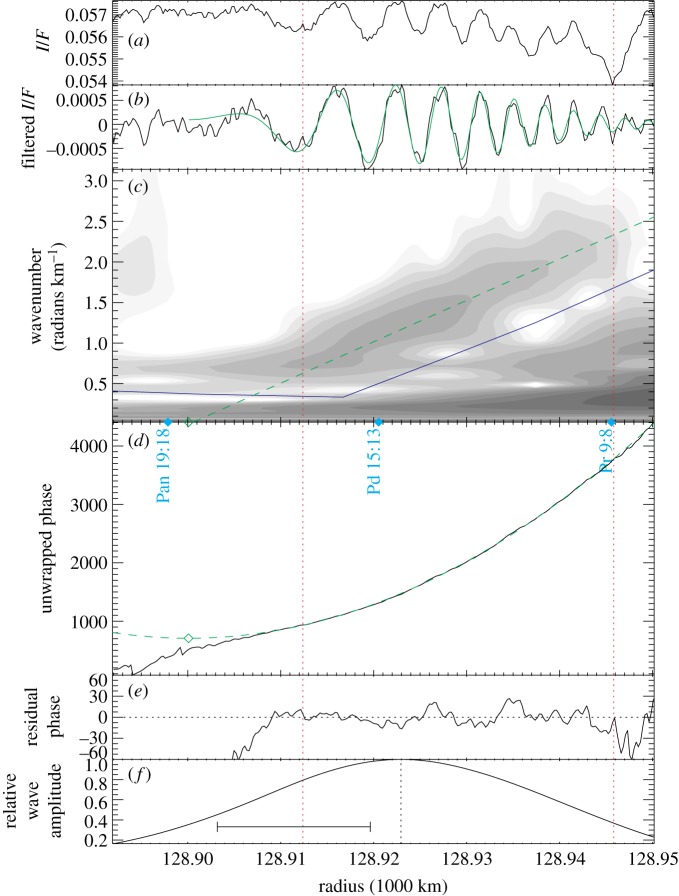
 , as in figure 2b, ‘unwrapped’ to show how phase accumulates quadratically (solid line); the expected phase ϕDW(r) (dotted line). The region of
  shown in bold was used in a quadratic fit (dashed line); the zero-derivative point is plotted as a solid diamond. (d) All three curves from figure 3c, shown as residuals with the expected phase ϕDW(r). (e) The input synthetic density wave from figure 2a (solid line); the fitted density wave, after the analysis of §4a(i), but still with randomly chosen values of ξD and AL (bold solid line). Fitted values given in the figure can be compared with the input parameters (table 1) used to generate the wave. Figure from Tiscareno et al. [11].
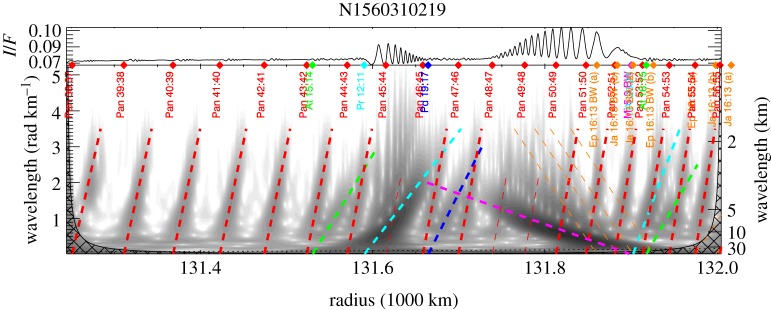
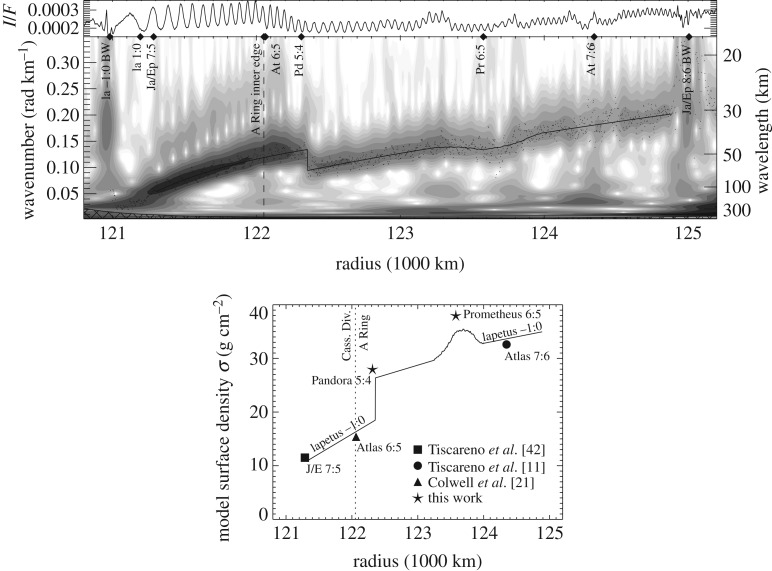
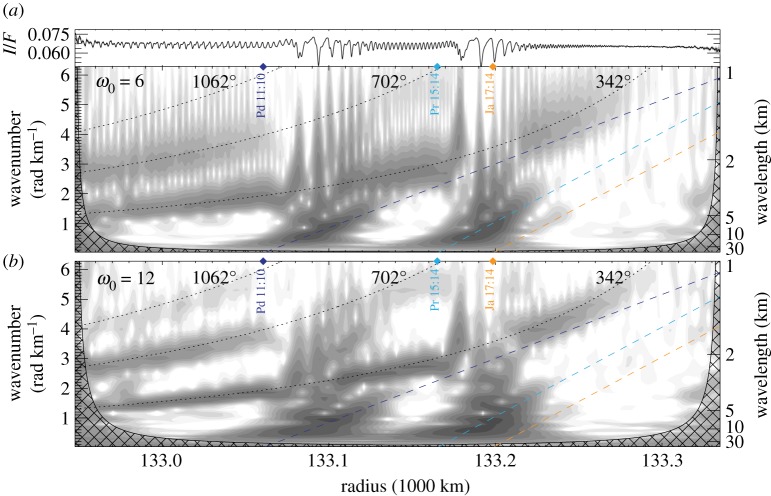
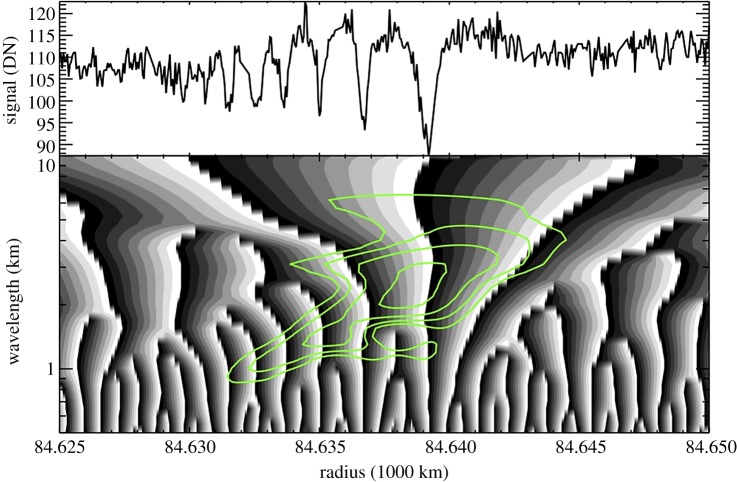
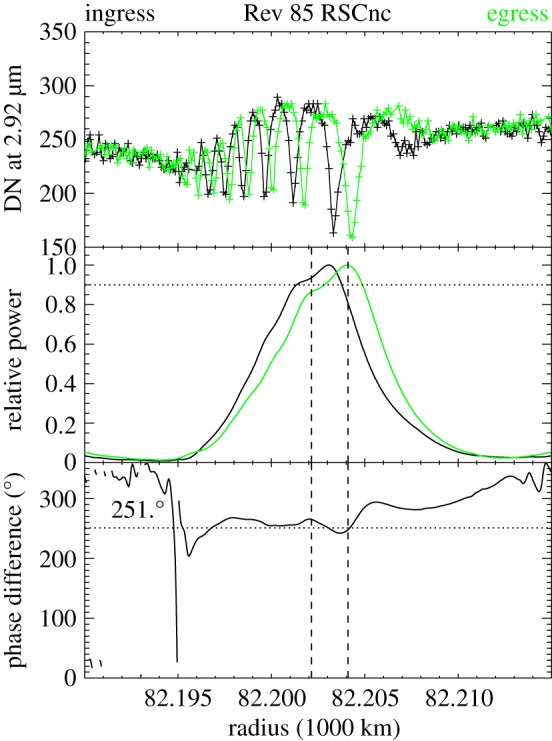
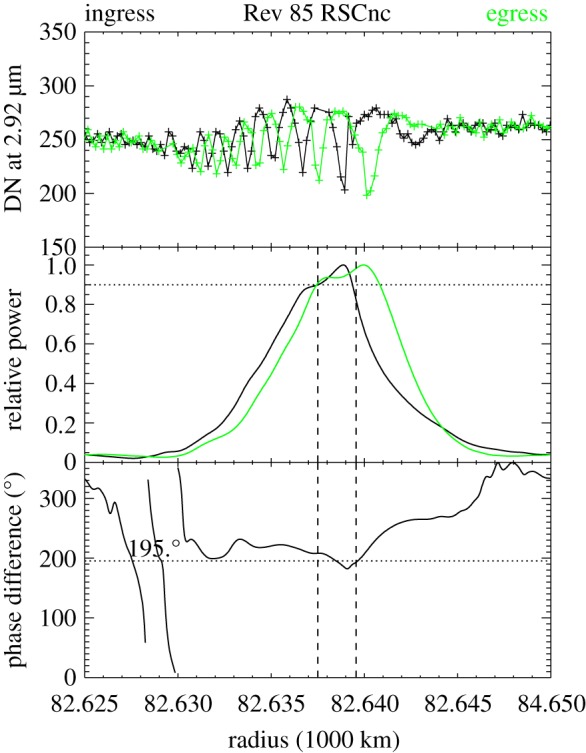
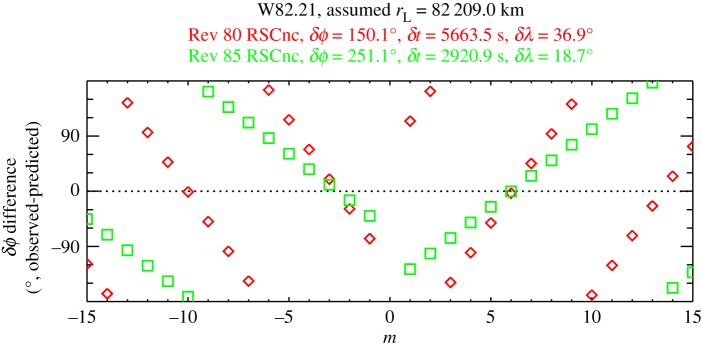
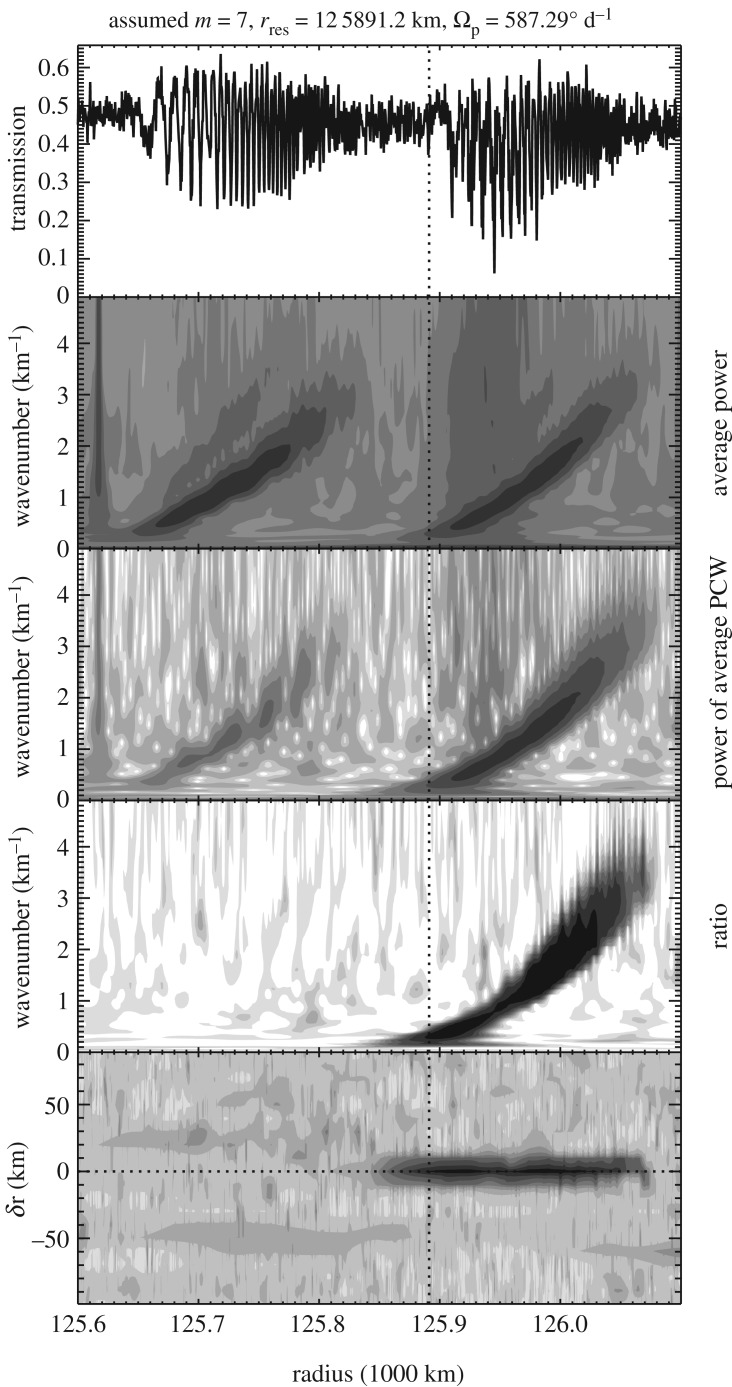
 for the γ Crucis occultations, with clear diagonal bands associated with both waves. The third panel shows the power of the average phase-corrected wavelet Eϕ, assuming m = 7 and a pattern speed appropriate for the Prometheus 7:6 resonance (the exact resonance location is marked by the vertical dotted line). Note that this highlights the right-hand wave. The fourth panel shows the ratio of the above powers
  , and shows only the signal from that wave. Finally, the bottom panel shows the peak value of
  as a function of radius and assumed pattern speed, parametrized as a displacement δr from the expected Prometheus 7:6 resonance location (marked with a horizontal dotted line). Note that the maps of
  and Eϕ use a common logarithmic stretch, while the maps of
  use a linear stretch. Figure from Hedman & Nicholson [24].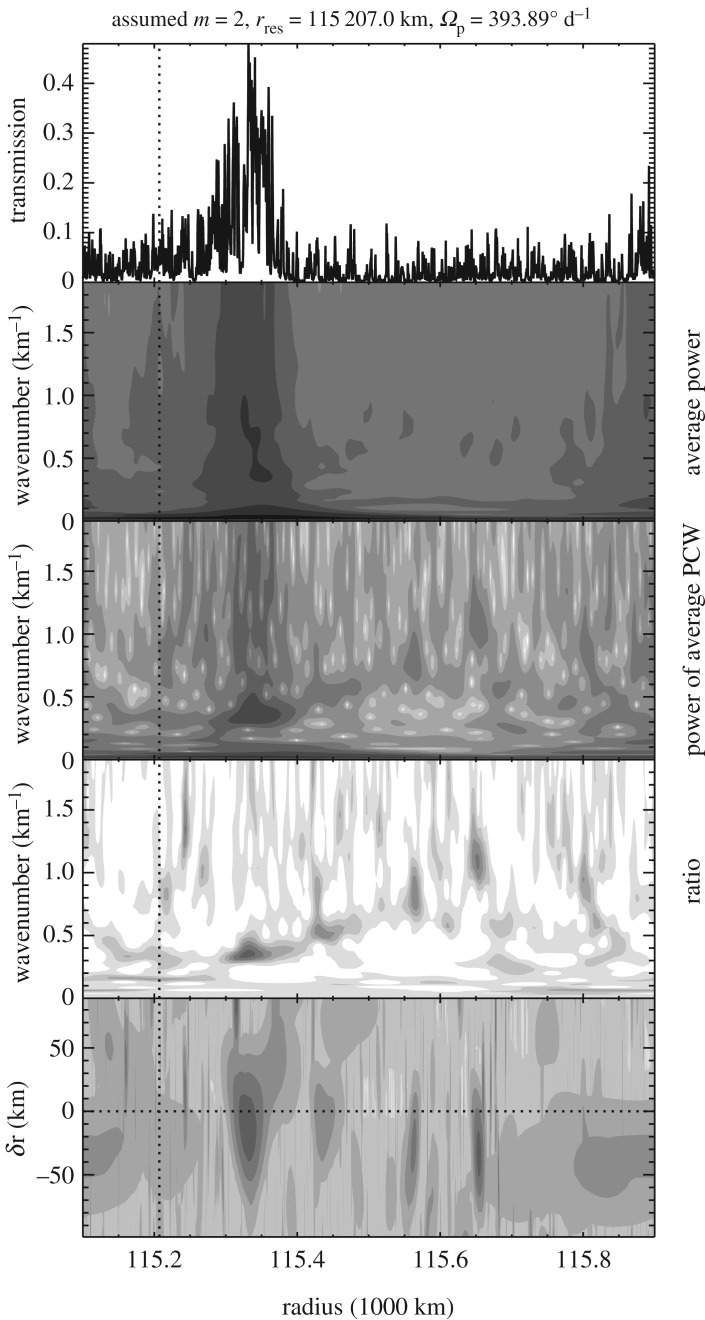
References
-
- Lin CC, Shu FH. 1964. On the spiral structure of disk galaxies. Astrophys. J. 140, 646–655. (10.1086/147955) - DOI
-
- Goldreich P, Tremaine S. 1982. The dynamics of planetary rings. Ann. Rev. Astron. Astrophys. 20, 249–283. (10.1146/annurev.aa.20.090182.001341) - DOI
-
- Shu FH. 1984. Waves in planetary rings. In Planetary rings (eds R Greenberg, A Brahic), pp. 513–561. Tucson, AZ: University of Arizona Press.
-
- Hedman MM, Nicholson PD. 2013. Kronoseismology: Using density waves in Saturn's C ring to probe the planet's interior. Astron. J. 146, 12 (10.1088/0004-6256/146/1/12) - DOI
-
- Hedman MM, Nicholson PD. 2014. More Kronoseismology with Saturn's rings. Mon. Not. R. Astron. Soc. 444, 1369–1388. (10.1093/mnras/stu1503) - DOI
Publication types
LinkOut - more resources
Full Text Sources
Other Literature Sources
