


Endothelial Colony-Forming Cells in Young Adults Born Preterm: A Novel Link Between Neonatal Complications and Adult Risks for Cardiovascular Disease
- PMID: 29987124
- PMCID: PMC6064846
- DOI: 10.1161/JAHA.118.009720
Endothelial Colony-Forming Cells in Young Adults Born Preterm: A Novel Link Between Neonatal Complications and Adult Risks for Cardiovascular Disease
Abstract
Background: Preterm birth is linked to cardiovascular risks and diseases. Endothelial progenitor cells play a critical role in vascular development and repair. Cord blood endothelial progenitor cells of preterm-born infants, especially endothelial colony-forming cells (ECFC), show enhanced susceptibility to prematurity-related pro-oxidant stress. Whether ECFC dysfunction is present in adulthood following preterm birth is unknown.
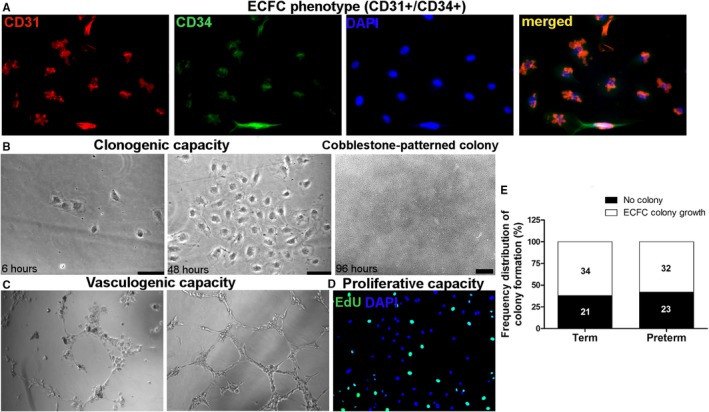
Methods and results: This cross-sectional observational study includes 55 preterm-born (≤29 gestational weeks) young adults (18-29 years old, 38% male) and 55 sex- and age-matched full-term controls. ECFC were isolated from peripheral blood; cell proliferative and vascular cord formation capacities were assessed in vitro. Daytime systolic blood pressure was higher, whereas glucose tolerance and body mass index were lower in preterm-born subjects. ECFC colonies grew in culture for 62% of full-term- and 58% of preterm-born participants. Preterm-born participants have formed ECFC colonies later in culture and have reduced proliferation compared with controls. Only in preterm-born individuals, we observed that the later the ECFC colony grows in culture, the worse was overall ECFC function. In addition, in preterms, elevated systolic blood pressure significantly correlated with reduced ECFC proliferation (rS=-0.463; P=0.030) and numbers of branches formed on matrigel (rS=-0.443; P=0.039). In preterm-born subjects, bronchopulmonary dysplasia was associated with impaired ECFC function, whereas exposure to antenatal steroids related to better ECFC function.
Conclusions: This study is the first to examine ECFC in preterm-born adults and to demonstrate ECFC dysfunction compared with full-term controls. In the preterm-born group, ECFC dysfunction was associated with bronchopulmonary dysplasia, the major prematurity-related neonatal morbidity, and with increased systolic blood pressure into adulthood.
Keywords: bronchopulmonary dysplasia; cardiovascular disease risk factors; endothelial progenitor cells; hypertension; pregnancy and postpartum; preterm birth.
© 2018 The Authors. Published on behalf of the American Heart Association, Inc., by Wiley.
Figures
References
-
- Crump C, Sundquist K, Sundquist J, Winkleby MA. Gestational age at birth and mortality in young adulthood. JAMA. 2011;306:1233–1240. - PubMed
-
- Hovi P, Vohr B, Ment LR, Doyle LW, McGarvey L, Morrison KM, Evensen KA, van der Pal S, Grunau RE; Collaboration AABPI , Brubakk AM, Andersson S, Saigal S, Kajantie E. Blood pressure in young adults born at very low birth weight: adults born preterm international collaboration. Hypertension. 2016;68:880–887. - PubMed
-
- Lewandowski AJ, Davis EF, Yu G, Digby JE, Boardman H, Whitworth P, Singhal A, Lucas A, McCormick K, Shore AC, Leeson P. Elevated blood pressure in preterm‐born offspring associates with a distinct antiangiogenic state and microvascular abnormalities in adult life. Hypertension. 2015;65:607–614. - PubMed
-
- Bonamy AK, Martin H, Jorneskog G, Norman M. Lower skin capillary density, normal endothelial function and higher blood pressure in children born preterm. J Intern Med. 2007;262:635–642. - PubMed
Publication types
MeSH terms
Grants and funding
LinkOut - more resources
Full Text Sources
Other Literature Sources
Medical
Molecular Biology Databases
