


A Conceptual Model of Angelman Syndrome and Review of Relevant Clinical Outcomes Assessments (COAs)
- PMID: 29987743
- PMCID: PMC6335381
- DOI: 10.1007/s40271-018-0323-7
A Conceptual Model of Angelman Syndrome and Review of Relevant Clinical Outcomes Assessments (COAs)
Abstract
Background: Angelman syndrome (AS) is a rare, neurological genetic disorder for which no clinical outcomes assessments (COAs) or conceptual models (CM) have been developed.
Objective: This study aimed to identify symptoms and impacts relevant and important in this patient population and develop a conceptual model of AS, and to evaluate the content validity of selected COA instruments with potential for inclusion in clinical studies of AS to capture treatment benefit.
Methods: For both concept elicitation (CE) and cognitive interviews (CI), caregivers of children, adolescents, and adults with AS and clinicians with AS experience were targeted. For CI, clinicians discussed the Modified Performance-Oriented Mobility Assessment (MPOMA-G) and ProtoKinetics Zeno Walkway™ and caregivers reviewed the Pediatric Evaluation of Disability Inventory Computer Adaptive Test (PEDI-CAT), the Anxiety, Depression and Mood Scale (ADAMS), the Aberrant Behavior Checklist-Community (ABC-C), and the Morning Diary.
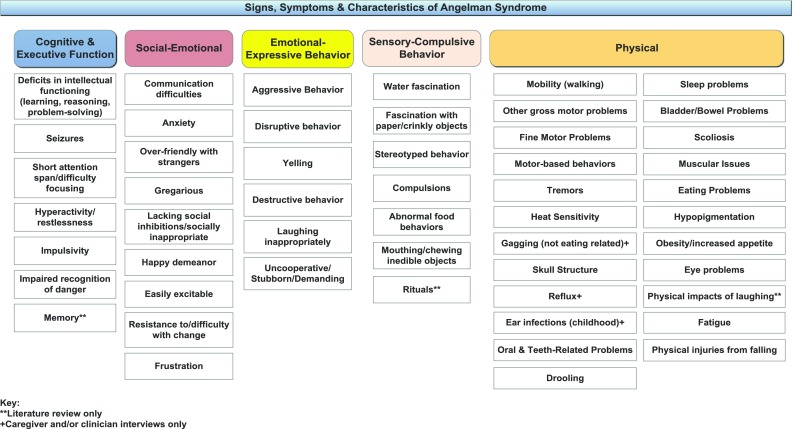
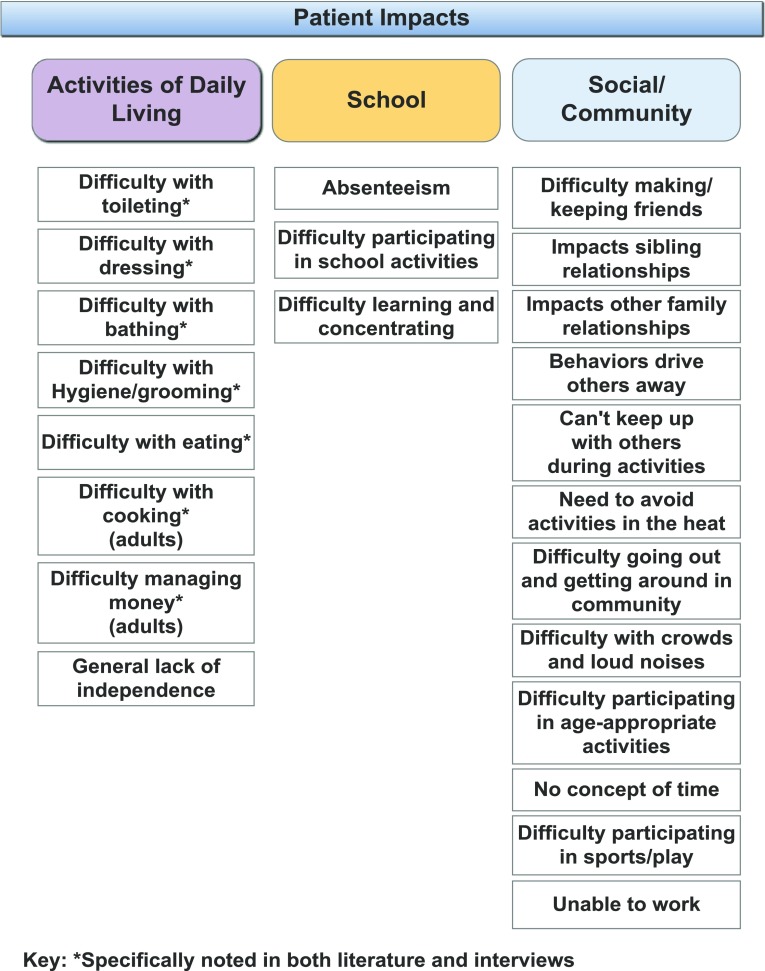
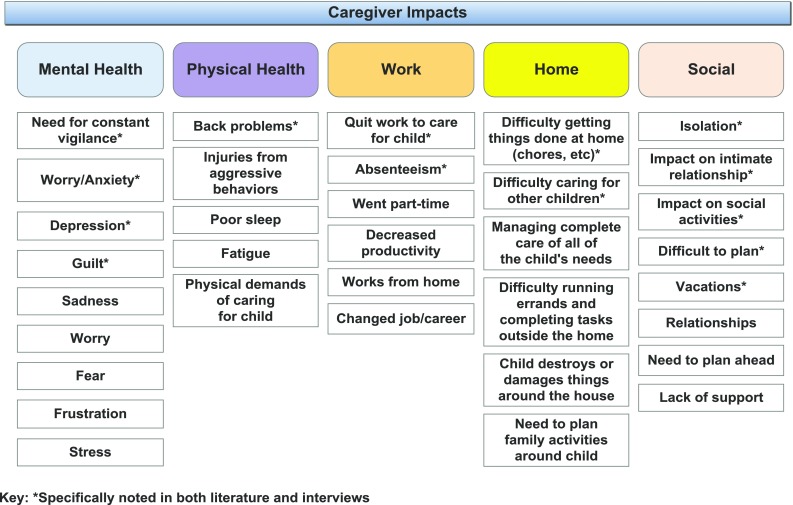
Results: Four clinicians and 34 caregivers participated in CE interviews; three clinicians and 36 caregivers participated in CI. A conceptual model, initially informed by literature, was refined based on interview data. Five domains of symptoms, signs, and characteristics of AS were identified: cognitive and executive functioning, social-emotional, emotional-expressive behavior, sensory-compulsive behavior, and physical. Patient impacts were identified in three domains: activities of daily living, school, and social/community. Caregiver impacts were identified in five domains: mental health, physical health, work, home, and social. While all instruments demonstrated the ability to provide relevant data for the AS population, each instrument either contained some items irrelevant to individuals with AS or was missing important concepts based on the interviews. No single instrument covered all relevant domains specific to AS.
Conclusion: Future work should consider the adaptation of existing COAs and the development of a novel AS-specific instrument for use in clinical research to ensure outcomes important to this patient population are captured.
Conflict of interest statement
Conflict of Interest
J.C. Grieco, R. Cabo, and J. Visootsak are employees of Ovid Therapeutics and own stock in Ovid Therapeutics. B. Romero and E. Flood are employees of ICON, which was hired by Ovid to conduct this study.
Ethics/Consent
This study received approval from Salus IRB (Austin, TX, USA), a central institutional review board. All study participants provided written informed consent.
Ethical Approval
All procedures performed in studies involving human participants were in accordance with the ethical standards of the institutional and/or national research committee and with the 1964 Helsinki declaration and its later amendments or comparable ethical standards.
Figures
References
-
- Food and Drug Administration (FDA); US Department of Health and Human Services; Center for Drug Evaluation and Research (CDER); Center for Biologics Evaluation and Research (CBER); Center for Devices and Radiological Health (CDRH). Guidance for Industry Patient-Reported Outcome Measures: Use in Medical Product Development to Support Labeling Claims. 2009. https://www.fda.gov/downloads/Drugs/GuidanceComplianceRegulatoryInformat... 21-01-18. Accessed 21 Jan 2018. - PubMed
Publication types
MeSH terms
LinkOut - more resources
Full Text Sources
Other Literature Sources
Research Materials
Miscellaneous
