. 2019 Jan;23(1):91-106.
doi: 10.1002/ejp.1288. Epub 2018 Jul 30.

Impaired chronic pain-like behaviour and altered opioidergic system in the TASTPM mouse model of Alzheimer's disease

Affiliations

Impaired chronic pain-like behaviour and altered opioidergic system in the TASTPM mouse model of Alzheimer's disease

Y Aman et al. Eur J Pain. 2019 Jan.

Abstract

Background: Chronic pain conditions, especially osteoarthritis (OA), are as common in individuals with Alzheimer's disease (AD) as in the general elderly population, which results in detrimental impact on patient's quality of life. However, alteration in perception of pain in AD coupled with deteriorating ability to communicate pain sensations often result in under-diagnosis and inappropriate management of pain. Therefore, a better understanding of mechanisms in chronic pain processing in AD is needed. Here, we explored the development and progression of OA pain and the effect of analgesics in a transgenic mouse model of AD.

Methods: Unilateral OA pain was induced chemically, via an intra-articular injection of monosodium iodoacetate (MIA) in the left knee joint of AD-mice (TASTPM) and age- and gender-matched C57BL/6J (WT). Pharmacological and biochemical assessments were conducted in plasma and spinal cord tissue.

Results: MIA resulted in hind paw mechanical hypersensitivity (allodynia), initiating on day 3, in TASTPM and WT controls. However, from 14 to 28 days, TASTPM displayed partial attenuation of allodynia and diminished spinal microglial response compared to WT controls. Naloxone, an opioid antagonist, re-established allodynia levels as observed in the WT group. Morphine, an opioid agonist, induced heightened analgesia in AD-mice whilst gabapentin was devoid of efficacy. TASTPM exhibited elevated plasma level of β-endorphin post-MIA which correlated with impaired allodynia.

Conclusions: These results indicate an alteration of the opioidergic system in TASTPM as possible mechanisms underlying impaired persistent pain sensitivity in AD. This work provides basis for re-evaluation of opioid analgesic use for management of pain in AD.

Significance: This study shows attenuated pain-like behaviour in a transgenic mouse model of Alzheimer's disease due to alterations in the opioidergic system and central plasticity mechanisms of persistent pain.


Figures

Figure 1
Figure 1
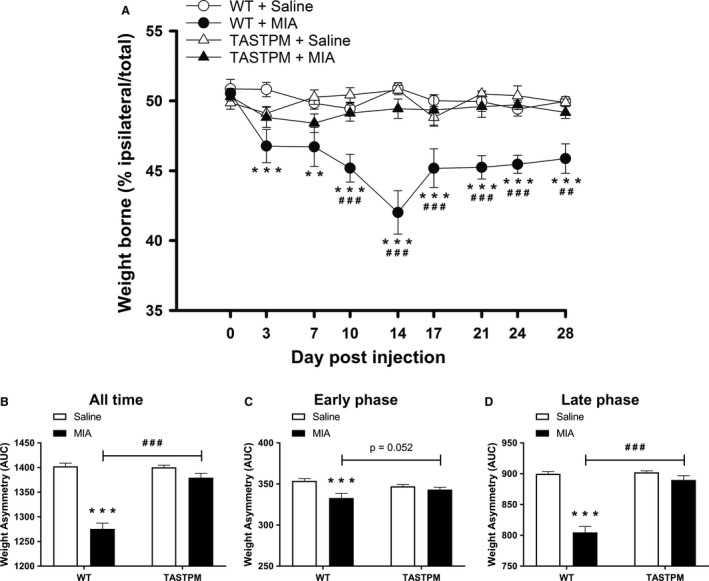
MIA‐induced weight asymmetry absent in TASTPM mice. Weight borne on ipsilateral hind limb, calculated as percentage of ipsilateral weight borne/total weight borne (ipsilateral + contralateral weight borne), by 6 months old TASTPM and age‐ and gender‐matched wild‐type (WT), was monitored at regular intervals prior to (baseline, 0) and up to 28 days post‐intra‐articular administration of MIA (1 mg/10 μL) or saline (control) into the left knee joint (A). Alteration in weight distribution was compared between experimental groups within genotype (**p < 0.01, ***p < 0.001) and between genotype within experimental group (## p < 0.01, ### p < 0.001) was detected using two‐way repeated measures ANOVA followed by the Student–Newman–Keuls post hoc test. The number of male and female per experimental group: WT + Saline (n = 10: five males and five females); WT + MIA (n = 8: four males and four females); TASTPM + Saline (n = 8: four males and four females); and TASTPM + MIA (n = 10: five males and five females). As no difference in thresholds was observed, prior to or at regular intervals post‐MIA administration, between male and female in both WT and TASTPM mice, the data were pooled. Data are as mean weight borne ± SEM (n = 8–10 mice per experimental group). Area under the curve (AUC) analysis was calculated and expressed as weight asymmetry where a lower value represents more severe weight asymmetry. All time is the analysis of AUC for baseline – day 28 (B), early phase (baseline – day 7) (C) and late phase (day 10 – day 28) (D). Statistical comparisons between experimental groups within genotype (***p < 0.001) and between genotype within experimental group (### p < 0.001) were conducted using two‐way ANOVA followed by the Student–Newman–Keuls post hoc test. All values are expressed as mean ± SEM (n = 8–10 mice per experimental group).
Figure 2
Figure 2
Partial reversal of MIA‐induced mechanical hypersensitivity in the ipsilateral hind paw of TASTPM mice. A representation of mechanical withdrawal responses in the ipsilateral hind paw of 6 months old TASTPM and age‐ and gender‐matched wild‐type (WT) that were measured at regular intervals prior to (baseline, 0) and up to 28 days post‐intra‐articular administration of MIA (1 mg/10 μL) or saline (control) into the left knee joint (A). Alteration in behaviour compared between experimental groups (MIA vs. Saline) within genotype (WT or TASTPM) (***p < 0.001) and between genotype (TASTPM vs. WT) within experimental group (Saline or MIA) (## p < 0.01, ### p < 0.001) was detected using two‐way repeated measures analysis of variance (ANOVA) followed by the Student–Newman–Keuls post hoc test. The number of male and female per experimental group: WT + Saline (n = 10: five males and five females); WT + MIA (n = 8: four males and four females); TASTPM + Saline (n = 8: four males and four females); and TASTPM + MIA (n = 10: five males and five females). As no difference in thresholds was observed, prior to or at regular intervals post‐MIA administration, between male and female in both WT and TASTPM mice, the data were pooled. Data are expressed as mean 50% paw withdrawal threshold (PWT) ± SEM (n = 8–10 mice per experimental group). Area under the curve (AUC) for ipsilateral hind paw was calculated and expressed as allodynia index where a lower value represents more severe mechanical hypersensitivity. All time is the analysis of AUC for baseline – day 28 (B), early phase (baseline – day 7) (C) and late phase (day 10 – day 28) (D). Statistical comparisons between experimental groups within genotype (***p < 0.001) and between genotype within experimental group (### p < 0.001) were observed using two‐way ANOVA followed by the Student–Newman–Keuls post hoc test. All values are expressed as mean AUC ± SEM (n = 8–10 mice per experimental group).
Figure 3
Figure 3
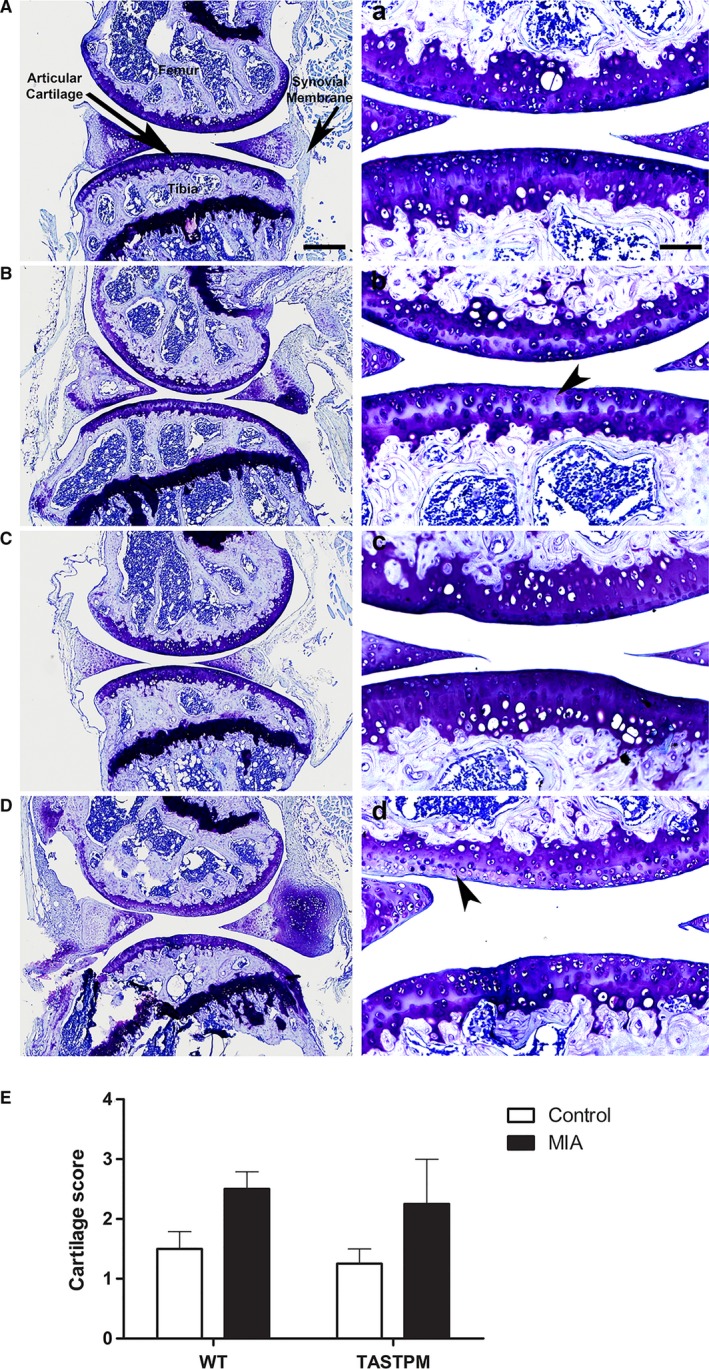
MIA‐induced knee cartilage degradation. Representation of toluidine blue staining of articular cartilage from control and MIA‐injected (ipsilateral) knee joints of wild‐type (WT, A–B) and TASTPM (C–D) mice 28 days post‐MIA. High magnification images for each experimental group representing the outlined box (a–d). Intact articular cartilage with regular and intense staining of proteoglycans was observed in the control WT and TASTPM mice, whereas 28 days post‐MIA injection, degradation and loss of ipsilateral articular cartilage (arrowheads) were induced in both WT and TASTPM knee joints. The scale bar represents 200 μm (A–D) and 100 μm (a–d). Quantitative analysis of knee joint pathology 28 days post‐MIA injection revealed an increase, yet insignificant (p > 0.05 Student's t‐test), in cartilage degradation exhibited by both TASTPM and WT compared to their respective saline controls (E). Data are shown as mean ± SEM (n = 4 (two males and two females) per experimental group).
Figure 4
Figure 4
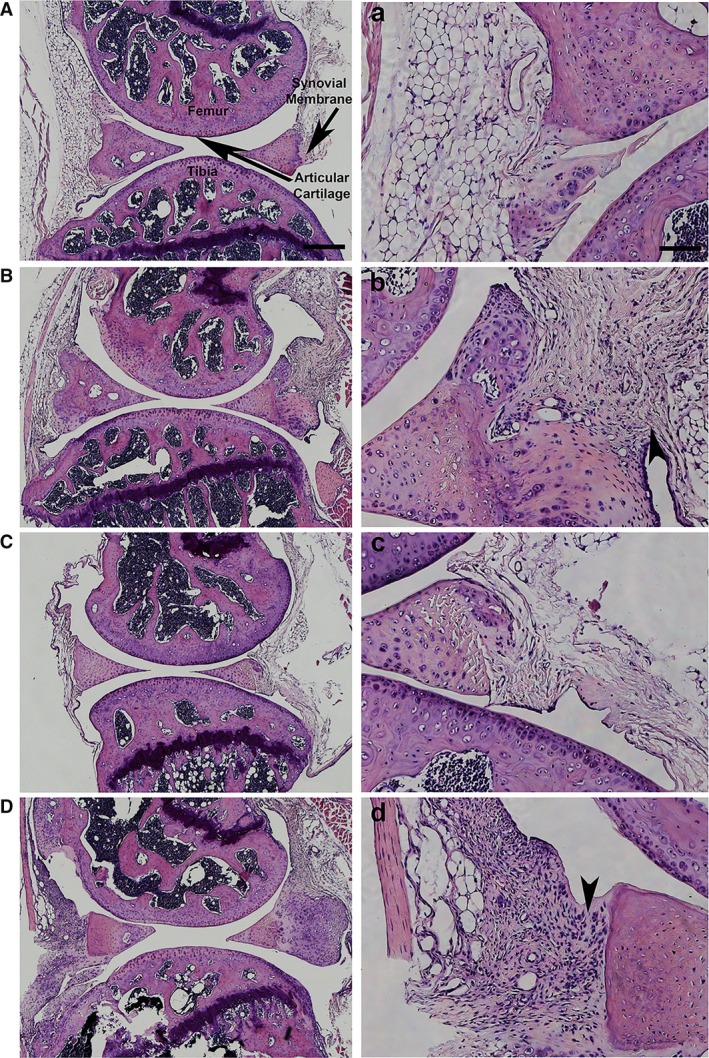
MIA‐induced inflammation in the synovial membrane. Representation of haematoxylin and eosin staining (H&E) of articular cartilage from control and MIA‐injected (ipsilateral) knee joints of wild‐type (WT, A–B) and TASTPM (C–D) mice 28 days post‐MIA. High magnification images for each experimental group representing the outlined box (a–d). H&E staining displayed minimal nuclei within the synovial membrane of WT and TASTPM controls. However, 28 days post‐MIA resulted in the thickening of the synovial membrane lining and infiltration of cells in the ipsilateral synovial membrane of MIA‐injected animals only (arrowheads). The scale bar represents 200 μm (A–D) and 100 μm (a–d).
Figure 5
Figure 5
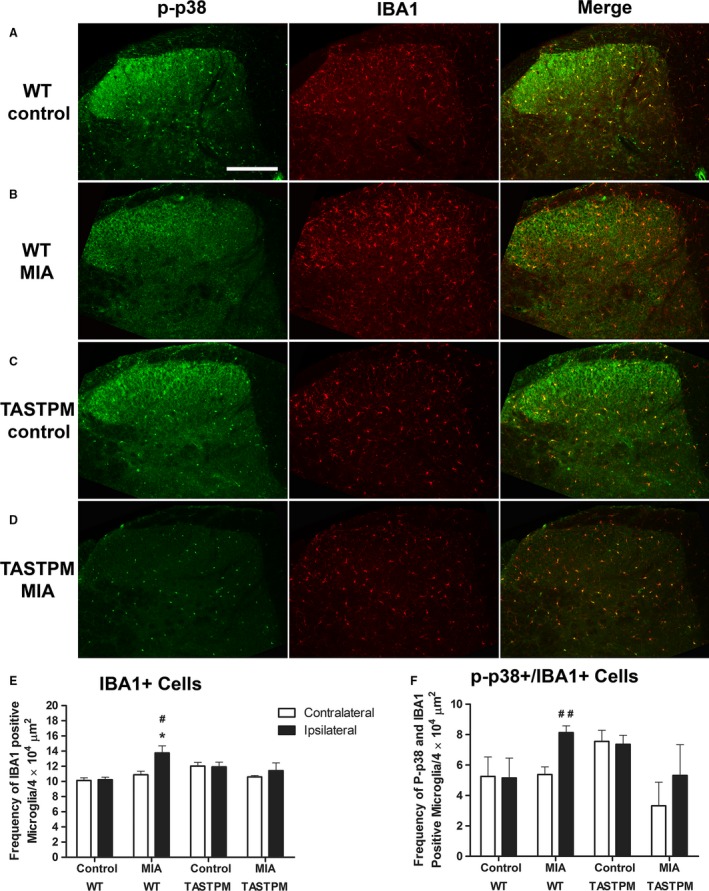
Lack of MIA‐induced spinal microgliosis exhibited by TASTPM mice. Representative images showing phospho‐p38 (p‐p38) expressing microglia (IBA1) in the dorsal horn of the spinal cord (L4–L5) 28 days after intra‐articular injection of saline (control) or MIA of TASTPM and age‐ and gender‐matched wild‐type (WT) mice (A–D). The scale bar represents 200 μm. Quantification of IBA1 immunopositive cells (E) and P‐p38 expressing IBA1 cell frequency (F) was conducted in pooled L4 and L5 dorsal horn of MIA and control mice. WT mice exhibited significantly greater frequency of IBA1 immunopositive microglia in the ipsilateral dorsal horn compared to WT control ipsilateral (*p < 0.05, Student's t‐test) and WT MIA contralateral, where increase in activated microglia was also evident (# p < 0.05, ## p < 0.01, Student's t‐test). Contrastingly, no apparent changes in microglial or activated microglia were observable in the ipsilateral MIA‐injected TASTPM mice compared to neither TASTPM control ipsilateral nor TASTPM MIA contralateral (p > 0.05, Student's t‐test). Data are shown as mean ± SEM (n = 4 (2 males and 2 females) per experimental group).
Figure 6
Figure 6
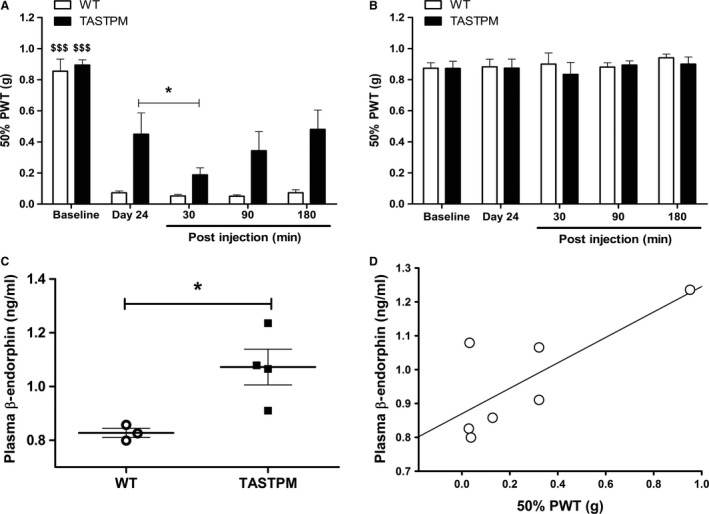
Increased opioidergic activity underlying impaired MIA‐induced mechanical hypersensitivity in TASTPM. Mechanical withdrawal responses of MIA‐injected mice were assessed in both hind paws, ipsilateral (A) and contralateral (B), prior to MIA injection (baseline). Twenty‐four days post‐MIA administration, mice were administrated (i.p.) with naloxone hydrochloride (1 mg/kg) and withdrawal thresholds were assessed in both hind paws at regular intervals prior to (Day 24) and up to 180 min post‐naloxone injection. Ipsilateral hind paw 50% paw withdrawal thresholds (PWT) on day 24 were significantly lower than respective baseline in both genotypes at all time points ($$$ p < 0.001). Naloxone hydrochloride injection reduced ipsilateral mechanical thresholds only in the TASTPM ipsilateral hind paw 30 min post‐administration (*p < 0.05) compared to pre‐injection values. No effect of naloxone on mechanical thresholds was detected in wild‐type (WT) ipsilateral (A). Also naloxone did not have any effect on the contralateral hind paws of both genotypes at any time point (B). Statistical analysis was conducted using two‐way repeated measures ANOVA followed by the Student–Newman–Keuls post hoc test. The 50% PWT values are presented as mean ± SEM (n = 6 (three males and three females) mice per group). Plasma concentration of β‐endorphin was determined by EIA 28 days post‐administration of MIA into the left knee joint of WT (one male and two females) and TASTPM (two males and two females) (C). MIA‐injected TASTPM displayed significantly greater levels of plasma β‐endorphin compared to WT (*p < 0.05, Student's t‐test). Data are presented as mean ± SEM (n = 3–4 per experimental group). A positive relationship between the level of plasma concentration of β‐endorphin and ipsilateral 50% PWT 28 days post‐MIA injection was detected using linear regression (R 2 = 0.589, p < 0.05) (D). Data plotted as individual animal plasma β‐endorphin and 50% PWT observed on day 28.
Figure 7
Figure 7
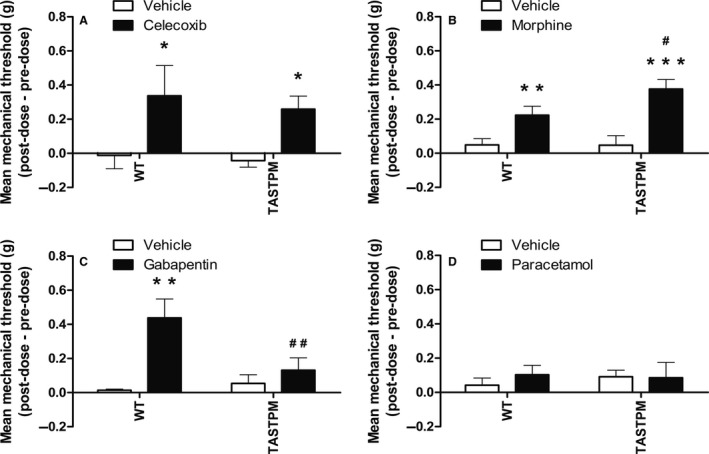
Altered analgesic responses in TASTPM Mice. Mechanical withdrawal thresholds of MIA‐injected mice were assessed prior to and at specified intervals post‐analgesic or vehicle administration. Both wild‐type (WT: three males and three females per treatment group) and TASTPM (four males and four females per treatment group) mice exhibited increase in mechanical thresholds 1 h post‐oral (p.o.) administration of celecoxib (30 mg/kg) on 6–7 days post‐MIA injection compared to their respective vehicle (methyl cellulose) controls (*p < 0.05) (A). Administration of morphine (6 mg/kg; s.c.), an opioid agonist, on 28 days after MIA injection resulted in significant reversal of mechanical hypersensitivity in both WT (4 males and 4 females per treatment group) and TASTPM (five males and five females per treatment group) mice (1 h post‐injection; **p < 0.01; ***p < 0.001) compared to their respective vehicle (saline) controls, with greater degree of analgesia observed in TASTPM compared to WT mice (# p < 0.05) (B). Gabapentin (60 mg/kg; p.o.; 22–24 days post‐MIA) was only effective in reversing MIA‐induced mechanical hypersensitivity in WT (five males and three females per treatment group) mice (**p < 0.01; 3 h post‐injection), with no effect detected in TASTPM (five males and four females per treatment group) (p > 0.05), compared to their respective vehicle (dH2O) controls. The analgesic effect of gabapentin was significantly greater in WT mice compared to TASTPM (## p < 0.01) (C). Paracetamol (300 mg/kg; p.o.) was ineffective in alleviating MIA‐induced mechanical hypersensitivity (p > 0.05) in both WT (Vehicle: three males and three females; Paracetamol: three male and two females) and TASTPM (Vehicle: two male and three females: Paracetamol: five males and four females) mice when administrated 28 days after MIA injection (30 min post‐injection), compared to their respective vehicle (saline) control group (D). Statistical analysis was conducted using two‐way ANOVA followed by the Student–Newman–Keuls post hoc test. Data are presented as difference between post‐dose and pre‐dose 50% PWT values that are illustrated as mean ± SEM (n = 5–10 mice per experimental group).

References

    1. Achterberg, W.P. , Pieper, M.J. , van Dalen‐Kok, A.H. , de Waal, M.W. , Husebo, B.S. et al. (2013). Pain management in patients with dementia. Clin Interv Aging 8, 1471–1482. - PMC - PubMed
    1. Aman, Y. , Pitcher, T. , Simeoli, R. , Ballard, C. , Malcangio, M. (2016). Reduced thermal sensitivity and increased opioidergic tone in the TASTPM mouse model of Alzheimer's disease. Pain 157, 2285–2296. - PMC - PubMed
    1. Ballard, C.G. , Gauthier, S. , Cummings, J.L. , Brodaty, H. , Grossberg, G.T. , Robert, P. , Lyketsos, C.G. (2009). Management of agitation and aggression associated with Alzheimer disease. Nat Rev Neurol 5, 245–255. - PubMed
    1. Ballard, C. , Corbett, A. , Howard, R. (2014). Prescription of antipsychotics in people with dementia. Br J Psychiatry 205, 4–5. - PubMed
    1. Beyreuther, B. , Callizot, N. , Stohr, T. (2007). Antinociceptive efficacy of lacosamide in the monosodium iodoacetate rat model for osteoarthritis pain. Arthritis Res Ther 9, R14. - PMC - PubMed

Publication types

MeSH terms