Review
. 2018 Mar 16;3(4):794-803.
doi: 10.1016/j.ekir.2018.03.006. eCollection 2018 Jul.

Comparative Efficacy and Safety of Therapies in IgA Nephropathy: A Network Meta-analysis of Randomized Controlled Trials

Affiliations
Review

Comparative Efficacy and Safety of Therapies in IgA Nephropathy: A Network Meta-analysis of Randomized Controlled Trials

Pingping Yang et al. Kidney Int Rep. .

Abstract

The present study aims to compare the relative efficacy and safety of different interventions for IgA nephropathy (IgAN) with proteinuria more than 1 g/d by using network meta-analysis. We searched PubMed, Embase, and the Cochrane Library for studies compared the rate of clinical remission and/or end-stage renal disease (ESRD) and/or serious adverse events in IgAN patients with proteinuria (>1 g/d). The surface under the cumulative ranking area (SUCRA) was calculated to rank the interventions. A total of 21 randomized controlled trials with 1822 participants were included for the comparisons of 7 interventions. The rank of the most effective treatments to induce clinical remission was renin-angiotensin system inhibitors (RASi) plus urokinase, steroid plus tonsillectomy, and RASi plus steroid with a SUCRA of 0.912, 0.710, and 0.583, respectively. As for the prevention of ESRD or doubling of serum creatinine, RASi plus steroid (SUCRA 0.012) was the most effective, followed by RASi (SUCRA 0.282) and steroid (SUCRA 0.494), leaving mycophenolate mofetil as the least effective (SUCRA 0.644). There was no statistical difference among all interventions in the occurrence of serious adverse events. The current network meta-analysis demonstrated for the first time that RASi plus steroid is probably the best therapeutic choice, not only for reducing proteinuria but also for maintaining long-term renal protection.

Keywords: IgA nephropathy; end-stage renal disease; network meta-analysis; proteinuria; renin−angiotensin system; steroid.


Figures
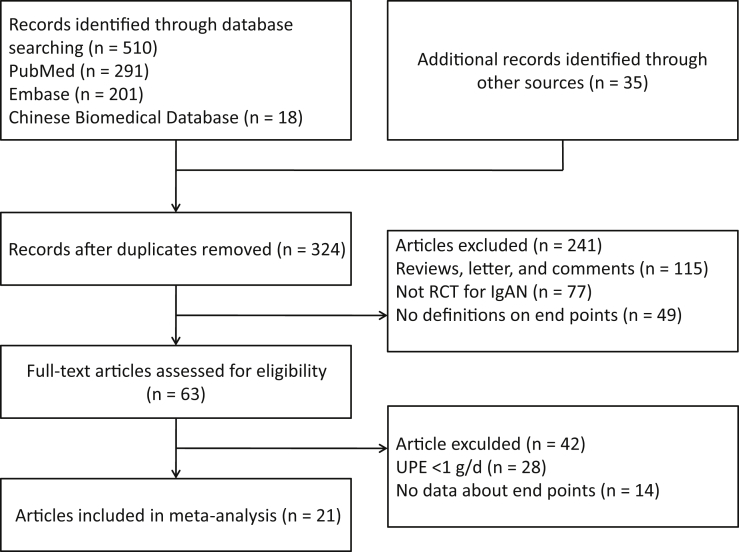
Figure 1
Figure 1
Preferred Reporting Items for Systematic Reviews and Meta-Analyses (PRISMA) flow diagram of identification process for eligible articles. IgAN, IgA nepropathy; RCT, randomized controlled trial; UPE, urinary protein excretion.
Figure 2
Figure 2
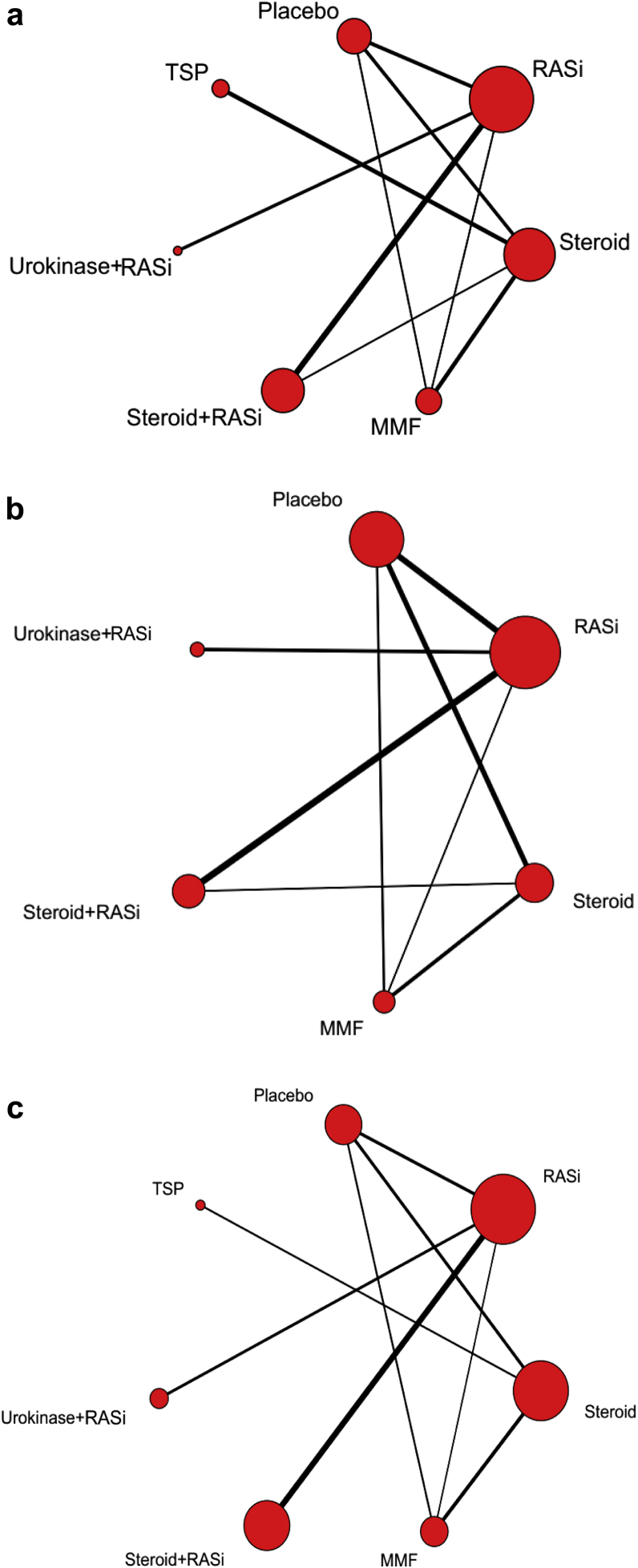
Network plot of treatment comparisons for Bayesian network meta-analysis. Lines represent trials comparing 2 classes of drug or drugs for (a) clinical remission, (b) end-stage renal disease and doubling of serum creatinine level, and (c) serious adverse events of IgA nephropathy. The size of the nodes (red circles) corresponds to the sample size of the interventions. Comparisons are linked with a line, of which the thickness corresponds to the number of trials that assessed the comparison. MMF, mycophenolate mofetil; RASi, renin−angiotensin system inhibitor; TSP, tonsillectomy combined with steroid pulse therapy.
Figure 3
Figure 3
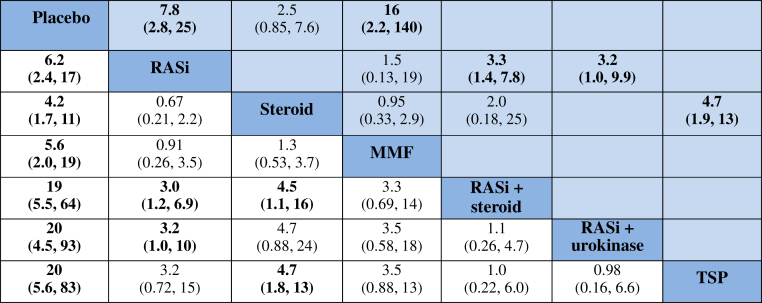
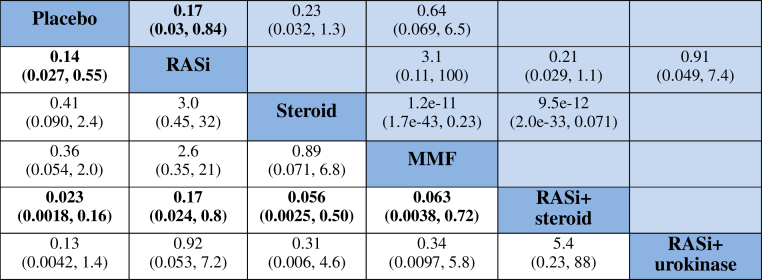
Summary of results from network meta-analysis (on the lower triangle) and traditional pairwise meta-analysis (on the upper triangle) on clinical remission. On the lower triangle, the column-defining treatment is compared with the row-defining treatment, and odds ratios (ORs) of < 1 favor the column-defining treatment. On the upper triangle, the row-defining treatment is compared with the column-defining treatment, and ORs of < 1 favor the row-defining treatment. To obtain ORs for comparisons in the opposite direction, reciprocals should be taken. Significant results are shown in boldface type. MMF, mycophenolate mofetil; RASi, renin angiotensin system inhibitor; TSP, tonsillectomy combined with steroid pulse therapy.
Figure 4
Figure 4
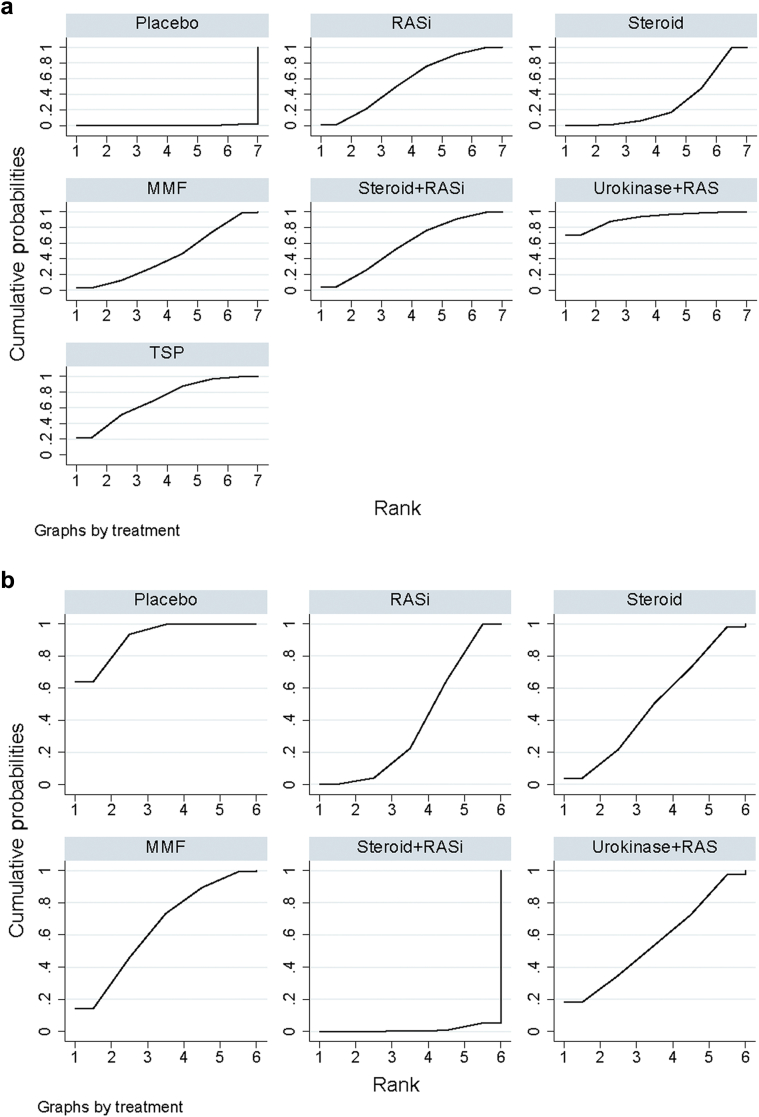
Rankings of surface under the cumulative ranking area (SUCRA) for efficacy of treatments to induce end points in IgA nephropathy. (a) Clinical remission, (b) end-stage renal disease (ESRD) and doubling of serum creatinine level, and (c) serious adverse events (SAEs) of IgAN. The graphs display the distribution of probabilities of treatment, ranking from the best through the worst for each outcome. Ranking indicates the probability that the drug class is “best,” second-“best,” etc. For example, RAS inhibitors plus urokinase and steroid combined with tonsillectomy were among the best treatments for inducing disease remission, while the placebo provided the lowest probability of disease remission (worst). On the other hand, the ranking suggests that MMF posed the highest risk for incurring ESRD or creatinine doubling (worst), whereas renin−angiotensin system (RAS) inhibitors (RASi) plus steroid incurred the lowest probability of ESRD or creatinine doubling (best). MMF, mycophenolate mofetil; TSP, tonsillectomy combined with steroid pulse therapy.
Figure 4
Figure 4
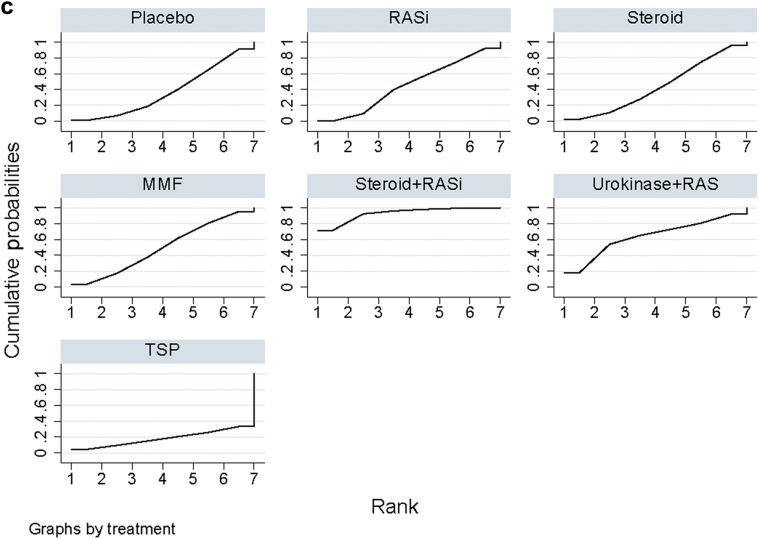
Rankings of surface under the cumulative ranking area (SUCRA) for efficacy of treatments to induce end points in IgA nephropathy. (a) Clinical remission, (b) end-stage renal disease (ESRD) and doubling of serum creatinine level, and (c) serious adverse events (SAEs) of IgAN. The graphs display the distribution of probabilities of treatment, ranking from the best through the worst for each outcome. Ranking indicates the probability that the drug class is “best,” second-“best,” etc. For example, RAS inhibitors plus urokinase and steroid combined with tonsillectomy were among the best treatments for inducing disease remission, while the placebo provided the lowest probability of disease remission (worst). On the other hand, the ranking suggests that MMF posed the highest risk for incurring ESRD or creatinine doubling (worst), whereas renin−angiotensin system (RAS) inhibitors (RASi) plus steroid incurred the lowest probability of ESRD or creatinine doubling (best). MMF, mycophenolate mofetil; TSP, tonsillectomy combined with steroid pulse therapy.
Figure 5
Figure 5
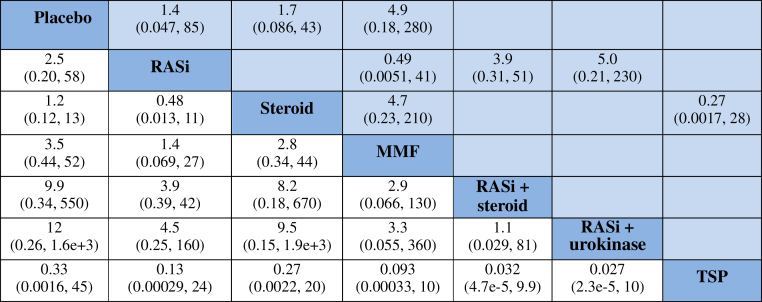
Summary of results from network meta-analysis (on the lower triangle) and traditional pairwise meta-analysis (on the upper triangle) on end-stage renal disease and doubling of serum creatinine level. On the lower triangle, the column-defining treatment is compared with the row-defining treatment, and odds ratios (ORs) > 1 favor the column-defining treatment. On the upper triangle, the row-defining treatment is compared with the column-defining treatment, and an OR > 1 favors the row-defining treatment. To obtain ORs for comparisons in the opposite direction, reciprocals should be taken. Significant results are shown in boldface type. Direct comparisons within 2 inconsistent loops are underlined. MMF, mycophenolate mofetil; RASi, renin−angiotensin system inhibitors.
Figure 6
Figure 6
Summary of results from network meta-analysis (on the lower triangle) and traditional pairwise meta-analysis (on the upper triangle) on serious adverse events. On the lower triangle, the column-defining treatment is compared with the row-defining treatment, and odds ratios (ORs) of > 1 favor the column-defining treatment. On the upper triangle, the row-defining treatment is compared with the column-defining treatment, and ORs of > 1 favor the row-defining treatment. To obtain ORs for comparisons in the opposite direction, reciprocals should be taken. Direct comparisons within 2 inconsistent loops are underlined. MMF, mycophenolate mofetil; RASi, renin−angiotensin system inhibitors; TSP, tonsillectomy combined with steroid pulse therapy.

References

    1. Wyatt R.J., Julian B.A. IgA nephropathy. N Engl J Med. 2013;368:2402–2414. - PubMed
    1. Lin M., Du L., Brandtzaeg P., Pan-Hammarstrom Q. IgA subclass switch recombination in human mucosal and systemic immune compartments. Mucosal Immunol. 2014;7:511–520. - PubMed
    1. Roberts I.S. Pathology of IgA nephropathy. Nat Rev Nephrol. 2014;10:445–454. - PubMed
    1. Appel G.B., Waldman M. The IgA nephropathy treatment dilemma. Kidney Int. 2006;69:1939–1944. - PubMed
    1. Radhakrishnan J., Cattran D.C. The KDIGO practice guideline on glomerulonephritis: reading between the (guide) lines—application to the individual patient. Kidney Int. 2012;82:840–856. - PubMed