


Severe illness associated with reported use of synthetic cannabinoids: a public health investigation (Mississippi, 2015)
- PMID: 29989463
- PMCID: PMC11331360
- DOI: 10.1080/15563650.2018.1485927
Severe illness associated with reported use of synthetic cannabinoids: a public health investigation (Mississippi, 2015)
Abstract
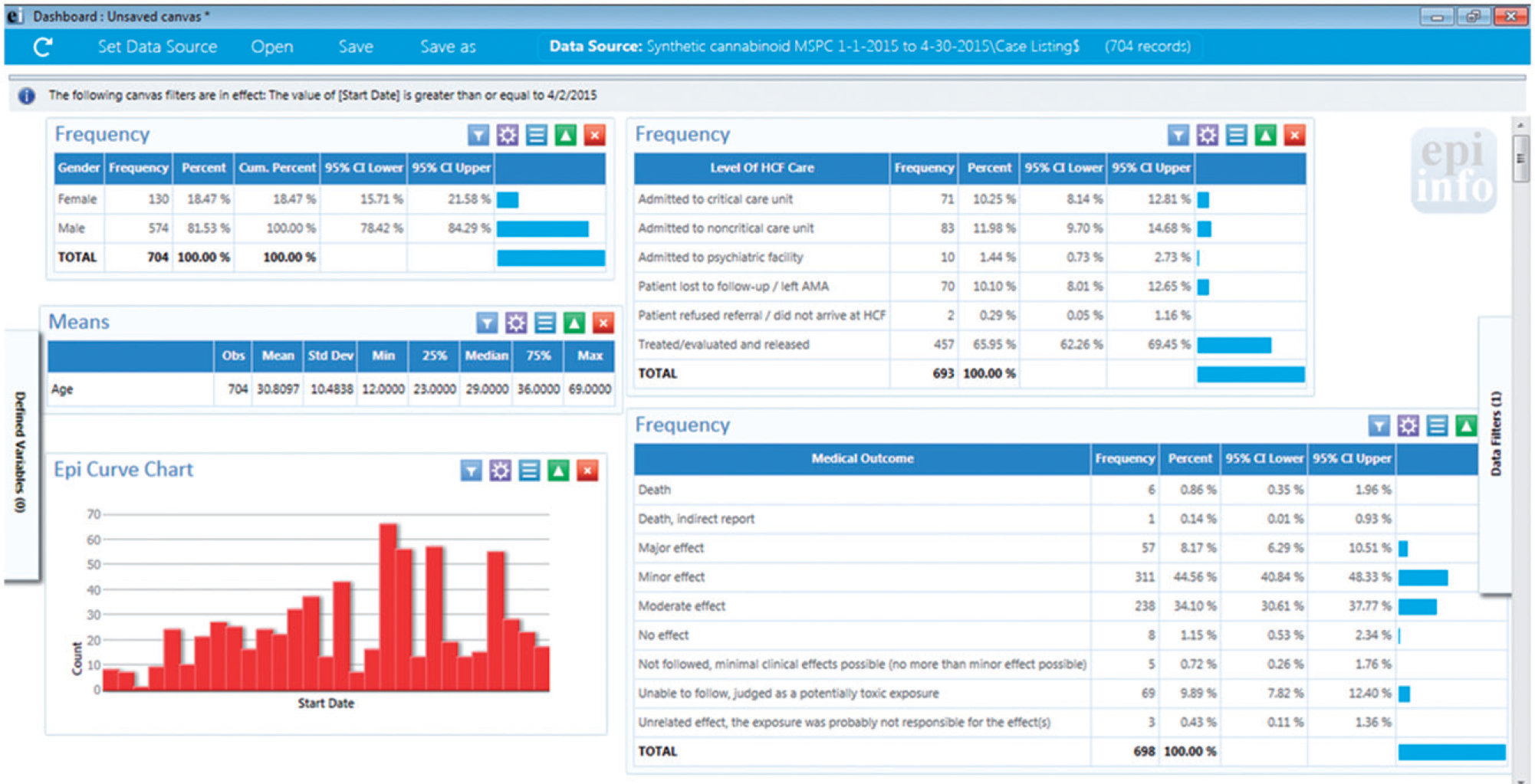
Study objectives: In April 2015, a multistate outbreak of illness linked to synthetic cannabinoid (SC) use was unprecedented in magnitude and severity. We identified Mississippi cases in near-real time, collected information on cases to characterize the outbreak, and identified the causative SC.
Methods: A case was defined as any patient of a Mississippi healthcare facility who was suspected of SC use and presenting with ≥2 of the following symptoms: sweating, severe agitation, or psychosis during April 2-May 3, 2015. Clinicians reported cases to the Mississippi Poison Control Center (MPCC). We used MPCC data to identify cases at the University of Mississippi Medical Center (UMMC) to characterize in further detail, including demographics and clinical findings. Biologic samples were tested for known and unknown SCs by liquid chromatography quadrupole time-of-flight mass spectrometry (LC-QTOF/MS).
Results: Clinicians reported 721 cases (11 deaths) statewide; 119 (17%) were UMMC patients with detailed data for further analysis. Twelve (10%) were admitted to an intensive care unit and 2 (2%) died. Aggression (32%), hypertension (33%), and tachycardia (42%) were common. SCs were identified in serum from 39/56 patients (70%); 33/39 patients (85%) tested positive for MAB-CHMINACA (N-(1-amino-3,3-dimethyl-1-oxobutan-2-yl)-1-(cyclohexylmethyl)-1H-indazole-3-carboxamide) or its metabolites. Compared to all patients tested for SCs, those positive for MAB-CHMINACA were more likely to have altered mental status on examination (OR = 3.3, p = .05).
Conclusion: SC use can cause severe health effects. MAB-CHMINACA was the most commonly detected SC in this outbreak. As new SCs are created, new strategies to optimize surveillance and patient care are needed to address this evolving public health threat.
Keywords: Drugs of abuse; epidemiology; outbreak investigation; poison centers; synthetic cannabinoids.
Figures




References
-
- Ciolino LA. Quantitation of synthetic cannabinoids in plant materials using high performance liquid chromatography with UV detection (validated method). J Forensic Sci. 2015;60:1171–1181. - PubMed
-
- DrugFacts: high school and youth trends. National Institute on Drug Abuse website [cited 2016 Jul 20]. Available from: https://www.drugabuse.gov/publications/drugfacts/high-school-youth-trends.
-
- Every-Palmer S Synthetic cannabinoid JWH-018 and psychosis: an explorative study. Drug Alcohol Depend. 2011;117:152–157. - PubMed
MeSH terms
Substances
Grants and funding
LinkOut - more resources
Full Text Sources
Other Literature Sources
Medical
Research Materials
Miscellaneous
