Randomized Controlled Trial
. 2019 Apr 1;27(2):191-197.
doi: 10.1123/japa.2018-0093. Epub 2019 Jan 20.

2,000 Steps/Day Does Not Fully Protect Skeletal Muscle Health in Older Adults During Bed Rest

Randomized Controlled Trial

2,000 Steps/Day Does Not Fully Protect Skeletal Muscle Health in Older Adults During Bed Rest

Emily Arentson-Lantz et al. J Aging Phys Act. .

Abstract

Physical activity in an inpatient setting is often limited to brief periods of walking. For healthy adults, public health agencies recommend a minimum of 150 min/week of moderate-intensity exercise. The authors sought to determine if meeting this activity threshold, in the absence of incidental activities of daily living, could protect skeletal muscle health during bed rest. Healthy older adults (68 ± 2 years) were randomized to 7-day bed rest with (STEP, n = 7) or without (CON, n = 10) a 2,000 steps/day intervention. Performing 2018 ± 4 steps/day did not prevent the loss of lean leg mass and had no beneficial effect on aerobic capacity, strength, or muscle fiber volume. However, the insulin response to an oral glucose challenge was preserved. Performing a block of 2,000 steps/day, in the absence of incidental activities of daily living, was insufficient to fully counter the catabolic effects of bed rest in healthy older adults.

Keywords: atrophy; inactivity; muscle function; physical activity.


Figures
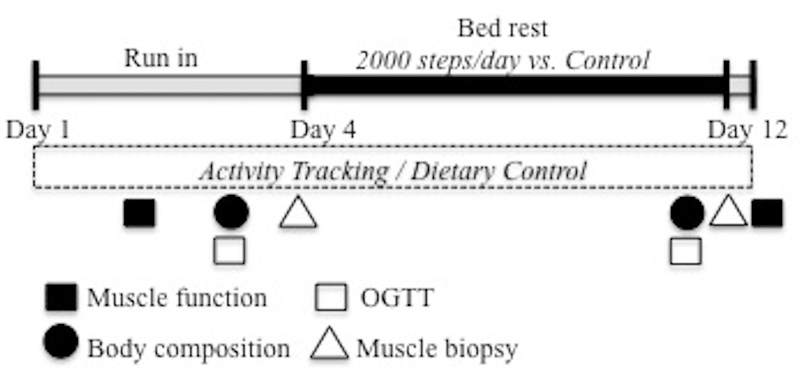
Figure. 1.
Figure. 1.
Study timeline. The 3 d ambulatory, run-in included baseline testing of dependent measures, activity tracking and dietary control. During the 7 d bed rest phase, subjects were randomized to 2000 steps/day (STEP) or bed rest alone (CON). Dependent measures were re-assessed on day 10–12. Subjects were encouraged to minimize physical activity between completion of bed rest on the afternoon of day 11 and completion of muscle function testing on day 12.
Figure 2.
Figure 2.
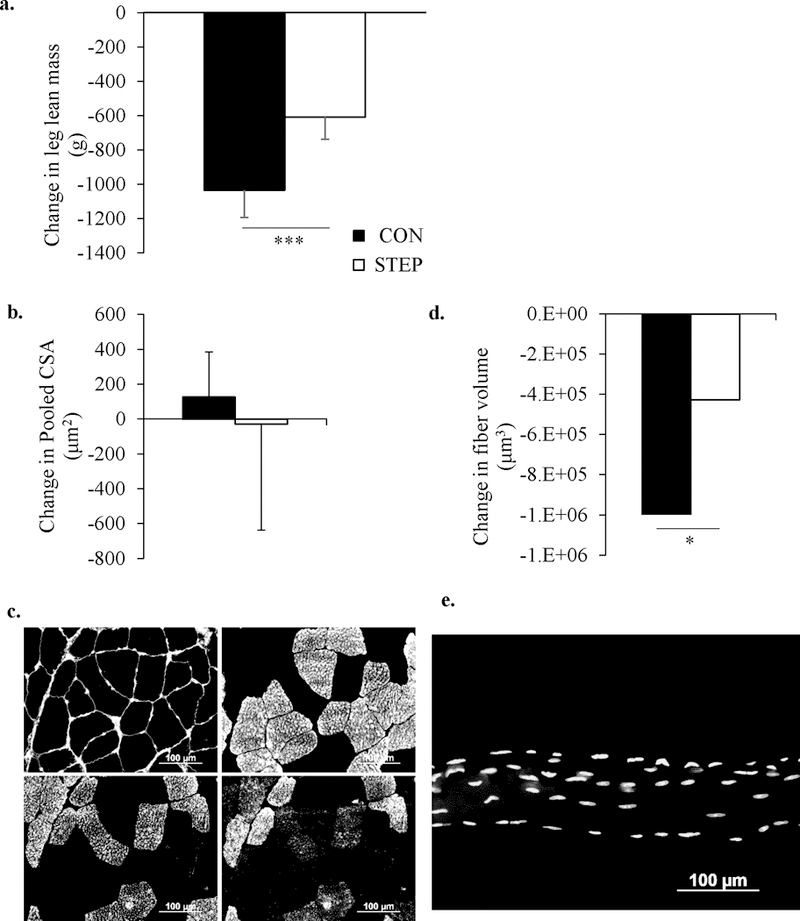
Seven days of bed rest significantly decreased leg lean mass (a) and muscle fiber volume (d), and was not rescued by 2000 steps a day. However, there was no change in muscle fiber cross sectional area (c) and (e) are representative of images used for muscle fiber cross sectional area (pink fibers = Type 1, green fibers = Type 2a, orange fibers = Type 2a/2x) and single fiber volume (stacked z-stack image, yellow dots represent individual myonuclei), respectively. The 95% confidence interval for fiber volume was (1867292, 4273740). The black bars represent the CON group and the white bars represent the STEP group. * significant difference from pre-bed rest (p < 0.05); *** significant difference from pre-bed rest, (p < 0.001)
Figure 3.
Figure 3.
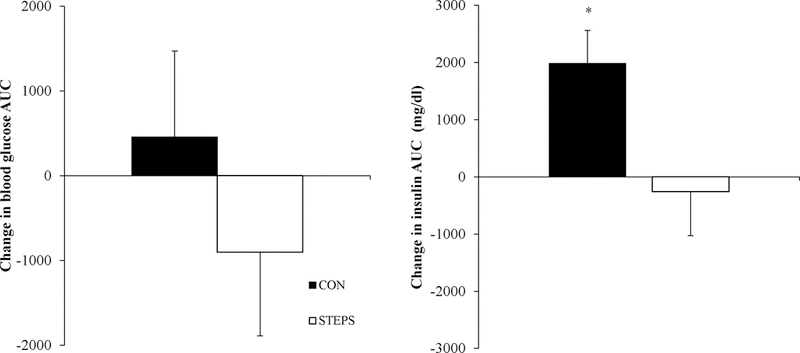
Blood glucose and plasma insulin were measured at baseline (0 min) and 30, 60, 90 and 120 min following a 75 g oral glucose tolerance test and the area under the curve was calculated. There was not significant effect of time or group on glucose AUC. However, there were a main effect of bed rest (p=0.089), group (p=0.025) and an interaction of bed rest x group (p=0.032) on plasma insulin AUC. The control group experienced a significant increase in plasma insulin (p< 0.05) that was not exhibited by the STEP group.

References

    1. Arentson-Lantz EJ, English KL, Paddon-Jones D, & Fry CS (2016). Fourteen days of bed rest induces a decline in satellite cell content and robust atrophy of skeletal muscle fibers in middle-aged adults. J Appl Physiol (1985), 120(8), 965–975. doi:10.1152/japplphysiol.00799.2015 - DOI - PMC - PubMed
    1. Baldwin C, van Kessel G, Phillips A, & Johnston K (2017). Accelerometry Shows Inpatients With Acute Medical or Surgical Conditions Spend Little Time Upright and Are Highly Sedentary: Systematic Review. Phys Ther, 97(11), 1044–1065. doi:10.1093/ptj/pzx076 - DOI - PubMed
    1. Blocker WP Jr. (1992). Maintaining functional independence by mobilizing the aged. Geriatrics, 47(1), 42, 48–50, 53 passim. - PubMed
    1. Breen L, Stokes KA, Churchward-Venne TA, Moore DR, Baker SK, Smith K, . . . Phillips SM (2013). Two weeks of reduced activity decreases leg lean mass and induces “anabolic resistance” of myofibrillar protein synthesis in healthy elderly. J Clin Endocrinol Metab, 98(6), 2604–2612. doi:10.1210/jc.2013-1502 - DOI - PubMed
    1. Chodzko-Zajko WJ, Proctor DN, Fiatarone Singh MA, Minson CT, Nigg CR, Salem GJ, & Skinner JS (2009). American College of Sports Medicine position stand. Exercise and physical activity for older adults. Med Sci Sports Exerc, 41(7), 1510–1530. doi:10.1249/MSS.0b013e3181a0c95c - DOI - PubMed

Publication types

LinkOut - more resources