. 2018 Sep 14;4(9):1385-1394.
doi: 10.1021/acsinfecdis.8b00115. Epub 2018 Jul 23.

Structure-Activity Relationships of the Competence Stimulating Peptide in Streptococcus mutans Reveal Motifs Critical for Membrane Protease SepM Recognition and ComD Receptor Activation

Affiliations

Structure-Activity Relationships of the Competence Stimulating Peptide in Streptococcus mutans Reveal Motifs Critical for Membrane Protease SepM Recognition and ComD Receptor Activation

Chowdhury Raihan Bikash et al. ACS Infect Dis. .

Abstract

Streptococcus mutans ( S. mutans) is a Gram-positive human pathogen that is one of the major contributors to dental caries, a condition with an economic cost of over $100 billion per year in the United States. S. mutans secretes a 21-amino-acid peptide termed the competence stimulating peptide (21-CSP) to assess its population density in a process termed quorum sensing (QS) and to initiate a variety of phenotypes such as biofilm formation and bacteriocin production. 21-CSP is processed by a membrane bound protease SepM into active 18-CSP, which then binds to the ComD receptor. This study seeks to determine the molecular mechanism that ties 21-CSP:SepM recognition and 18-CSP:ComD receptor binding and to identify QS modulators with distinct activity profiles. To this end, we conducted systematic replacement of the amino acid residues in both 21-CSP and 18-CSP and assessed the ability of the mutated analogs to modulate QS. We identified residues that are important to SepM recognition and ComD receptor binding. Our results shed light on the S. mutans competence QS pathway at the molecular level. Moreover, our structural insights of the CSP signal can be used to design QS-based anti-infective therapeutics against S. mutans.

Keywords: Streptococcus mutans; competence stimulating peptide; quorum sensing.


Figures
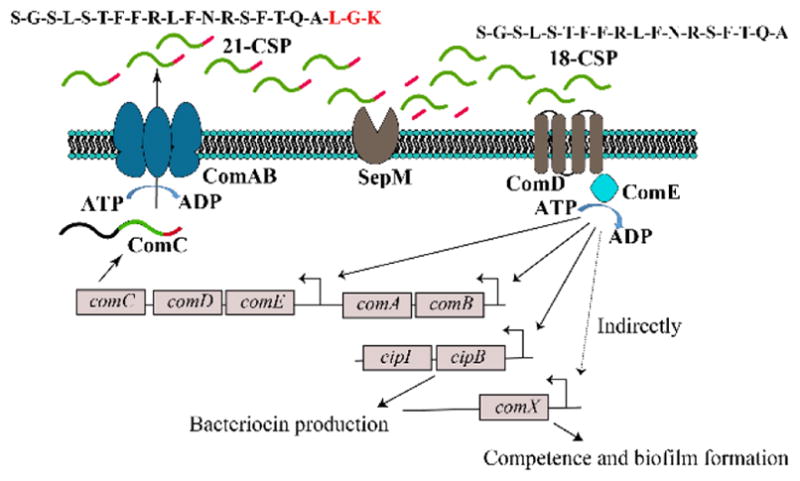
Figure 1
Figure 1
CSP-mediated QS circuit of S. mutans. The CSP pro-peptide, ComC, is processed and secreted by the dedicated ABC transporter (ComAB) as 21-CSP, which is further cleaved by a membrane protease, SepM, to form the active 18-CSP signal. 18-CSP interacts with the cognate transmembrane histidine-kinase receptor ComD, leading to phosphorylation of ComE, a response regulator, and results in autoinduction of the QS circuitry, the production of bacteriocins, and expression of comX, which codes for additional QS-regulated phenotypes.
Figure 2
Figure 2
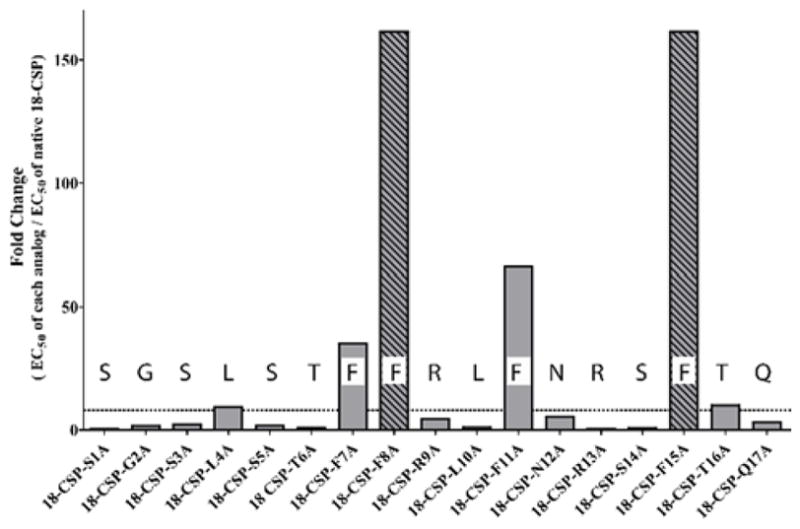
Plot of the ratio of 18-CSP alanine analogs EC50 values divided by the EC50 value of 18-CSP in the SAB249 strain. The plot reveals a periodic sharp reduction in activity every 3–4 residues along the peptide sequence, consistent with an α-helix conformation. Striped bars represent analogs with EC50 values >1,000 nM, thus the EC50 ratio is >160. >8-fold decrease in potency was considered significant (dashed line).
Figure 3
Figure 3
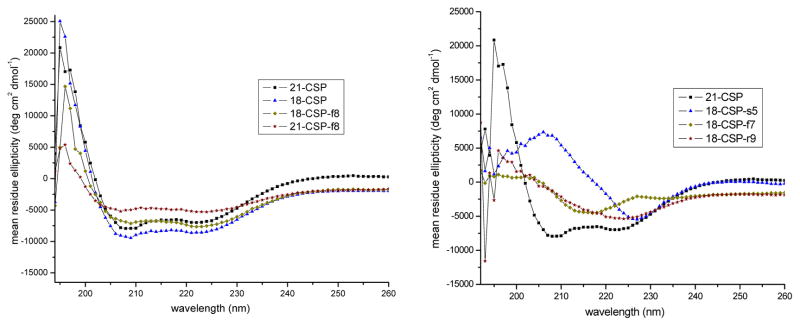
CD spectra of select CSP analogs in membrane mimicking conditions. Both 21-CSP and 18-CSP adopt an α-helix conformation. Similarly, 18-CSP-f8 and 21-CSP-f8 also adopt an α-helix conformation. To the contrary, 18-CSP-s5 adopts a β-turn, while 18-CSP-f7 and 18-CSP-r9 adopt a β-sheet conformation.
Figure 4
Figure 4
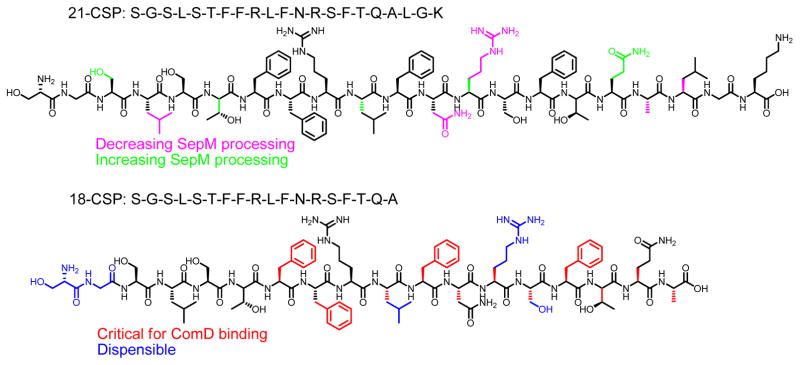
Minimal structural requirements for 21-CSP processing by SepM and 18-CSP binding to the ComD receptor.

References

    1. Ng WL, Bassler BL. Bacterial quorum-sensing network architectures. Annu Rev Genet. 2009;43:197–222. doi: 10.1146/annurev-genet-102108-134304. - DOI - PMC - PubMed
    1. Miller MB, Bassler BL. Quorum sensing in bacteria. Annu Rev Microbiol. 2001;55:165–199. doi: 10.1146/annurev.micro.55.1.165. - DOI - PubMed
    1. Bassler BL. How bacteria talk to each other: regulation of gene expression by quorum sensing. Curr Opin Microbiol. 1999;2:582–587. - PubMed
    1. Rutherford ST, Bassler BL. Bacterial quorum sensing: its role in virulence and possibilities for its control. Cold Spring Harb Perspect Med. 2012;2:a012427. doi: 10.1101/cshperspect.a012427. - DOI - PMC - PubMed
    1. von Bodman SB, Willey JM, Diggle SP. Cell-cell communication in bacteria: united we stand. J Bacteriol. 2008;190:4377–4391. doi: 10.1128/JB.00486-08. - DOI - PMC - PubMed

Publication types

MeSH terms

LinkOut - more resources