Obstructive Sleep Apnea in Cardiac Rehabilitation Patients
- PMID: 29991415
- PMCID: PMC6040801
- DOI: 10.5664/jcsm.7206
Obstructive Sleep Apnea in Cardiac Rehabilitation Patients
Abstract
Study objectives: Although regular physical activity improves obstructive sleep apnea (OSA) in the general population, this finding has not been assessed in postmyocardial infarction (MI) patients in a rehabilitation setting (coronary artery disease, CAD). We aimed to determine whether cardiac rehabilitation may benefit post-MI patients in terms of OSA disease and associated autonomic nervous system (ANS) activity.
Methods: Consecutive post-MI patients participating in the ambulatory cardiac rehabilitation program of St-Etienne University Hospital were included in this study. The apnea-hypopnea index calculated from electrocardiogram (ECG)-derived respiration (AHIEDR) was obtained through nocturnal Holter ECG recordings. According to AHIEDR, patients were classified as normal, mild, moderate, or severe OSA (< 5, 5-14, 15-29, ≥ 30, respectively). Physiological performance (peak VO2) was established via cardiopulmonary exercise testing. ANS activity was evaluated through spontaneous baroreflex sensibility as well as heart rate variability analysis.
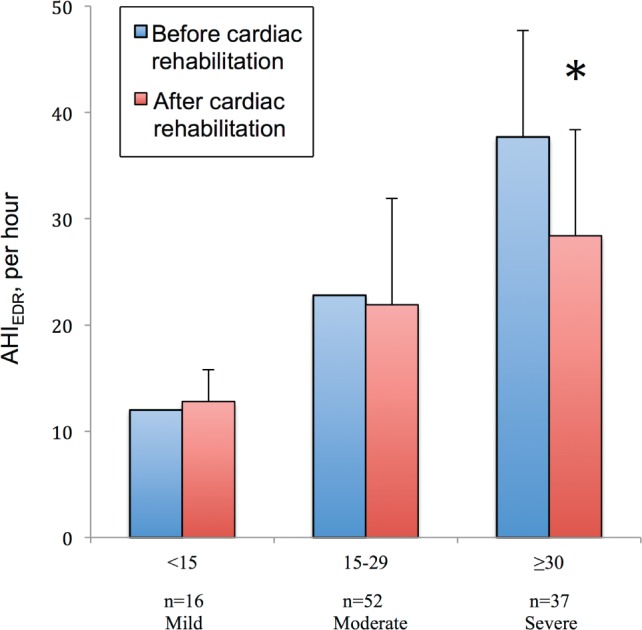
Results: Of the 105 patients with CAD and OSA included (95 men, 55.2 ± 12.4 years), 100 had at least 1 cardiovascular risk factor (98%) and 52 patients (50%) had an ANS dysfunction. Surprisingly, 68 of these patients with OSA (65%) were free of classical diurnal symptoms usually associated with sleep apnea. In response to cardiac rehabilitation, AHIEDR decreased significantly (-9.3 ± 9.5, P < .0001) only in patients with severe OSA, and the decrease was even greater when peak VO2 and baroreflex sensibility improved beyond 20% compared to basal values (-11.6 ± 9.1, P < .001).
Conclusions: Severe OSA in patients with CAD is significantly improved after 2 months of cardiopulmonary rehabilitation. Reviving ANS activity through physical activity might be a target for complementary therapy of OSA in patients with CAD.
Keywords: autonomic nervous system; cardiac rehabilitation; coronary artery disease; obstructive sleep apnea; physical activity.
© 2018 American Academy of Sleep Medicine.
Figures

References
-
- Mehra R, Rodriguez K, Kirchner HL, Strohl KP. Sleep apnea in acute coronary syndrome: high prevalence but low impact on 6-month outcome. Sleep Med. 2006;7(6):521–528. - PubMed
-
- Ben Ahmed H, Boussaid H, Hamdi I, Boujnah MR. Prevalence and predictors of obstructive sleep apnea in patients admitted for acute myocardial infarction. Ann Cardiol Angeiol. 2014;63(2):65–70. - PubMed
-
- Coughlin SR, Mawdsley L, Mugarza JA, Calverley PM, Wilding JP. Obstructive sleep apnoea is independently associated with an increased prevalence of metabolic syndrome. Eur Heart J. 2004;25(9):735–741. - PubMed
-
- Marin JM, Carrizo SJ, Vicente E, Agusti AG. Long-term cardiovascular outcomes in men with obstructive sleep apnoea-hypopnoea with or without treatment with continuous positive airway pressure: an observational study. Lancet. 2005;365(9464):1046–1053. - PubMed
-
- Sin DD, Mayers I, Man GCW, Pawluk L. Long-term compliance rates to continuous positive airway pressure in obstructive sleep apnea: A population-based study. Chest. 2002;121(2):430–435. - PubMed
MeSH terms
LinkOut - more resources
Full Text Sources
Other Literature Sources
Medical
Miscellaneous