


Altered monocyte phenotypes but not impaired peripheral T cell immunity may explain susceptibility of the elderly to develop tuberculosis
- PMID: 29991459
- PMCID: PMC6119637
- DOI: 10.1016/j.exger.2018.06.029
Altered monocyte phenotypes but not impaired peripheral T cell immunity may explain susceptibility of the elderly to develop tuberculosis
Abstract
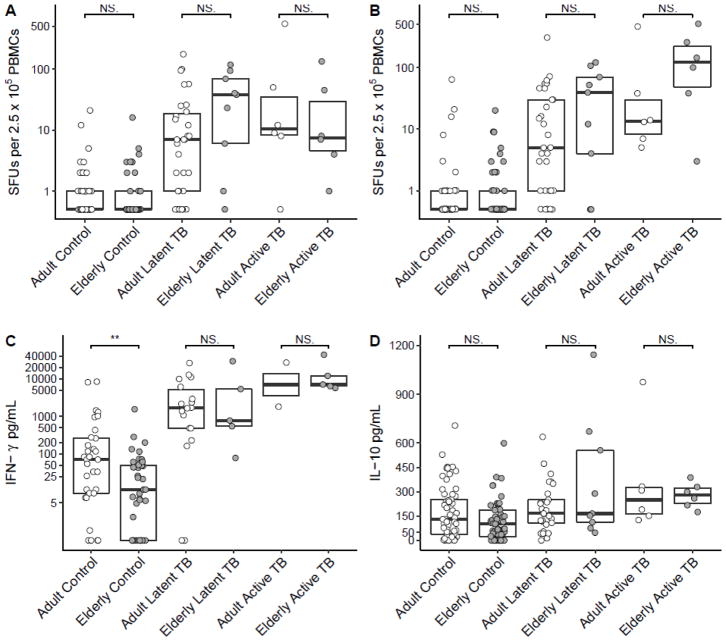
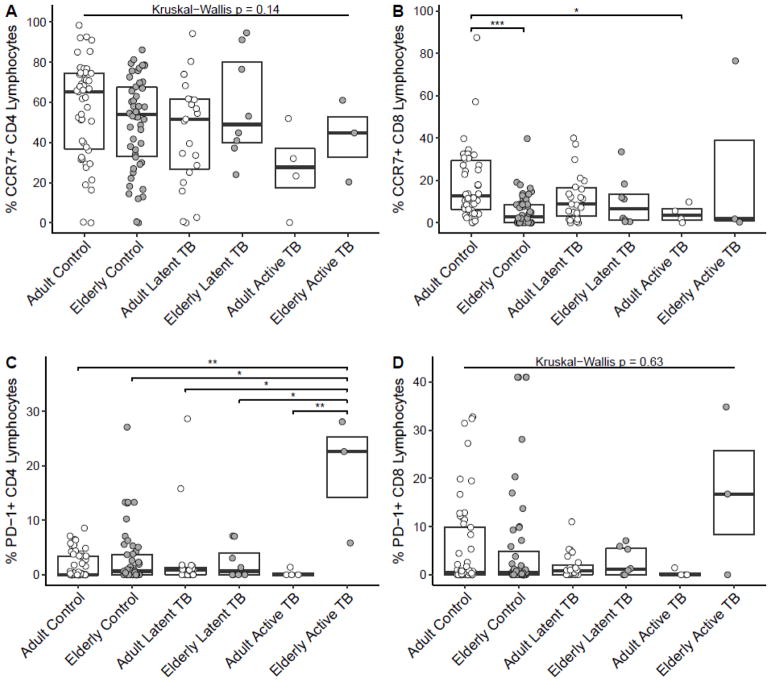
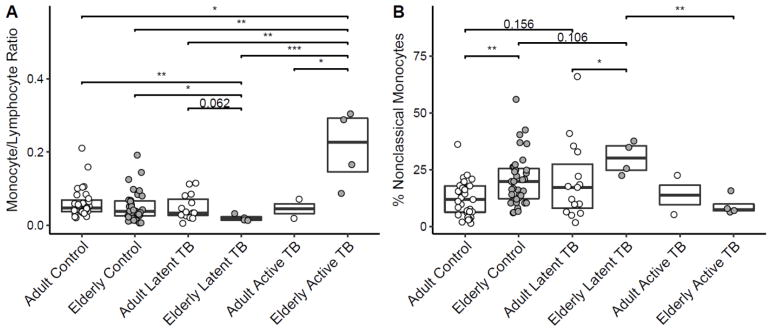
Tuberculosis (TB) is the leading killer due to a single infectious disease worldwide. With the aging of the global population, the case rate and deaths due to TB are highest in the elderly population. While general immunosenescence associated with old age is thought to contribute to the susceptibility of the elderly to develop active TB disease, very few studies of immune function in elderly individuals with Mycobacterium tuberculosis (M.tb) infection or disease have been performed. In particular, impaired adaptive T cell immunity to M.tb is one proposed mechanism for the elderly's increased susceptibility primarily on the basis of the decreased delayed type hypersensitivity response to tuberculin-purified protein derivative in the skin of elderly individuals. To investigate immunological reasons why the elderly are susceptible to develop active TB disease, we performed a cross-sectional observational study over a five year period (2012-2016) enrolling participants from 2 age groups (adults: 25-44 years; elderly: 65 and older) and 3 M.tb infection statuses (active TB, latent TB infection, and healthy controls without history of M.tb infection). We hypothesized that impaired peripheral T cell immunity plays a role in the biological susceptibility of the elderly to TB. Contrary to our hypothesis, we observed no evidence of impaired M.tb specific T cell frequency or altered production of cytokines implicated in M.tb control (IFN-γ, IL-10) in peripheral blood in the elderly. Instead, we observed alterations in monocyte proportion and phenotype with age and M.tb infection that suggest their potential role in the susceptibility of the elderly to develop active TB. Our results suggest a potential link between the known widespread low-grade systemic inflammation of old age, termed "inflammaging," with the elderly's specific susceptibility to developing active TB. Moreover, our results highlight the need for further research into the biological reasons why the elderly are more susceptible to disease and death from TB, so that public health systems can be better equipped to face the present and future problem of TB in an aging global population.
Keywords: Geriatrics; Immunosenescence; Inflammaging; Monocyte; T cell; Tuberculosis.
Copyright © 2018 The Authors. Published by Elsevier Inc. All rights reserved.
Conflict of interest statement
None.
Figures
References
-
- Adambekov DA, Morozov VL. T-suppressors and their functional activity in tuberculosis in middle-aged and elderly subjects. Probl Tuberk. 1989:32–34. - PubMed
-
- Agius E, Lacy KE, Vukmanovic-Stejic M, Jagger AL, Papageorgiou AP, Hall S, Reed JR, Curnow SJ, Fuentes-Duculan J, Buckley CD, Salmon M, Taams LS, Krueger J, Greenwood J, Klein N, Rustin MHA, Akbar AN. Decreased TNF-α synthesis by macrophages restricts cutaneous immunosurveillance by memory CD4+ T cells during aging. J Exp Med. 2009;206:1929–1940. doi: 10.1084/jem.20090896. - DOI - PMC - PubMed
-
- Balboa L, Romero MM, Basile JI, García CASy, Schierloh P, Yokobori N, Geffner L, Musella RM, Castagnino J, Abbate E, de la Barrera S, Sasiain MC, Alemán M. Paradoxical role of CD16+CCR2+CCR5+ monocytes in tuberculosis: efficient APC in pleural effusion but also mark disease severity in blood. J Leukoc Biol. 2011;90:69–75. doi: 10.1189/jlb.1010577. - DOI - PubMed
Publication types
MeSH terms
Substances
Grants and funding
LinkOut - more resources
Full Text Sources
Other Literature Sources
Medical
