


doi: 10.1038/s41467-018-05175-8.
Non-Hermitian photonics promises exceptional topology of light
Affiliations
- PMID: 29991729
- PMCID: PMC6039517
- DOI: 10.1038/s41467-018-05175-8
Item in Clipboard
Non-Hermitian photonics promises exceptional topology of light
Nat Commun.
.
Abstract
The band degeneracy, either the exceptional point of a non-Hermitian system or the Dirac point associated with a topological system, can feature distinct symmetry and topology. Their synergy will further produce more exotic topological effects in synthetic matter.
Conflict of interest statement
The authors declare no competing interests.
Figures
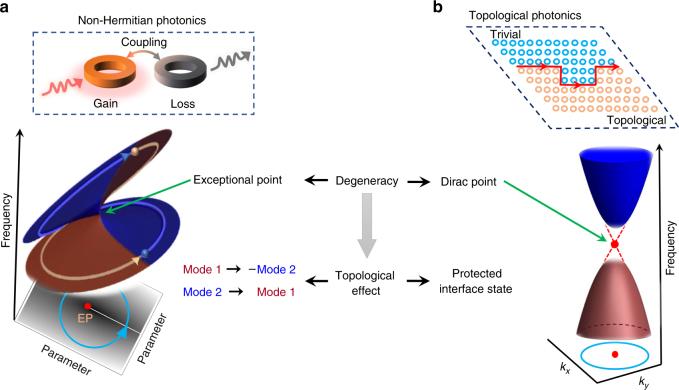
The topology of exceptional point and Dirac point degeneracies. A generic photonic non-Hermitian system is composed of coupled gain and loss materials such as ring resonators (inset of a). An exceptional point (EP) can appear in the frequency spectrum of such a system at some critical values of the coupling and the gain/loss coefficient. The topological properties of a second-order EP are best understood by two Riemann surfaces (shown in blue and brown colours) connected at the square root branch point. The two surfaces represent two eigenfrequencies with complex values. An encircling of the EP can be induced by suitable parameter changes. Starting on the upper surface, one ends up on the lower surface after one round and vice versa (the states move smoothly from one surface to the other). Encircling twice brings one back to the initial point, but the modes acquire a π-Berry phase; after 4 cycles, the modes return to their starting phases. For a non-adiabatic encircling, the states suddenly jump from one surface to the other, leading to different final states depending on the direction of encircling (not shown). A schematic of a topological band structure near the Dirac point degeneracy is shown in (b). The Berry phase, calculated over a closed loop in the Brillion zone, is related to the topological invariant, known as the Chern number. The gapless edge mode (red dashed line) connects the conduction and valence band. Such an edge state propagates along the interfaces formed by topologically different materials (see red line in the inset). Between the panels, we schematically point out the fundamental degeneracies associated with non-Hermitian and topological photonics

Novel functionalities from the interplay between optical non-Hermiticity and topological photonics. a shows the unit cell of a coupled resonator array, with hopping rate κ and onsite gain/loss coefficient γ, which is equivalent to its Hermitian counterpart with a modified coupling . The non-Hermiticity controlled coupling accomplishes the topological phase transition from the trivial to non-trivial band structures via the degeneracy by tuning the gain/loss coefficient as shown in (b). Here C represents the Chern number related to the bulk band. c shows a typical unit cell of a coupled resonator array subjected to a pseudo-spin-dependent imaginary gauge field engineered by an anti-resonance link ring with gain on the lower half and loss on the upper half. This coupling scheme is equivalent to two site resonators with asymmetric hopping rates: the clockwise circulating light hops from left to right with a rate of exp(h), while it hops from right to left with a much smaller rate of exp(−h), where h is the single-pass amplification/attenuation of the lower/upper halves of the link ring. d shows the topological pseudo-spin subbands, subjected to the imaginary gauge field, containing the amplifying propagation state with forward group velocity (orange curve) and the attenuating propagation state with backward group velocity (blue curve). Owing to the imaginary gauge field, only the forward propagation can be observed in real space while the backscattering is absorbed in the link rings, resulting in robust one-way propagation, as shown in (e)
References
-
- Lu L, Joannopoulos JD, Soljačić M. Topological photonics. Nat. Photon. 2014;8:821–829. doi: 10.1038/nphoton.2014.248. - DOI
-
- Feng L, El-Ganainy R, Ge L. Non-Hermitian photonics based on parity-time symmetry. Nat. Photon. 2017;11:752–762. doi: 10.1038/s41566-017-0031-1. - DOI
-
- Berry M. Physics of non-Hermitian degeneracies. Czech. J. Phys. 2004;54:1039–1047. doi: 10.1023/B:CJOP.0000044002.05657.04. - DOI
Publication types
LinkOut - more resources
Full Text Sources
Other Literature Sources
