


Changing of the Genomic Pattern of Salmonella Enteritidis Strains Isolated in Brazil Over a 48 year-period revealed by Whole Genome SNP Analyses
- PMID: 29993044
- PMCID: PMC6041339
- DOI: 10.1038/s41598-018-28844-6
Changing of the Genomic Pattern of Salmonella Enteritidis Strains Isolated in Brazil Over a 48 year-period revealed by Whole Genome SNP Analyses
Abstract
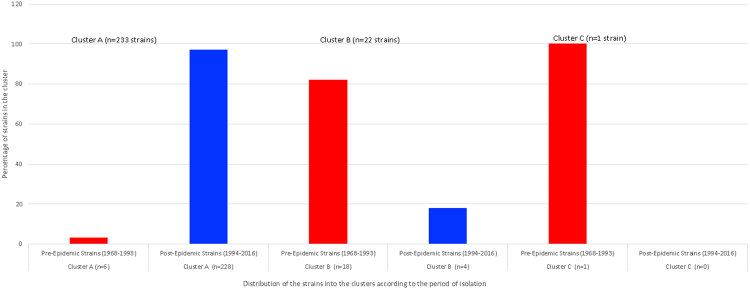
Salmonella Enteritidis became the main serovar isolated from gastroenteritis cases in Brazil after the 90's. In this study we used whole genome sequence analysis to determine the phylogenetic relationships among a collection of strains isolated in Brazil to identify possible genomic differences between the strains isolated in the pre and post-epidemic period. Also, we compared our data from strains isolated in Brazil to strains available in the public domain from other South American countries. Illumina technology was used to sequence the genome of 256 Salmonella Enteritidis strains isolated over a 48 year-period in Brazil, comprising the pre- and post-epidemic period. Phylogenetic analyses revealed distinct lineages for strains isolated before and after 1994. Moreover, the phage region SE20 that may be related to the emergence of Salmonella Enteritidis worldwide was present only in strains of the post-epidemic cluster. In conclusion, our results showed that the genomic profile of Salmonella Enteritidis strains isolated in Brazil shifted after 1994, replaced by a global epidemic group of strains. It may be hypothesized that the presence of the prophage SE20 might have conferred to these strains a better ability to colonize chicken and consequently to infect and cause disease in humans, which might better explain the increase in the number of S. Enteritidis cases in Brazil and other South American countries. However, to verify this hypothesis further studies are needed.
Conflict of interest statement
The authors declare no competing interests.
Figures

References
-
- CDC. An Atlas of Salmonella in the United States, 1968–2011: Laboratory-based Enteric Disease Surveillance. (Atlanta, Georgia, 2013).
Publication types
MeSH terms
LinkOut - more resources
Full Text Sources
Other Literature Sources
