. 2018 Sep;22(9):4460-4473.
doi: 10.1111/jcmm.13745. Epub 2018 Jul 11.

Triggering of cancer cell cycle arrest by a novel scorpion venom-derived peptide-Gonearrestide

Affiliations

Triggering of cancer cell cycle arrest by a novel scorpion venom-derived peptide-Gonearrestide

Bin Li et al. J Cell Mol Med. 2018 Sep.

Abstract

In this study, a novel scorpion venom-derived peptide named Gonearrestide was identified in an in-house constructed scorpion venom library through a combination of high-throughput NGS transcriptome and MS/MS proteome platform. In total, 238 novel peptides were discovered from two scorpion species; and 22 peptides were selected for further study after a battery of functional prediction analysis. Following a series of bioinformatics analysis alongside with in vitro biological functional screenings, Gonearrestide was found to be a highly potent anticancer peptide which acts on a broad spectrum of human cancer cells while causing few if any observed cytotoxic effects on epithelial cells and erythrocytes. We further investigated the precise anticancer mechanism of Gonearrestide by focusing on its effects on the colorectal cancer cell line, HCT116. NGS RNA sequencing was employed to obtain full gene expression profiles in HCT116 cells, cultured in the presence and absence of Gonearrestide, to dissect signalling pathway differences. Taken together the in vitro, in vivo and ex vivo validation studies, it was proven that Gonearrestide could inhibit the growth of primary colon cancer cells and solid tumours by triggering cell cycle arrest in G1 phase through inhibition of cyclin-dependent kinases 4 (CDK4) and up-regulate the expression of cell cycle regulators/inhibitors-cyclin D3, p27, and p21. Furthermore, prediction of signalling pathways and potential binding sites used by Gonearrestide are also presented in this study.

Keywords: MS/MS proteome; NGS transcriptome; anticancer mechanism; binding sites; signalling pathways; venom library.


Figures

Figure 1
Figure 1
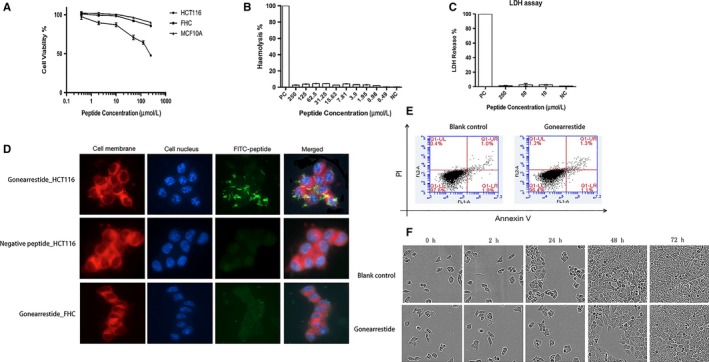
Anti‐proliferative of Gonearrestide. A, Dose‐dependent anti‐proliferative effects of Gonearrestide treated on human cancer cell lines HCT116 and human normal cell lines MCF10A, FHC after 24 h of incubation (n = 15). The growth inhibition of cells at each peptide concentration was calculated as a percentage of the growth observed in controls, which was treated as 100%. B, Haemolytic activity of Gonearrestide with gradient concentrations on human red blood cells. Haemolysis was calculated as a percentage compared with positive control (add Triton X‐100), which was treated as positive control (n = 15). C, LDH release of Gonearrestide with gradient concentrations on cancer cell HCT116. LDH release was calculated as a percentage compared with positive control (add Triton X‐100), which was treated as 100% (n = 15). D, Cellular location of FITC‐labelled peptide binding on human cell lines. (Confocal microscope with 63X/oil magnification) E, Apoptosis result of Gonearrestide on HCT116 using flow cytometry. Blank control group was cells without adding peptide. F, Inhibition effect of Gonearrestide working on human colon cancer cell line HCT116 generated by IncuCyte live cell imaging system. Blank control group was cells treated with equal amount of PBS (n = 15)
Figure 2
Figure 2
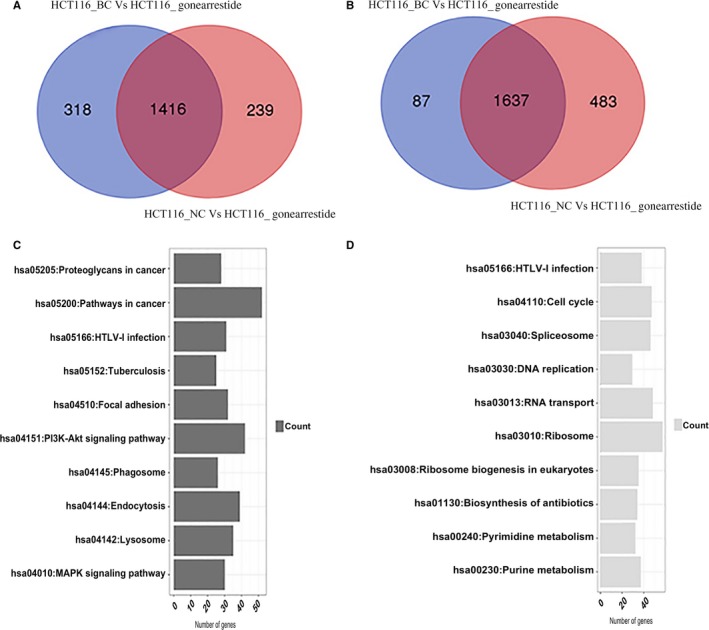
Comparison results and function/pathway annotation of HCT116_BC vs HCT116_Gonearrestide set and HCT116_NC vs HCT116_Gonearrestide set. A, Up‐regulated genes. B, Down‐regulated genes. C, Top 10 up‐regulated pathways. D, Top 10 down‐regulated pathways
Figure 3
Figure 3
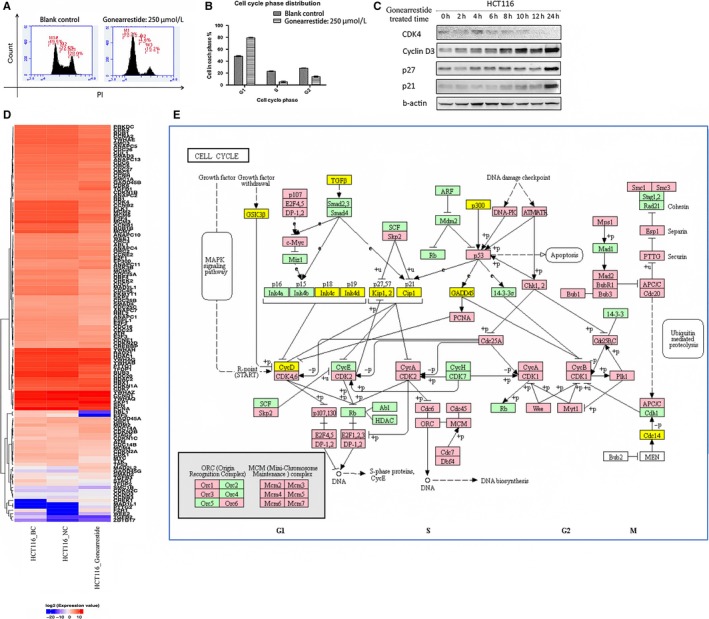
Cell cycle assay results. A, Cell cycle phase distribution of Gonearrestide on human colon cancer cell line HCT116 after 24 h of incubation using flow cytometry. B, Calculated percentage of cells in each phase (n = 9). C, Cell cycle‐related proteins regulated by Gonearrestide on HCT116. Time‐point “0 h” was blank control group treated with equal amount of PBS. D, Heat map of cell cycle‐related genes. E, Cell cycle checkpoint control‐related pathways (yellow indicating up‐regulated genes and red indicating down‐regulated genes)
Figure 4
Figure 4
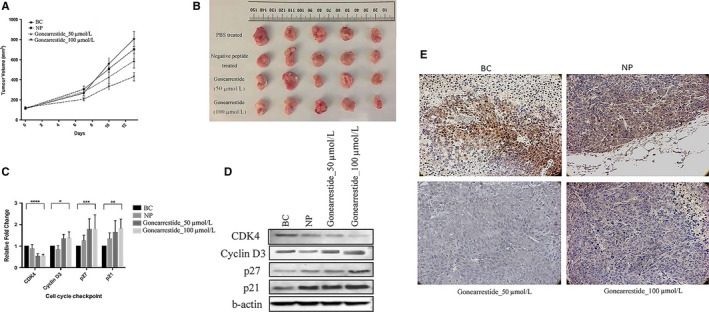
In vivo anticancer activity of Gonearrestide on HCT116 xenograft model (n = 5). A, Tumour volume growth curve after peptide treatment. B, Mice tumour tissues after sacrifice. C, Relative fold change of cell cycle‐related genes regulated by Gonearrestide on mice tumour. The levels of significance are: *< .05; **< .01; ***< .001; ****< .001. D, Western blot results of cell cycle checkpoints proteins regulated by Gonearrestide on mice tumour. E, Immunohistochemical analysis of paraffin‐embedded mice tumour tissue sections using cell cycle checkpoints antibody CDK4 (1:100), noted that CDK4 was dysregulated
Figure 5
Figure 5
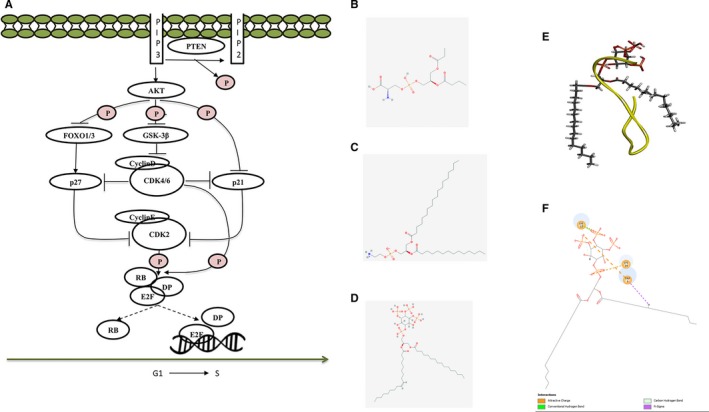
Predicted signalling pathways and potential binding site. A, Predicted signalling pathways involved in cell cycle progress of colon cancer HCT116 treated with Gonearrestide. Noted that the regulated genes were identified by RNA‐seq, among which p27, p21, CDK4/6 and Cyclin D3 were evaluated by Western bolt. B‐D, 2D structures of PS, PE and PIP3. E, Peptide‐lipid interactions between Gonearrestide and PIP3 lipid molecular generated through C‐DOCKER. F, 2D diagram of the peptide‐lipid interaction, which shows the electrostatic interaction between Gonearrestide and PIP3

References

    1. Burstein HJ. Side effects of chemotherapy. J Clin Oncol. 2000;18:693‐693. - PubMed
    1. Ferlay J, Soerjomataram I, Dikshit R, et al. Cancer incidence and mortality worldwide: sources, methods and major patterns in GLOBOCAN 2012. Int J Cancer. 2015;136:E359‐E386. - PubMed
    1. Onishi AC, Hincker AM, Lee FY. Surmounting chemotherapy and radioresistance in chondrosarcoma: molecular mechanisms and therapeutic targets. Sarcoma. 2011;2011:381564. - PMC - PubMed
    1. Bonavida B. Sensitization of Cancer Cells for Chemo/immuno/radio‐therapy. Totowa, NJ: Springer Science & Business Media; 2008.
    1. Escoubas P, Quinton L, Nicholson GM. Venomics: unravelling the complexity of animal venoms with mass spectrometry. J Mass Spectrom. 2008;43:279‐295. - PubMed

Publication types

MeSH terms