


Tolerance induction in hemophilia: innovation and accomplishments
- PMID: 29994897
- PMCID: PMC10546904
- DOI: 10.1097/MOH.0000000000000446
Tolerance induction in hemophilia: innovation and accomplishments
Abstract
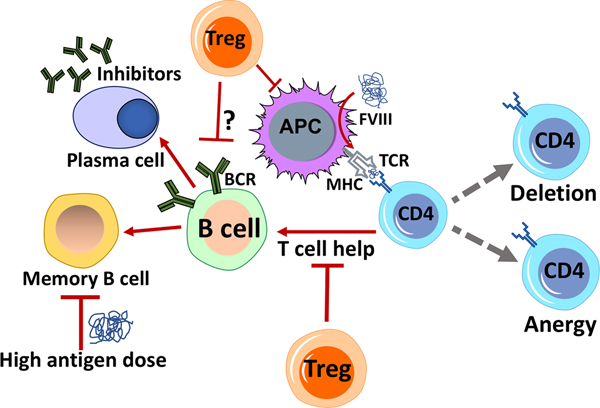
Purpose of review: Hemophilia is an X-linked blood coagulation genetic disorder, which can cause significant disability. Replacement therapy for coagulation factor VIII (hemophilia A) or factor IX (hemophilia B) may result in the development of high-affinity alloantibodies ('inhibitors') to the replacement therapy, thus making it ineffective. Therefore, there is interest in directing immunological responses towards tolerance to infused factors.
Recent findings: In this review, we will discuss latest advancements in the development of potentially less immunogenic replacement clotting factors, optimization of current tolerance induction protocols (ITI), preclinical and clinical data of pharmacological immune modulation, hepatic gene therapy, and the rapidly advancing field of cell therapies. We will also evaluate publications reporting data from preclinical studies on oral tolerance induction using chloroplast-transgenic (transplastomic) plants.
Summary: Until now, no clinical prophylactic immune modulatory protocol exists to prevent inhibitor formation to infused clotting factors. Recent innovative technologies provide hope for improved eradication and perhaps even prevention of inhibitors.
Conflict of interest statement
Figures

References
-
- Young G: New challenges in hemophilia: long-term outcomes and complications. Hematology Am Soc Hematol Educ Program 2012, 2012:362–368. - PubMed
-
- Stonebraker JS, Bolton-Maggs PH, Michael Soucie J, Walker I, Brooker M: A study of variations in the reported haemophilia B prevalence around the world. Haemophilia 2012, 18:e91–94. - PubMed
-
- White GC 2nd, Rosendaal F, Aledort LM, Lusher JM, Rothschild C, Ingerslev J, Factor V, Factor IXS: Definitions in hemophilia. Recommendation of the scientific subcommittee on factor VIII and factor IX of the scientific and standardization committee of the International Society on Thrombosis and Haemostasis. Thromb Haemost 2001, 85:560. - PubMed
-
- Kempton CL, Meeks SL: Toward optimal therapy for inhibitors in hemophilia. Blood 2014, 124:3365–3372. - PubMed
Publication types
MeSH terms
Substances
Grants and funding
LinkOut - more resources
Full Text Sources
Other Literature Sources
Medical
Miscellaneous
