


Effects of dietary energy levels on rumen bacterial community composition in Holstein heifers under the same forage to concentrate ratio condition
- PMID: 29996759
- PMCID: PMC6042446
- DOI: 10.1186/s12866-018-1213-9
Effects of dietary energy levels on rumen bacterial community composition in Holstein heifers under the same forage to concentrate ratio condition
Abstract
Background: The rumen bacterial community plays a critical role in feeds degradation and productivity. The effects of different forage to concentrate ratios on the ruminal microbial population structure have been studied extensively; however, research into changes in the ruminal bacterial community composition in heifers fed different energy level diets, with the same forage to concentrate ratio, has been very limited. The purpose of this study was to investigate the effects of different dietary energy levels, with the same forage to concentrate ratio, on ruminal bacterial community composition of heifers. Furthermore, we also determine the relationship between rumen bacteria and ruminal fermentation parameters.
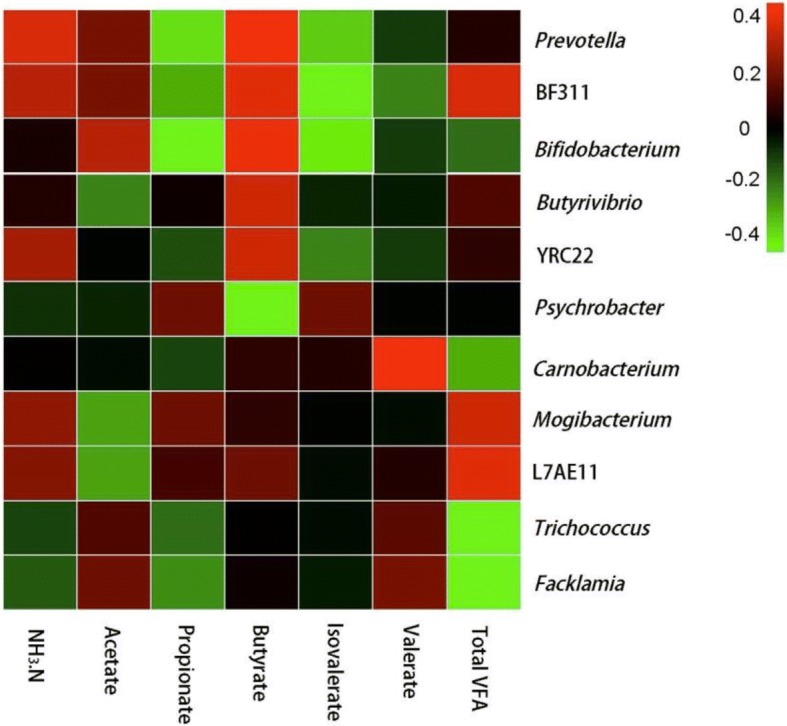
Results: The 16S rRNA gene sequencing showed that, under the same forage to concentrate ratio of 50:50, an 8% difference in dietary energy level had no significant impact on the alpha diversity and the relative abundance of the major phyla and most of the major genera in heifers. In all the treatments groups, Firmicutes, Bacteroidetes, and Proteobacteria were the dominant phyla. Spearman correlation analysis between the relative abundances of the rumen bacteria at the genus level and the fermentation parameters showed that the relative abundances of Prevotella and BF311 were positively correlated with the ammonia nitrogen and butyrate concentrations, and these two genera were negatively correlated with the propionate and isovalerate concentrations, respectively, and the genus Bifidobacterium was positively correlated with the butyrate concentration and was negatively correlated with propionate and isovalerate concentration. The total volatile fatty acid concentration was positively correlated with BF311 abundances, and was negatively correlated with Trichococcus and Facklamia abundances.
Conclusions: Under the same forage to concentrate ratio condition of 50:50, an 8% difference in dietary energy levels had little impact on rumen bacterial community composition in heifers. The correlations between some genera of ruminal bacteria and the concentrations of volatile fatty acids and ammonia nitrogen might be indicative that the ruminal fermentation parameters are strongly influenced by the rumen bacterial community composition.
Keywords: Dietary energy level; Forage to concentrate ratio; Heifer; Rumen bacterial community; Sequencing.
Conflict of interest statement
Authors’ information
Key Laboratory of Feed Biotechnology of the Ministry of Agriculture, Feed Research Institute, Chinese Academy of Agricultural Sciences, Beijing, BJ, China.
Ethics approval and consent to participate
The experimental procedures used in this study were approved by the Animal Ethics Committee of the Chinese Academy of Agricultural Sciences.
Consent for publication
Not applicable.
Competing interests
The authors declare that they have no competing interests.
Publisher’s Note
Springer Nature remains neutral with regard to jurisdictional claims in published maps and institutional affiliations.
Figures

References
-
- Hobson P, Stewart C. The rumen microbial ecosystem. London: Blackie Academic and Professional; 1997.
-
- Vlkova E, Trojanova I, Rada V. Distribution of bifidobacteria in the gastrointestinal tract of calves. Folia Microbiol. 2006;51(4):325–8. - PubMed
Publication types
MeSH terms
Substances
LinkOut - more resources
Full Text Sources
Other Literature Sources
