Review
. 2018 Jul 11;13(1):114.
doi: 10.1186/s13023-018-0856-9.

Alpha-1 antitrypsin deficiency: outstanding questions and future directions

Affiliations
Review

Alpha-1 antitrypsin deficiency: outstanding questions and future directions

María Torres-Durán et al. Orphanet J Rare Dis. .

Abstract

Background: Alpha-1 antitrypsin deficiency (AATD) is a rare hereditary condition that leads to decreased circulating alpha-1 antitrypsin (AAT) levels, significantly increasing the risk of serious lung and/or liver disease in children and adults, in which some aspects remain unresolved.

Methods: In this review, we summarise and update current knowledge on alpha-1 antitrypsin deficiency in order to identify and discuss areas of controversy and formulate questions that need further research.

Results: 1) AATD is a highly underdiagnosed condition. Over 120,000 European individuals are estimated to have severe AATD and more than 90% of them are underdiagnosed.

Conclusions: 2) Several clinical and etiological aspects of the disease are yet to be resolved. New strategies for early detection and biomarkers for patient outcome prediction are needed to reduce morbidity and mortality in these patients; 3) Augmentation therapy is the only specific approved therapy that has shown clinical efficacy in delaying the progression of emphysema. Regrettably, some countries reject registration and reimbursement for this treatment because of the lack of larger randomised, placebo-controlled trials. 4) Alternative strategies are currently being investigated, including the use of gene therapy or induced pluripotent stem cells, and non-augmentation strategies to prevent AAT polymerisation inside hepatocytes.

Keywords: Alpha-1 antitrypsin; Alpha-1 antitrypsin deficiency; Augmentation therapy; COPD; Cirrhosis; Panniculitis; Rare respiratory diseases; SERPINA1; Vasculitis.


Conflict of interest statement

Ethics approval and consent to participate

Not applicable.

Consent for publication

Not applicable.

Competing interests

Drs. María Torres-Durán, Silvia Castillo, Amparo Escribano, María Mercedes Navarro García, Daniel Pellicer, Lucía Bañuls, Francisco Casas and Francisco Dasí report no disclosures.

Dr. José Luis López-Campos reports personal fees and non-financial support from Grifols, during the conduct of the study.

Dr. Miriam Barrecheguren reports personal fees from Menarini, personal fees from GlaxoSmithKline, personal fees from Gebro pharme, personal fees from Novartis, personal fees from Grifols, outside the submitted work.

Dr. Miravitlles reports personal fees from Boehringer Ingelheim, AstraZeneca, Chiesi, GlaxoSmithKline, Menarini, Teva, Grifols and Novartis, personal fees from Bayer Schering, Boehringer Ingelheim, GlaxoSmithKline, Gebro Pharma, CLS Behring, Cipla, MediImmune, Mereo Biopharma, Teva, Novartis and Grifols, outside the submitted work.

Dr. Martinez-Delgado reports grants from Ministerio de Economía y Competitividad. ISCIII. (Spain), other from Registro Español de pacientes con Deficit de alfa-1 antitripsina (REDAAT). Fundación Española de Pulmón, during the conduct of the study.

Dr. Baloira reports personal fees and non-financial support from GRIFOLS during the conduct of the study.

Publisher’s Note

Springer Nature remains neutral with regard to jurisdictional claims in published maps and institutional affiliations.

Figures
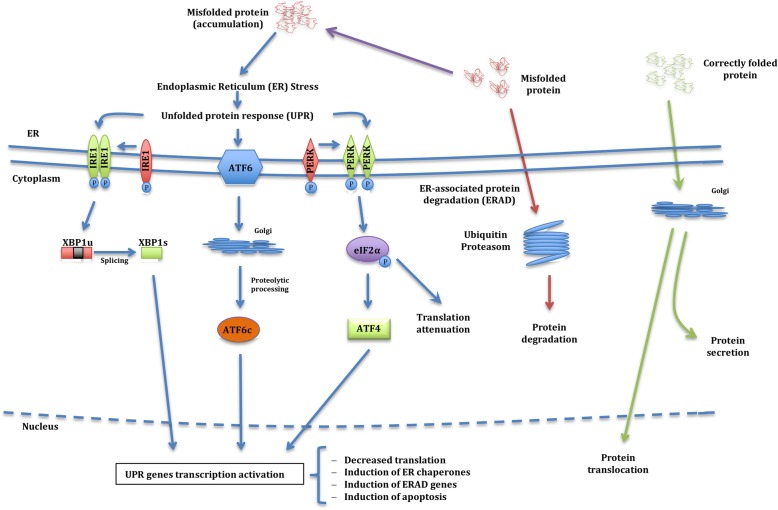
Fig. 1
Fig. 1
Endoplasmic reticulum (ER) stress and the unfolded protein response (UPR) initiation. Properly folded proteins (Green arrows) are processed at the Golgi apparatus and then translocated to their destination sites. Misfolded proteins (Red arrows) are retained in the ER lumen and are degraded by the ER-associated protein degradation machinery (ERAD). Under certain pathological situations misfolded proteins aggregate and accumulate into the ER lumen triggering a condition called ER stress (Blue arrows). In response to ER stress, the cell activates the Unfolded Protein Response (UPR), in which accumulated misfolded proteins are sensed by inositol-requiring enzyme 1 (IRE1), activating factor 6 (ATF6) and protein kinase R-like endoplasmic reticulum kinase (PERK) proteins. IRE1 protein dimerises, auto-phosphorylates and activates its endoribonuclease activity, which removes a small intron of the transcription factor X-box-binding protein 1 (XBP1u) that is then converted in XBP1s which acts as a transcriptional activator. ATF6 is cleaved and activated in the Golgi apparatus to yield a transcription factor (ATF6c) that migrates to the nucleus where activates the transcription of UPR target genes. PERK also dimerises and phosphorylates the eukaryotic translation initiation 2α (eIF2α), which attenuates most translation but stimulates translation of the transcription factor ATF4, which in turn activates genes to protect cells against the ER stress. The UPR signalling consists of four mechanisms: i) decreased translation to prevent further misfolded protein accumulation; ii) induction of ER chaperones to increase folding capacity; iii) induction of ERAD genes to increase degradation of misfolded proteins and iv) induction of apoptosis to remove stressed cells
Fig. 2
Fig. 2
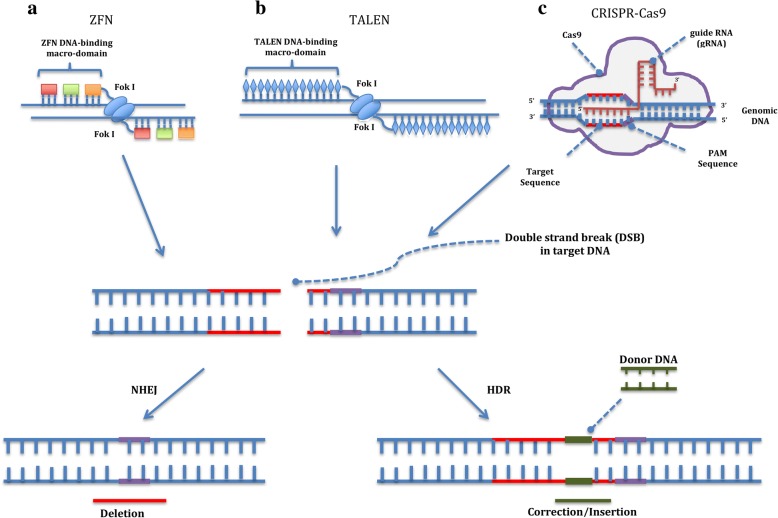
Genome editing with engineered nucleases. Genome editing involves two steps: i) a nuclease is engineered to cleave a specific (target) sequence in the DNA creating a double strand break (DSB); ii) the cell’s ability to repair the DSB by non-homologous end-joining (NHEJ) causes a deletion in the target gene that can result in gene mutation or complete knockout whereas homology-directed repair (HDR) by homologous recombination using a homologous DNA template results in gene correction or insertion depending on the DNA donor structure. There are three main classes of engineered nucleases. a Zinc finger nucleases (ZFNs) consist of a DNA-binding macro-domain designed to target the sequence of interest that is composed of several zinc-fingers each one recognising three nucleotides in the target sequence and linked to the nuclease domain of the FokI restriction enzyme. After dimerisation of two ZFNs in inverse orientation and with an optimal spacing of 5–7 nucleotides, the dimeric FokI cleaves the DNA between the binding sites. b Transcription activator-like effector nucleases (TALENs) have a similar structure to that of ZFNs. The TALEN DNA-binding macro-domain is composed of a tandem array of 34 aminoacids each recognising a single nucleotide. Similarly to ZFNs, TALENs also depend on FoKI activity and dimerisation to create a DSB between the binding sites. c In the CRISPR-Cas9 system, a site-specific DNA cleavage is performed by nuclease Cas9 directed by complementary between an engineered single guide RNA (gRNA) and the target sequence
Fig. 3
Fig. 3
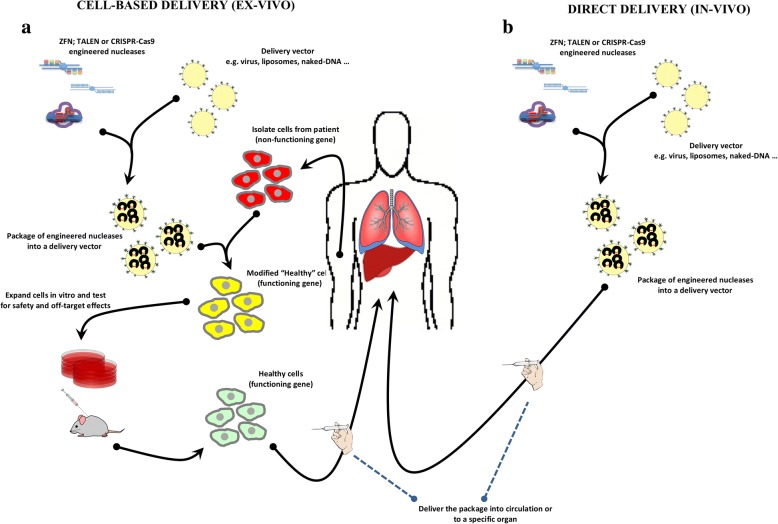
Strategies for delivery of engineered nucleases. a Cell-based (ex-vivo) approach. The therapeutic engineered nucleases are packaged into a delivery vehicle (virus, liposomes, naked-DNA, etc). Cells from patient carrying the mutated non-functioning gene are isolated and transfected with engineered nucleases to correct the mutated gene. Modified “healthy” cells are expanded in vitro and test for safety and off-target effects before being re-administered to the patient. b Direct-delivery (in vivo) approach. In that case, the therapeutic engineered nucleases are packaged into a delivery vehicle (virus, liposomes, naked-DNA, etc) and injected directly into the patient

References

    1. Stoller JK, Aboussouan LS. A review of α1-antitrypsin deficiency. Am J Respir Crit Care Med. 2012;185:246–259. doi: 10.1164/rccm.201108-1428CI. - DOI - PubMed
    1. Stoller JK, Brantly M. The challenge of detecting alpha-1 antitrypsin deficiency. COPD. 2013;10(1):26–34. doi: 10.3109/15412555.2013.763782. - DOI - PubMed
    1. Tan L, Dickens JA, Demeo DL, Miranda E, Perez J, Rashid ST, et al. Circulating polymers in α1-antitrypsin deficiency. Eur Respir J. 2014;43:1501–1504. doi: 10.1183/09031936.00111213. - DOI - PubMed
    1. Elliott PR, Stein PE, Bilton D, Carrell RW, Lomas DA. Structural explanation for the deficiency of S alpha 1-antitrypsin. Nat Struct Biol. 1996;3:910–911. doi: 10.1038/nsb1196-910. - DOI - PubMed
    1. Mahadeva R, Chang WS, Dafforn TR, Oakley DJ, Foreman RC, Calvin J, et al. Heteropolymerization of S, I, and Z alpha1-antitrypsin and liver cirrhosis. J Clin Invest. 1999;103:999–1006. doi: 10.1172/JCI4874. - DOI - PMC - PubMed

Publication types

MeSH terms

Substances