


Patterns of leisure-time physical activity across pregnancy and adverse pregnancy outcomes
- PMID: 29996930
- PMCID: PMC6042402
- DOI: 10.1186/s12966-018-0701-5
Patterns of leisure-time physical activity across pregnancy and adverse pregnancy outcomes
Abstract
Background: Although leisure-time physical activity (PA) contributes to overall health, including pregnancy health, patterns across pregnancy have not been related to birth outcomes. We hypothesized that women with sustained low leisure-time PA would have excess risk of adverse pregnancy outcomes, and that changing patterns across pregnancy (high to low and low to high) may also be related to risk of adverse pregnancy outcomes.
Methods: Nulliparous women (n = 10,038) were enrolled at 8 centers early in pregnancy (mean gestational age in weeks [SD] = 12.05 [1.51]. Frequency, duration, and intensity (metabolic equivalents) of up to three leisure activities reported in the first, second and third trimesters were analyzed. Growth mixture modeling was used to identify leisure-time PA patterns across pregnancy. Adverse pregnancy outcomes (preterm birth, [PTB, overall and spontaneous], hypertensive disorders of pregnancy [HDP], gestational diabetes [GDM] and small-for-gestational-age births [SGA]) were assessed via chart abstraction.
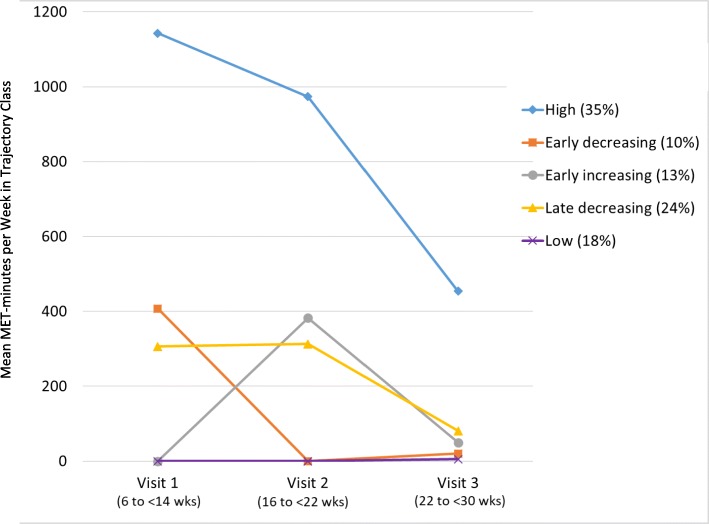
Results: Five patterns of leisure-time PA across pregnancy were identified: High (35%), low (18%), late decreasing (24%), early decreasing (10%), and early increasing (13%). Women with sustained low leisure-time PA were younger and more likely to be black or Hispanic, obese, or to have smoked prior to pregnancy. Women with low vs. high leisure-time PA patterns had higher rates of PTB (10.4 vs. 7.5), HDP (13.9 vs. 11.4), and GDM (5.7 vs. 3.1, all p < 0.05). After adjusting for maternal factors (age, race/ethnicity, BMI and smoking), the risk of GDM (Odds ratio 2.00 [95% CI 1.47, 2.73]) remained higher in women with low compared to high patterns. Early and late decreasing leisure-time PA patterns were also associated with higher rates of GDM. In contrast, women with early increasing patterns had rates of GDM similar to the group with high leisure-time PA (3.8% vs. 3.1%, adjusted OR 1.16 [0.81, 1.68]). Adjusted risk of overall PTB (1.31 [1.05, 1.63]) was higher in the low pattern group, but spontaneous PTB, HDP and SGA were not associated with leisure-time PA patterns.
Conclusions: Sustained low leisure-time PA across pregnancy is associated with excess risk of GDM and overall PTB compared to high patterns in nulliparous women. Women with increased leisure-time PA early in pregnancy had low rates of GDM that were similar to women with high patterns, raising the possibility that early pregnancy increases in activity may be associated with improved pregnancy health.
Trial registration: Registration number NCT02231398 .
Keywords: Gestational diabetes; Physical activity; Pregnancy; Preterm birth.
Conflict of interest statement
Ethics approval and consent to participate
All local institutional review boards approved the study protocol, and participants provided written informed consent prior to enrollment.
Consent for publication
Not applicable.
Competing interests
The authors declare that they have no competing interests.
Publisher’s Note
Springer Nature remains neutral with regard to jurisdictional claims in published maps and institutional affiliations.
Figures
References
-
- Physical Activity Guidelines Advisory Committee . 2018 Physical activity guidelines advisory committee scientific report. Washington, DC: U.S. Department of Health and Human Services; 2018.
Publication types
MeSH terms
Associated data
Grants and funding
- U10-HL120019/GF/International
- U10 HL119989/HL/NHLBI NIH HHS/United States
- U10-HL120018/GF/International
- U10-HL119992/GF/International
- U10 HL120018/HL/NHLBI NIH HHS/United States
- U10-HL119991/NIH NICHHD/International
- U10-HL119989/GF/International
- U10 HL120019/HL/NHLBI NIH HHS/United States
- 10-HL119993/GF/International
- U10 HL120006/HL/NHLBI NIH HHS/United States
- U10-HL120034/GF/International
- U10-HL119992/Office of Behavioral and Social Sciences Research/International
- U10 HL120034/HL/NHLBI NIH HHS/United States
- U10 HL119990/HL/NHLBI NIH HHS/United States
- U10 HL119991/HL/NHLBI NIH HHS/United States
- U10-HL120006/GF/International
- UG1 HD040512/HD/NICHD NIH HHS/United States
- U10-HL119990/GF/International
- U10 HL119992/HL/NHLBI NIH HHS/United States
- UL1TR000153/NIH National Center for Research Resources & The National Center for Advancing Translational Sciences/International
- UL1TR001108/NIH National Center for Research Resources & The National Center for Advancing Translational Sciences/International
- U10 HL119993/HL/NHLBI NIH HHS/United States
- U10-HL119991/NIH NHLBI/International
LinkOut - more resources
Full Text Sources
Other Literature Sources
Medical
