


Different diversification histories in tropical and temperate lineages in the ascomycete subfamily Protoparmelioideae (Parmeliaceae)
- PMID: 29997448
- PMCID: PMC6037653
- DOI: 10.3897/mycokeys.36.22548
Different diversification histories in tropical and temperate lineages in the ascomycete subfamily Protoparmelioideae (Parmeliaceae)
Abstract
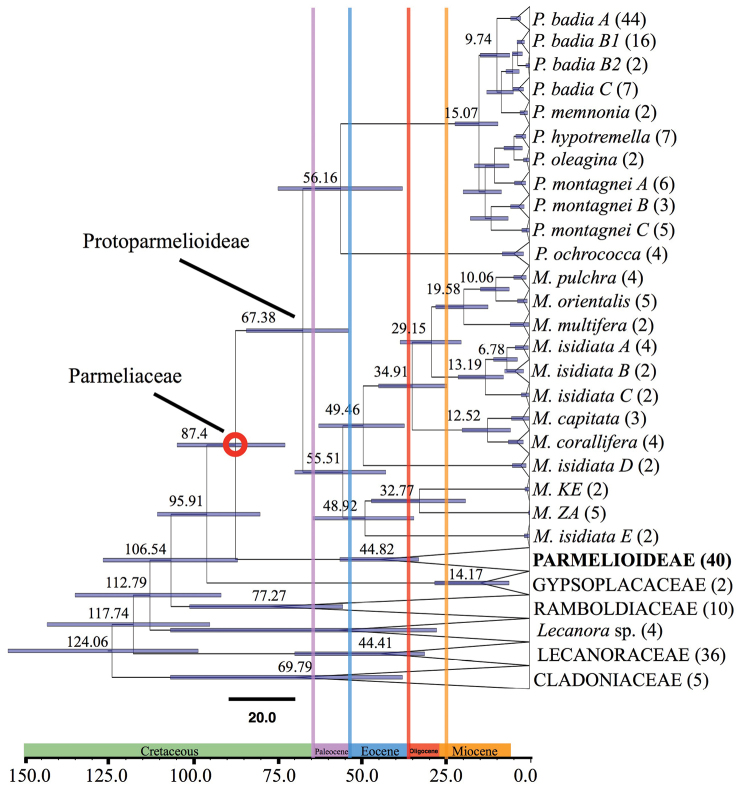
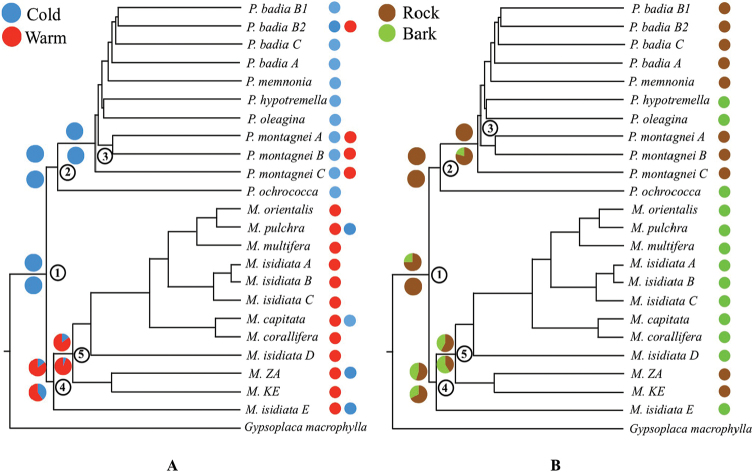
Background: Environment and geographic processes affect species' distributions as well as evolutionary processes, such as clade diversification. Estimating the time of origin and diversification of organisms helps us understand how climate fluctuations in the past might have influenced the diversification and present distribution of species. Complementing divergence dating with character evolution could indicate how key innovations have facilitated the diversification of species. Methods: We estimated the divergence times within the newly recognised subfamily Protoparmelioideae (Ascomycota) using a multilocus dataset to assess the temporal context of diversification events. We reconstructed ancestral habitats and substrate using a species tree generated in *Beast. Results: We found that the diversification in Protoparmelioideae occurred during the Miocene and that the diversification events in the tropical clade Maronina predate those of the extratropical Protoparmelia. Character reconstructions suggest that the ancestor of Protoparmelioideae was most probably a rock-dwelling lichen inhabiting temperate environments. Conclusions: Major diversification within the subtropical/tropical genus Maronina occurred between the Paleocene and Miocene whereas the diversifications within the montane, arctic/temperate genus Protoparmelia occurred much more recently, i.e. in the Miocene.
Keywords: Diversification pattern; ancestral state reconstruction; dating; extra-tropical; habitat; lichenised fungi; mountain uplifts; parallel evolution; substrate.
Figures
References
-
- Amo de Paz G, Cubas P, Divakar PK, Lumbsch HT, Crespo A. (2011) Origin and diversification of major clades in parmelioid lichens (Parmeliaceae, Ascomycota) during the Paleogene inferred by Bayesian analysis. PLoS ONE 6: e28161. https://doi.org/10.1371/journal.pone.0028161 - DOI - PMC - PubMed
-
- Aptroot A, Diederich P, Van Herk CM, Spier L, Wirth V. (1997) Protoparmelia hypotremella, a new sterile corticolous species from Europe, and its lichenicolous fungi. Lichenologist 29: 415–424. https://doi.org/10.1006/lich.1997.0096 - DOI
-
- Arup U, Ekman S, Grube M, Mattsson J-E, Wedin M. (2007) The sister group relation of Parmeliaceae (Lecanorales, Ascomycota). Mycologia 99: 42–49. https://doi.org/10.1080/15572536.2007.11832599 - DOI - PubMed
-
- Bapteste E, Van Iersel L, Janke A, Kelchner S, Kelk S, Mcinerney JO, Morrison DA, Nakhleh L, Steel M, Stougie L, Whitfield J. (2013) Networks: expanding evolutionary thinking. Trends in Genetics 29: 439–441. https://doi.org/10.1016/j.tig.2013.05.007 - DOI - PubMed
-
- Cattin L, Schuerch J, Salamin N, Dubey S. (2016) Why are some species older than others? A large-scale study of vertebrates. BMC Evolutionary Biology 16: 90. https://doi.org/10.1186/s12862-016-0646-8. https://doi.org/10.1186/s12862-016-0646-8 - DOI - DOI - PMC - PubMed
LinkOut - more resources
Full Text Sources
Other Literature Sources
Miscellaneous