Review
. 2018 Jun 26:9:654.
doi: 10.3389/fphys.2018.00654. eCollection 2018.

Lipid and Non-lipid Factors Affecting Macrophage Dysfunction and Inflammation in Atherosclerosis

Affiliations
Review

Lipid and Non-lipid Factors Affecting Macrophage Dysfunction and Inflammation in Atherosclerosis

Mark S Gibson et al. Front Physiol. .

Abstract

Atherosclerosis is a chronic inflammatory disease and a leading cause of human mortality. The lesional microenvironment contains a complex accumulation of variably oxidized lipids and cytokines. Infiltrating monocytes become polarized in response to these stimuli, resulting in a broad spectrum of macrophage phenotypes. The extent of lipid loading in macrophages influences their phenotype and consequently their inflammatory status. In response to excess atherogenic ligands, many normal cell processes become aberrant following a loss of homeostasis. This can have a direct impact upon the inflammatory response, and conversely inflammation can lead to cell dysfunction. Clear evidence for this exists in the lysosomes, endoplasmic reticulum and mitochondria of atherosclerotic macrophages, the principal lesional cell type. Furthermore, several intrinsic cell processes become dysregulated under lipidotic conditions. Therapeutic strategies aimed at restoring cell function under disease conditions are an ongoing coveted aim. Macrophages play a central role in promoting lesional inflammation, with plaque progression and stability being directly proportional to macrophage abundance. Understanding how mixtures or individual lipid species regulate macrophage biology is therefore a major area of atherosclerosis research. In this review, we will discuss how the myriad of lipid and lipoprotein classes and products used to model atherogenic, proinflammatory immune responses has facilitated a greater understanding of some of the intricacies of chronic inflammation and cell function. Despite this, lipid oxidation produces a complex mixture of products and with no single or standard method of derivatization, there exists some variation in the reported effects of certain oxidized lipids. Likewise, differences in the methods used to generate macrophages in vitro may also lead to variable responses when apparently identical lipid ligands are used. Consequently, the complexity of reported macrophage phenotypes has implications for our understanding of the metabolic pathways, processes and shifts underpinning their activation and inflammatory status. Using oxidized low density lipoproteins and its oxidized cholesteryl esters and phospholipid constituents to stimulate macrophage has been hugely valuable, however there is now an argument that only working with low complexity lipid species can deliver the most useful information to guide therapies aimed at controlling atherosclerosis and cardiovascular complications.

Keywords: atherosclerosis; chronic inflammation; lysosome dysfunction; macrophage heterogeneity; oxidized lipids.


Figures
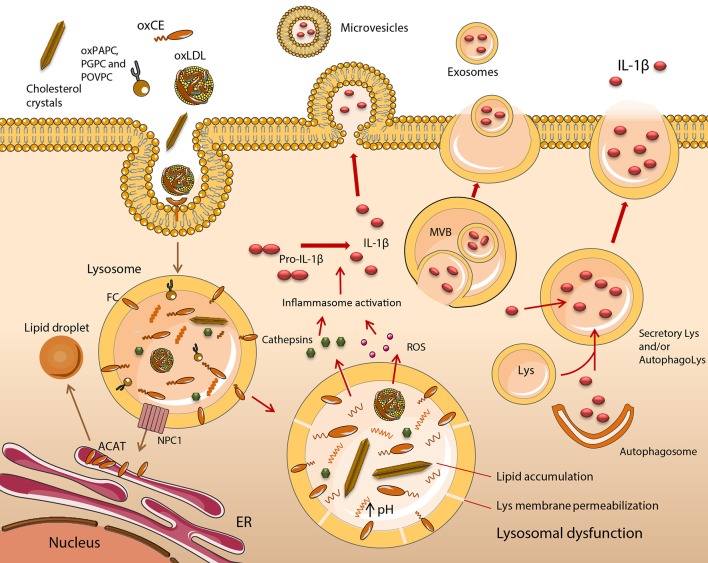
Figure 1
Figure 1
Functional impairment of lipid-engorged lysosomes stimulates inflammasome assembly and IL-1β release. The uptake of lipid and lipoprotein molecules occurs by a variety of scavenger receptor (SR), and Toll-like receptor (TLR)-mediated mechanisms such as phagocytosis or macropinocytosis. In early atherogenesis, monocyte (Mo)-derived macrophages (MOs) retain lipids and lipoproteins, which become degraded in lysosomes, with excess free cholesterol (FC) trafficked to the endoplasmic reticulum (ER). Cholesteryl esters (CE) are hydrolyzed in lysosomes by lysosomal acid lipase (LAL) to FC and fatty acids. FC is trafficked to the ER via Niemann Pick C1 (NPC1), where it becomes esterified by acyl CoA:cholesterol acyltransferase (ACAT), forming CE, which are packaged into cytoplasmic lipid droplets. This is a distinctive feature of foam cell formation. It is induced upon MO cholesterol loading, with lysosomal hydrolysis vital for the mobilization of lipid droplet-associated cholesterol for reverse cholesterol transport. This mechanism of sterol clearance is initially effective, however, when fatty streak lesions degenerate into unstable plaques, a substantial accumulation of CEs, their oxidized derivatives (oxCEs), and FC occurs in lysosomes due to inadequate hydrolysis and clearance. Lysosome dysfunction in excess lipid-loaded MOs is irreversible and is characterized by an inhibition of LAL and cathepsin activity, due to permanent alterations in lysosome function, resulting in the accumulation of cargo. Dysfunctional lysosomes become ruptured, releasing cathepsins, reactive oxygen species (ROS) and other molecules into the cytoplasm. These activate the NLRP3 inflammasome, leading to the maturation and release of IL-1β. Five potential mechanisms of IL-1β release have been described including the exocytosis of secretory lysosomes, exosomes and microvesicle shedding. Lys, lysosome; MVB, multivesicular body.
Figure 2
Figure 2
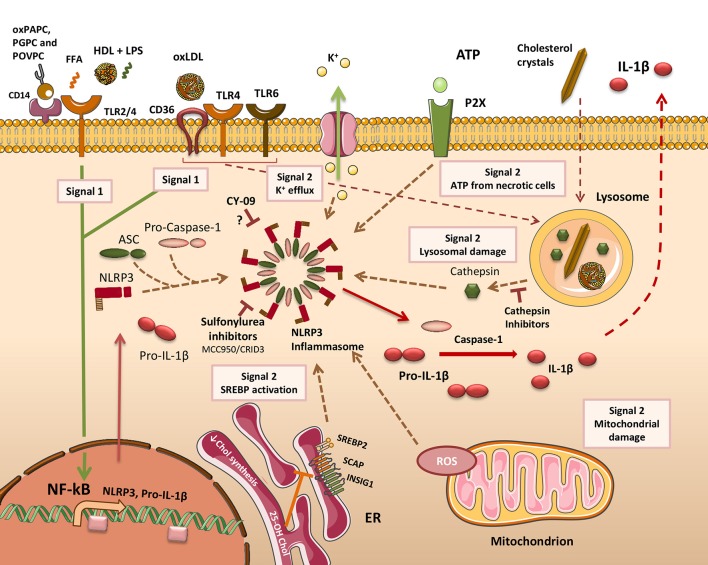
Mechanisms of inflammasome activation in atherosclerosis. To facilitate the release of IL-1β (& IL-18) in macrophages (MO), two distinct signals must be delivered. Firstly, cells need to be primed (Signal 1) to activate the NF-κB-responsive genes NLRP3 and IL-1β. In atherosclerosis, a broad range of lipid and lipoprotein agonists provides this signal by activating cell surface pattern recognition receptors (PRRs). 1-palmitoyl-2-arachidonoyl-sn-3-glycero-phosphorylcholine (oxPAPC), 1-palmitoyl-2-glutaroyl-sn-glycero-phosphatidylcholine (PGPC), and 1-palmitoyl-2-(5-oxovaleroyl)-sn-glycero-phosphatidylcholine (POVPC) prime cells through CD14. Toll-like receptor 2 (TLR2) has also been described as an oxPAPC receptor. Free fatty acids (FFA) prime MOs through a TLR2-TLR4 signaling complex. The ApoAI moiety in High-density lipoprotein (HDL) can co-activate peritoneal MOs along with Lipopolysaccharide (LPS) through TLR2 or TLR4. Oxidized LDL (oxLDL) can prime MOs via signaling through a CD36-TLR4-TLR6 receptor complex. CD36 can additionally promote oxLDL uptake and its conversion into cholesterol crystals within phagolysosomes. The second signal (Signal 2) is required for assembly of the canonical NACHT, LRR and PYD domains-containing protein 3 (NLRP3) inflammasome complex. A number of different activating stimuli are able to deliver this signal. These include increased sterol-regulatory element-binding protein 2 (SREBP2) activity, mitochondria-derived reactive oxygen species (ROS), lysosome damage leading to cathepsin release, and exogenously-derived ATP from adjacent necrotic cells. Activation of surface P2X receptors leads to K+ efflux through ion channels. Inflammasome activation produces mature caspase-1 which cleaves pro-IL-1β (or pro-IL-18), forming mature bioactive IL-1β that is released from the cell. Cathepsin inhibitors diminish IL-1β release by inhibiting NLRP3 inflammasome activation. Other chemicals shown to inhibit the NLRP3 inflammasome include MCC950, which also reduces atherosclerosis in mice, and CY-09 that works through an unknown mechanism. SCAP, SREBP cleavage-activating protein; INSIG, insulin-induced gene protein.

References

    1. A-Gonzalez N., Quintana J. A., Garcia-Silva S., Mazariegos M., González de la Aleja A., Nicolás-Ávila J. A., et al. (2017). Phagocytosis imprints heterogeneity in tissue-resident macrophages. J. Exp. Med. 214, 1281–1296. 10.1084/jem.20161375 - DOI - PMC - PubMed
    1. Andrei C., Dazzi C., Lotti L., Torrisi M. R., Chimini G., Rubartelli A. (1999). The secretory route of the leaderless protein interleukin 1beta involves exocytosis of endolysosome-related vesicles. Mol. Biol. Cell 10, 1463–1475. 10.1091/mbc.10.5.1463 - DOI - PMC - PubMed
    1. Baldrighi M., Mallat Z., Li X. (2017). NLRP3 inflammasome pathways in atherosclerosis. Atherosclerosis 267, 127–138. 10.1016/j.atherosclerosis.2017.10.027 - DOI - PubMed
    1. Bisgaard L. S., Mogensen C. K., Rosendahl A., Cucak H., Nielsen L. B., Rasmussen S. E., et al. (2016). Bone marrow-derived and peritoneal macrophages have different inflammatory response to oxLDL and M1/M2 marker expression - implications for atherosclerosis research. Sci. Rep. 6:35234. 10.1038/srep35234 - DOI - PMC - PubMed
    1. Black R. A., Kronheim S. R., Cantrell M., Deeley M. C., March C. J., Prickett K. S., et al. (1988). Generation of biologically active interleukin-1 beta by proteolytic cleavage of the inactive precursor. J. Biol. Chem., 263, 9437–9442. - PubMed

LinkOut - more resources