. 2018 Jun 27:9:476.
doi: 10.3389/fneur.2018.00476. eCollection 2018.

Genetically Epilepsy-Prone Rats Display Anxiety-Like Behaviors and Neuropsychiatric Comorbidities of Epilepsy

Affiliations

Genetically Epilepsy-Prone Rats Display Anxiety-Like Behaviors and Neuropsychiatric Comorbidities of Epilepsy

Brittany L Aguilar et al. Front Neurol. .

Abstract

Epilepsy is associated with a variety of neuropsychiatric comorbidities, including both anxiety and depression. Despite high occurrences of depression and anxiety seen in human epilepsy populations, little is known about the etiology of these comorbidities. Experimental models of epilepsy provide a platform to disentangle the contribution of acute seizures, genetic predisposition, and underlying circuit pathologies to anxious and depressive phenotypes. Most studies to date have focused on comorbidities in acquired epilepsies; genetic models, however, allow for the assessment of affective phenotypes that occur prior to onset of recurrent seizures. Here, we tested male and female genetically epilepsy-prone rats (GEPR-3s) and Sprague-Dawley controls in a battery of tests sensitive to anxiety-like and depressive-like phenotypes. GEPR-3s showed increased anxiety-like behavior in the open field test, elevated plus maze, light-dark transition test, and looming threat test. Moreover, GEPR-3s showed impaired prepulse inhibition of the acoustic startle reflex, decreased sucrose preference index, and impaired novel object recognition memory. We also characterized defense behaviors in response to stimulation thresholds of deep and intermediate layers of the superior colliculus (DLSC), but found no difference between strains. In sum, GEPR-3s showed inherited anxiety, an effect that did not differ significantly between sexes. The anxiety phenotype in adult GEPR-3s suggests strong genetic influences that may underlie both the seizure disorder and the comorbidities seen in epilepsy.

Keywords: anxiety; audiogenic seizures; comorbidity; depression; rat models; seizures.


Figures
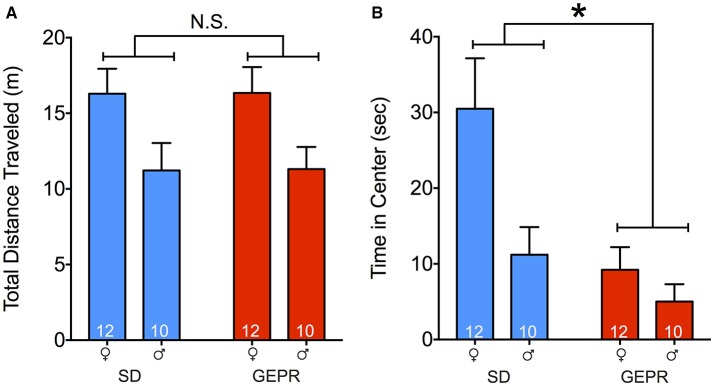
Figure 1
Figure 1
Open field test. (A) Total distance traveled (meters) for the duration of the test (10 min); males of both strains explored the arena less than females [F(1, 39) = 9.0, P = 0.005; Holm-Sidak post-tests, Ps < 0.05]. (B) Total time spent exploring the center (8.5″ × 8.5″) of the open field. GEPR-3s explored less than SD rats [*F(1, 39) = 9.2, P = 0.004], and males explored less than females [F(1, 39) = 6.7, P = 0.01]. Post-tests also showed a decrease in exploration of the center of the arena in female GEPR-3s relative to SD rats (Holm-Sidak corrected, P < 0.05). Figures show mean and standard error of the mean.
Figure 2
Figure 2
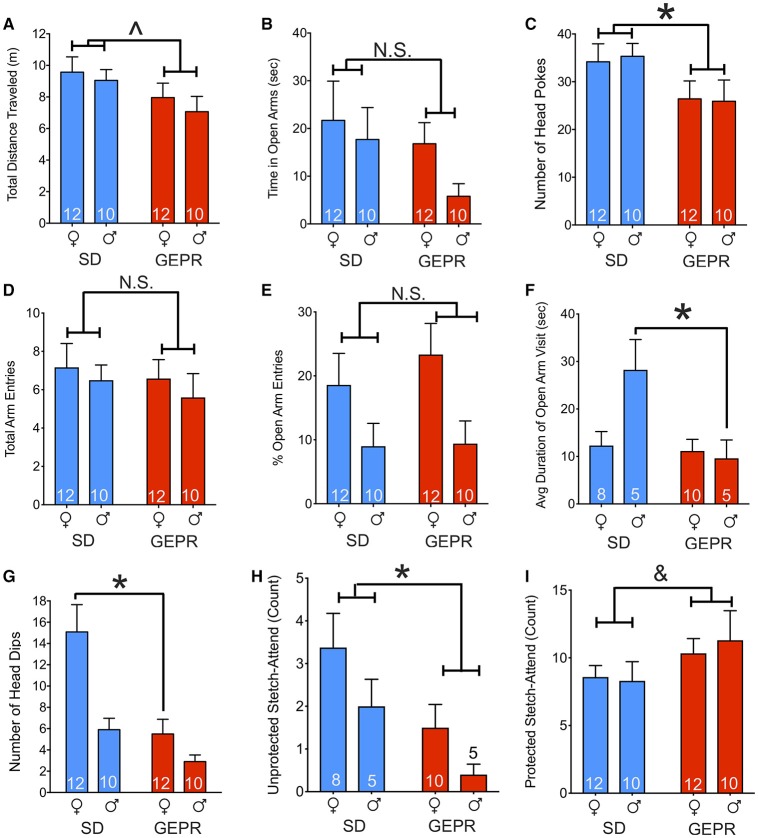
Elevated plus maze. (A) Total distance traveled in the maze for the duration of the test (300 s); GEPR-3s trending toward traveling less [∧F(1, 40) = 3.9, P = 0.055]. (B) Time spent in the open arms of the EPM did not differ by either strain or sex (Ps = 0.18 and 0.23, respectively). (C) GEPR-3s displayed a decrease in number of head pokes into the open arms [*F(1, 40) = 5.2, P = 0.03], but there was not an effect of sex. (D), Total arm entries throughout the duration of the test did not differ significantly by either strain or sex (Ps = 0.50 and 0.46, respectively). (E) Percent open arm entries differed by sex [F(1, 40) = 7.0, P = 0.01] but showed no effects of strain or strain-by-sex interaction (Ps = 0.56 and 0.63, respectively). (F) Average duration of open arm visit differed by strain [F(1, 24) = 7.04, P = 0.01] and showed a significant interaction of sex-by-strain [F(1, 24) = 5.499, P = 0.03], driven by males (*P = 0.009). (G) Number of head dips off the open arms differed by sex [F(1, 40) = 7.04, P = 0.01] and strain [F(1, 40) = 13.7, P = 0.0006]. The strain effect driven by females (P = 0.003). Accordingly, female GEPR-3s displayed fewer head dips than did female SDs (*P = 0.008). (H) Number of stretch-attend posture counts observed while the animal was in the “unprotected” portion of the maze (i.e., the open arms). SD rats has a higher frequency of this behavior as compared to GEPR-3s [*F(1, 24) = 6.5, P = 0.018]. There was a trend toward an effect of sex [F(1, 24) = 3.3, P = 0.08] but no strain-by-sex interaction (P = 0.8). (I) Number of stretch-attend posture counts observed while the animal was in the “protected” portion of the maze (i.e., the closed arms). There was a trend toward an effect of strain [&F(1, 40) = 2.9, P = 0.098] with GEPR-3s showing a greater number of this risk-assessing behavior than SD rats. There was neither an effect of sex, nor a strain by sex interaction (Ps = 0.81 and 0.67, respectively). Figures show mean and standard error of the mean.
Figure 3
Figure 3
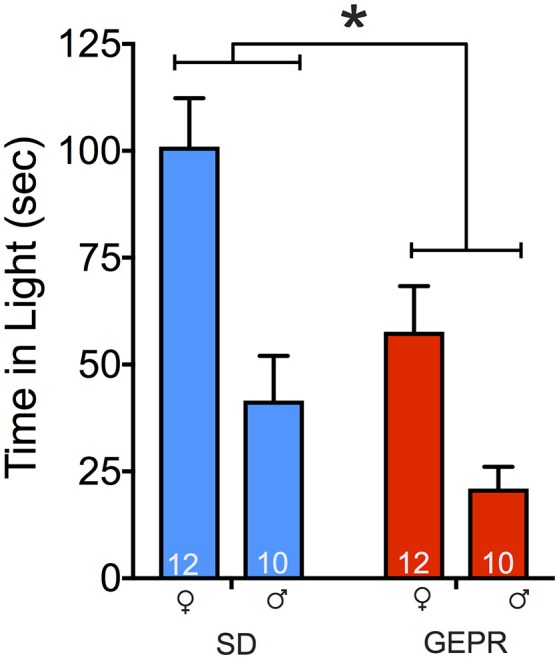
Light-dark transition test. GEPR-3s displayed reduced time spent in the light compartment [*F(1, 40) = 10.1, P = 0.003] and males spend less time in the light than females [F(1, 40) = 22.8, P < 0.0001]. Animals were initially placed in the light side of the apparatus; total test time was 5 min. Pairwise comparisons indicated a sex effect in both strains (Ps < 0.05, Holm-Sidak corrected), and the strain difference was significant for females, but not males (P < 0.05, Holm-Sidak corrected). Figures show mean and standard error of the mean.
Figure 4
Figure 4
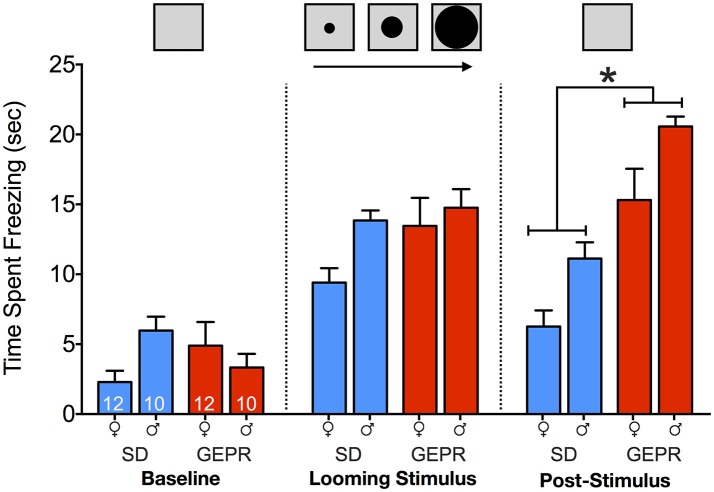
Looming threat test. Time spent freezing during: baseline period (22 s prior to stimulus presentation), presentation of looming stimulus (22 s), and in the post-stimulus period (22 s immediately after stimulus presentation). Overall, GEPR-3s spent more time frozen [F(1, 40) = 11.7, P = 0.001], but there was no effect of sex (P = 0.12). During the post-stimulus period, there was a significant increase in freezing in GEPR-3s as compared to SD rats (*Holm-Sidak Adjusted, Females: P = 0.0004 and Males: P = 0.0007). Figures show mean and standard error of the mean.
Figure 5
Figure 5
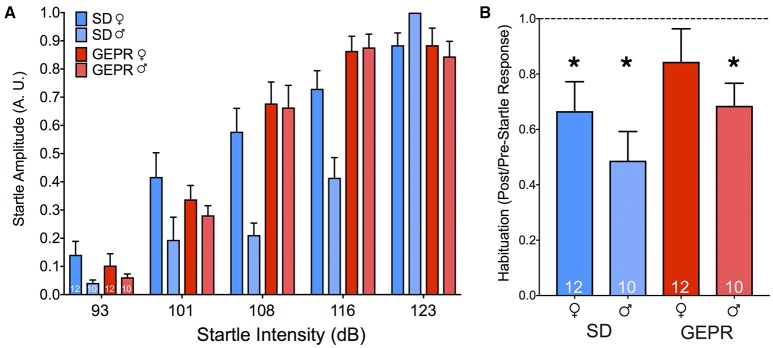
Acoustic startle response and habituation. (A) Startle amplitude (A.U.) as a result of increasing noise burst intensity (dB). We found a main effect of noise intensity [F(1.6, 64.6) = 23.4, P = 0.0000001], but no effect of either strain or sex (Ps = 0.5 and 0.9, respectively). (B) Habituation to the startling stimulus was present in all groups, except for the female GEPR-3s (*P < 0.01, one sample t-test when compared to the theoretical mean of 1.0). Figures show mean and standard error of the mean.
Figure 6
Figure 6
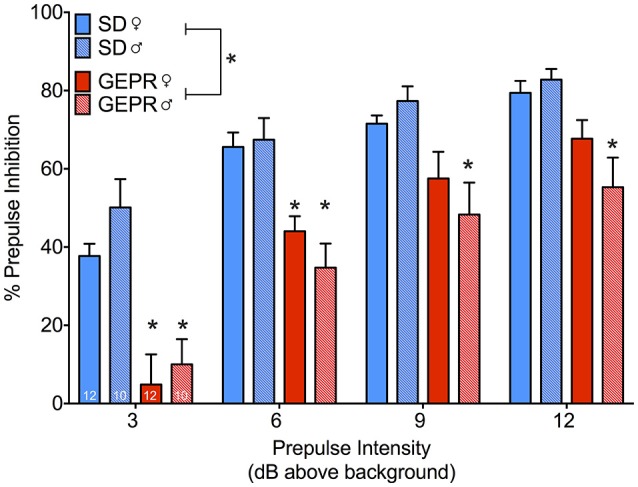
Prepulse inhibition of the acoustic startle response. All groups showed the expected increase in inhibition as a function of increasing prepulse intensity [F(2.3, 93.1) = 82.2, P = 5 × 10⁻²³], however GEPR-3s displayed a significant PPI deficit relative to SD rats [F(1, 40) = 43.5, P = 0.00000007]. Comparisons across strain for each sex revealed significant impairment in PPI at each prepulse intensity for male GEPR-3s as compared to male SD rats (Ps < 0.002, Holm-Sidak adjusted). For female GEPR-3s as compared to female SD rats, this effect was evident at lower prepulse intensities (PP3: P = 0.005; PP6 P = 0.02), but not higher prepulse intensities (PP9 and PP12 Ps = 0.1). Figures show mean and standard error of the mean. *significantl difference between strain, stratified by sex and prepulse.
Figure 7
Figure 7
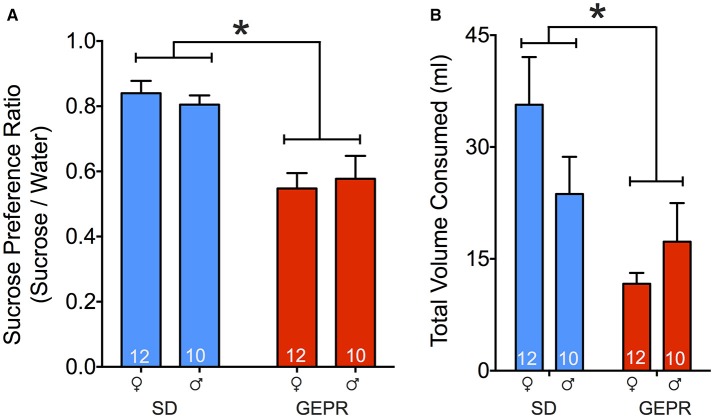
Sucrose preference test. (A) GEPR-3s displayed a significantly lower sucrose preference ratio than SD rats [*F(1, 40) = 29.3, P < 0.0001]. Pairwise comparisons showed that decreased sucrose preference in GEPR-3s was significant in both sexes female: P = 0.001, male: P = 0.003, Holm-Sidak corrected. (B) Total volume consumed across days differed between strains [F(1, 40) = 9.768, P = 0.0033], with GEPR-3s consuming significantly less than SD rats. Figures show mean and standard error of the mean.
Figure 8
Figure 8
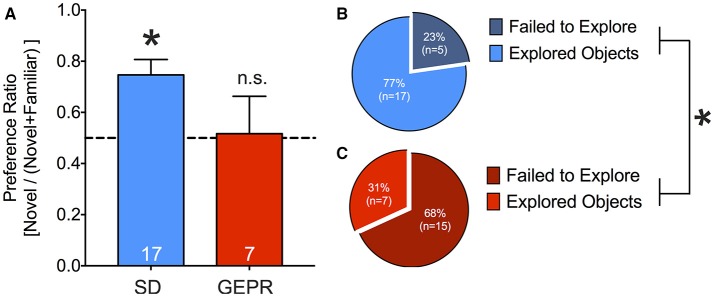
Novel object recognition test. (A) SD rats showed the expected novel object preference during the retention probe conducted 2 h after the familiarization session (one sample t-test, t = 4.1, df = 17, *P = 0.0008), GEPR-3s did not (preference ratio did not differ significantly from chance, P = 0.9). Preference ratio trended toward but did not reach the level of statistical significance between these two groups (t = 1.7, df = 23, P = 0.09). (B,C) Proportion of animals that failed to explore the objects during the familiarization session; A greater proportion of GEPR-3s failed to explore the objects as compared to SD rats (*P = 0.006, Fisher's Exact Test). Figures show mean and standard error of the mean.
Figure 9
Figure 9
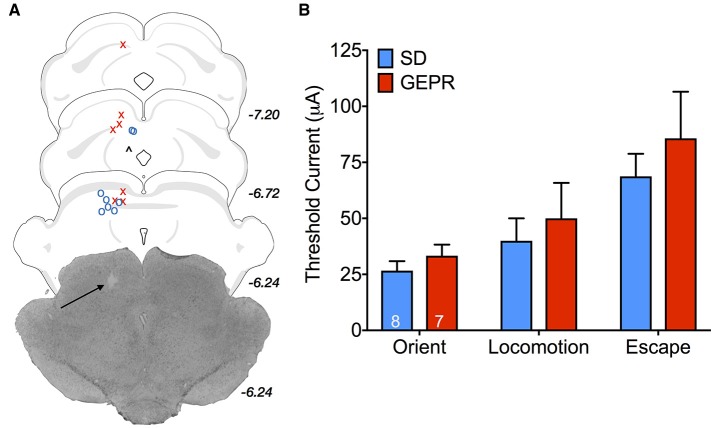
Stimulation thresholds for DLSC-evoked behaviors in male rats. (A) Electrode placement; O = SD rats, X = GEPR-3s, ∧ = misplaced electrode. Black arrow points to electrode tip in the representative photomicrograph. Electrode tips are plotted on planes from the BrainMaps 4.0 Atlas (37). (B) Threshold current required to evoke orienting, locomotor responses, or escape behaviors. No differences between strain (Orient: t = 1.026, df = 10, P = 0.33 Locomotion: t = 0.488, df = 5, P = 0.65 Escape: t = 0.765, df = 13, P = 0.46). Figures show mean and standard error of the mean.

References

    1. Gulati S, Yoganathan S, Chakrabarty B. Epilepsy, cognition and behavior. Indian J Pediatr. (2014) 81:1056–62. 10.1007/s12098-014-1530-4 - DOI - PubMed
    1. Kwon OY, Park SP. Depression and anxiety in people with epilepsy. J Clin Neurol Seoul Korea (2014) 10:175–88. 10.3988/jcn.2014.10.3.175 - DOI - PMC - PubMed
    1. Kanner AM. Anxiety disorders in epilepsy: the forgotten psychiatric comorbidity. Epilepsy Curr. (2011) 11:90–1. 10.5698/1535-7511-11.3.90 - DOI - PMC - PubMed
    1. Kanner AM, Barry JJ, Gilliam F, Hermann B, Meador KJ. Anxiety disorders, subsyndromic depressive episodes, and major depressive episodes: do they differ on their impact on the quality of life of patients with epilepsy? Epilepsia (2010) 51:1152–8. 10.1111/j.1528-1167.2010.02582.x - DOI - PubMed
    1. Kanner AM. Psychiatric issues in epilepsy: the complex relation of mood, anxiety disorders, and epilepsy. Epilepsy Behav. (2009) 15:83–7. 10.1016/j.yebeh.2009.02.034 - DOI - PubMed

LinkOut - more resources