


Obstructive Sleep Apnea With or Without Excessive Daytime Sleepiness: Clinical and Experimental Data-Driven Phenotyping
- PMID: 29997573
- PMCID: PMC6030350
- DOI: 10.3389/fneur.2018.00505
Obstructive Sleep Apnea With or Without Excessive Daytime Sleepiness: Clinical and Experimental Data-Driven Phenotyping
Abstract
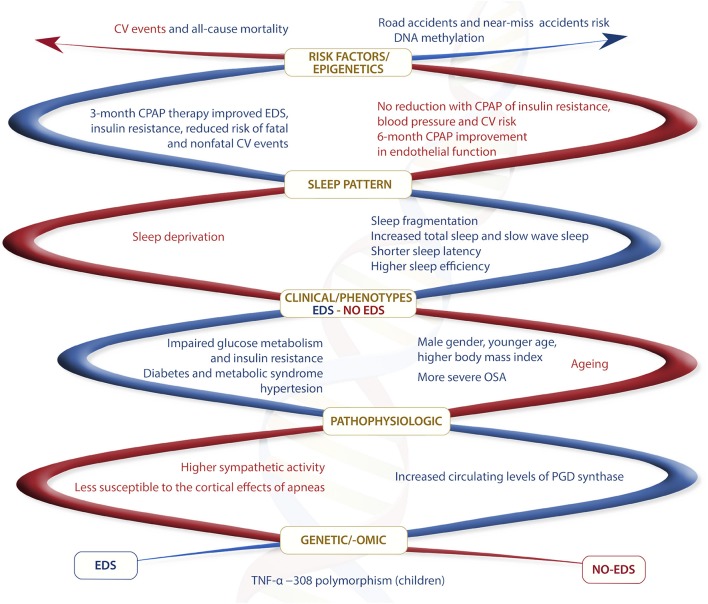
Introduction: Obstructive sleep apnea (OSA) is a serious and prevalent medical condition with major consequences for health and safety. Excessive daytime sleepiness (EDS) is a common-but not universal-accompanying symptom. The purpose of this literature analysis is to understand whether the presence/absence of EDS is associated with different physiopathologic, prognostic, and therapeutic outcomes in OSA patients. Methods: Articles in English published in PubMed, Medline, and EMBASE between January 2000 and June 2017, focusing on no-EDS OSA patients, were critically reviewed. Results: A relevant percentage of OSA patients do not complain of EDS. EDS is a significant and independent predictor of incident cardiovascular disease (CVD) and is associated with all-cause mortality and an increased risk of metabolic syndrome and diabetes. Male gender, younger age, high body mass index, are predictors of EDS. The positive effects of nasal continuous positive airway pressure (CPAP) therapy on blood pressure, insulin resistance, fatal and non-fatal CVD, and endothelial dysfunction risk factors have been demonstrated in EDS-OSA patients, but results are inconsistent in no-EDS patients. The most sustainable cause of EDS is nocturnal hypoxemia and alterations of sleep architecture, including sleep fragmentation. These changes are less evident in no-EDS patients that seem less susceptible to the cortical effects of apneas. Conclusions: There is no consensus if we should consider OSA as a single disease with different phenotypes with or without EDS, or if there are different diseases with different genetic/epigenetic determinants, pathogenic mechanisms, prognosis, and treatment.The small number of studies focused on this issue indicates the need for further research in this area. Clinicians must carefully assess the presence or absence of EDS and decide accordingly the treatment. This approach could improve combination therapy targeted to a patient's specific pathology to enhance both efficacy and long-term adherence to OSA treatment and significantly reduce the social, economic, and health negative impact of OSA.
Keywords: continuous positive airway pressure; excessive daytime sleepiness; hypoxia; obstructive sleep apnea; phenotype; sleep.
Figures
References
-
- Punjabi NM, O'Hearn DJ, Neubauer DN, Nieto FJ, Schwartz AR, Smith PL, et al. Modeling hypersomnolence in sleep-disordered breathing - a novel approach using survival analysis. Am J Resp Crit Care (1999) 159:1703–9. - PubMed
-
- American Academy of Sleep Medicine. International Classification of Sleep Disorders. 3rd Edn. Darien, IL: (2014).
-
- Randerath W, Bassetti CL, Bonsignore MR, Farre R, Ferini-Strambi L, Grote L, et al. Challenges and perspectives in obstructive sleep apnoea: report by an ad hoc working group of the sleep disordered breathing group of the european respiratory society and the european sleep research society. Eur Respir J. [Epub ahead of print]. (2018). 10.1183/13993003.02616-2017 - DOI - PubMed
LinkOut - more resources
Full Text Sources
Other Literature Sources
