Review
. 2016 May 1;7(5):2954-2963.
doi: 10.1039/c6sc00170j. Epub 2016 Feb 12.

Construction of homogeneous antibody-drug conjugates using site-selective protein chemistry

Affiliations
Review

Construction of homogeneous antibody-drug conjugates using site-selective protein chemistry

Padma Akkapeddi et al. Chem Sci. .

Abstract

Systemic chemotherapy, the current standard of care for the treatment of cancer, is rarely curative and is often accompanied by debilitating side effects. Targeted drug delivery stands as an alternative to chemotherapy, with the potential to improve upon its low efficacy and systemic toxicity. Among targeted therapeutic options, antibody-drug conjugates (ADCs) have emerged as the most promising. These conjugates represent a new class of biopharmaceuticals that selectively deliver potent cytotoxic drugs to cancer cells, sparing healthy tissue throughout the body. Despite this promise, early heterogenous ADCs suffered from stability, pharmacokinetic, and efficacy issues that hindered clinical development. Recent advances in antibody engineering, linkers for drug-release, and chemical site-selective antibody conjugation have led to the creation of homogenous ADCs that have proven to be more efficacious than their heterogeneous predecessors both in vitro and in vivo. In this minireview, we focus on and discuss recent advances in chemical site-selective modification strategies for the conjugation of drugs to antibodies and the resulting potential for the development of a new generation of homogenous ADCs.


Figures
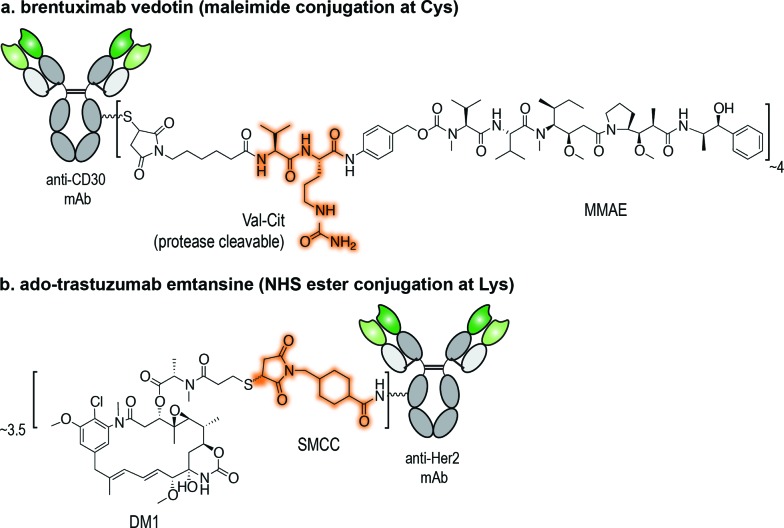
Fig. 1
Fig. 1. Structures of currently FDA approved ADCs. (a) Brentuximab vedotin (Adcetris®; Seattle Genetics/Millennium Pharmaceuticals); and (b) ado-trastuzumab emtansine (Kadcyla® – T-DM1; Roche/Genentech). NHS ester: N-hydroxysuccinimide ester; Val-Cit linker: valine-citrulline linker; SMCC: succinimidyl-4-[N-maleimidomethyl]cyclohexane-1-carboxylate; DM1: thiol-containing maytansinoid. MMAE: monomethyl auristatin E.
Fig. 2
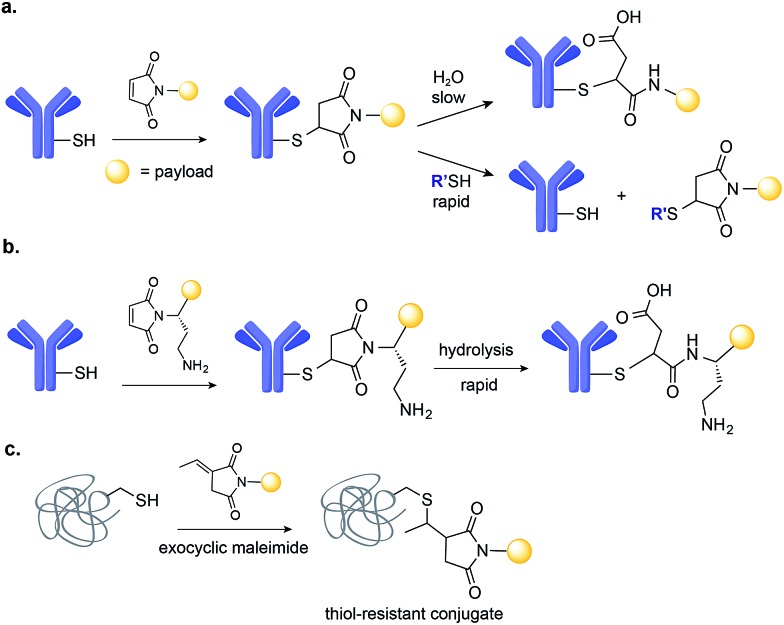
Fig. 2. Maleimide-based drug conjugation. (a) Maleimide conjugation leads to a thiosuccinimide adduct that can undergo either rapid retro Michael-addition reaction or slow hydrolysis. (b) Placement of a basic amino group adjacent to the maleimide promotes intramolecular thiosuccinimide ring hydrolysis. (c) The use of exocyclic maleimides derivatives as opposed to conventional endocyclic ones results in fully thiol-exchange resistant product.
Fig. 3
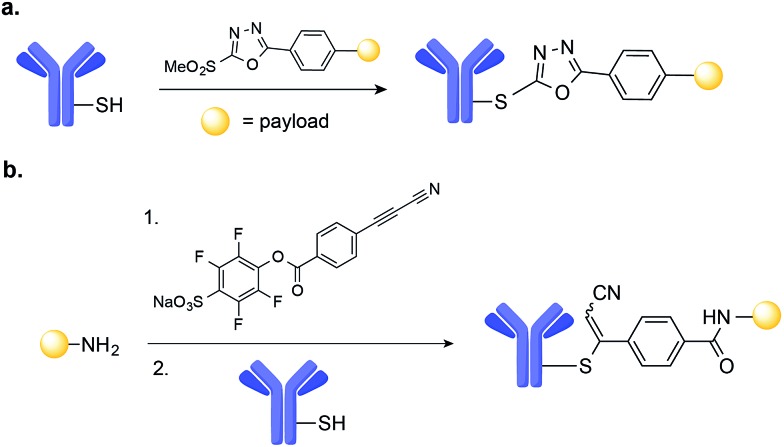
Fig. 3. New methods for the chemical site-selective modification of engineered Cys on the surface of mAb based on: (a) Julia–Kocieński-like reagents, such as methylsulfonylphenyloxadiazole. (b) Amine-to-thiol coupling using a heterobifunctional reagent, sodium 4-((4-(cyanoethynyl)benzoyl)oxy)-2,3,5,6-tetrafluorobenzenesulfonate.
Fig. 4
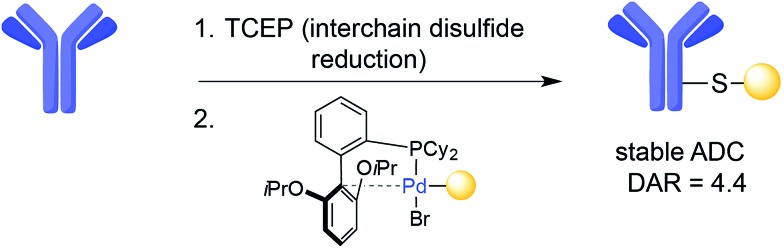
Fig. 4. Example of Cys arylation using an organometallic palladium reagent on trastuzumab.
Fig. 5
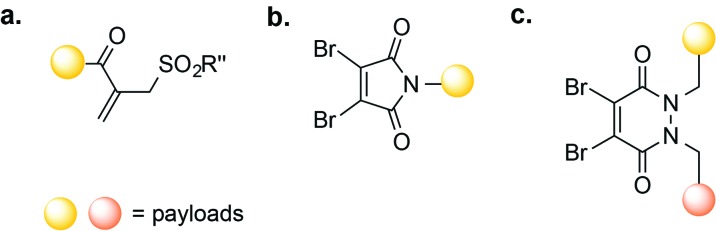
Fig. 5. Disulfide re-bridging methods for antibody-conjugation based on (a) vinylsulfone; (b) dibromomaleimide and (c) dibromopyridiazinedione reagents.
Fig. 6
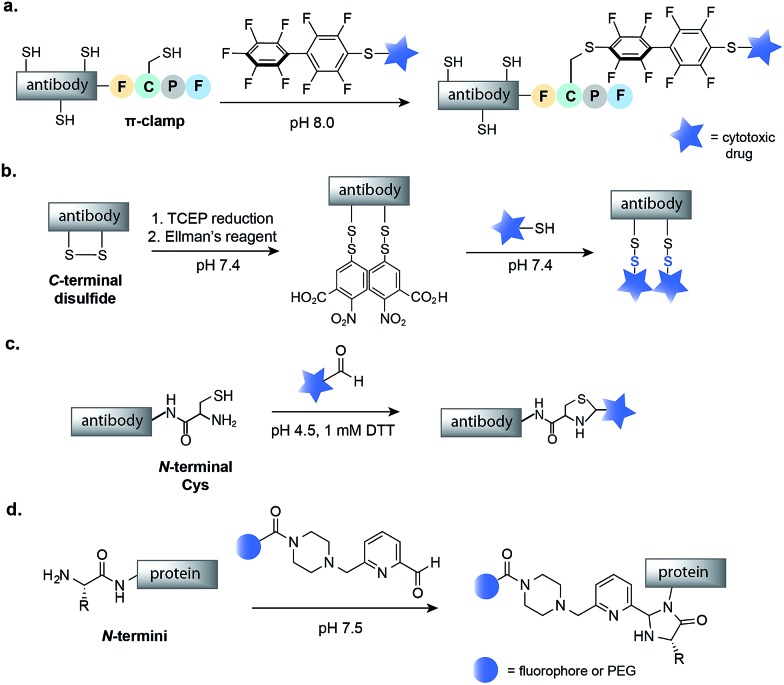
Fig. 6. Methods for the chemical modification of IgGs, antibody fragments and proteins at the N- or C-termini. (a) π-Clamp-mediated antibody conjugation using perfluoroaromatic reagents. (b) Mixed disulfide formation of C-terminal Cys. (c) Thiazolidine modification of N-terminal Cys with aldehyde containing drugs. (d) N-Terminal imidazolidinone formation using 2-pyridinecarboxyaldehyde reagents. TCEP–Tris(2-carboxyethyl)phosphine; DTT–dithiothreitol.
Fig. 7
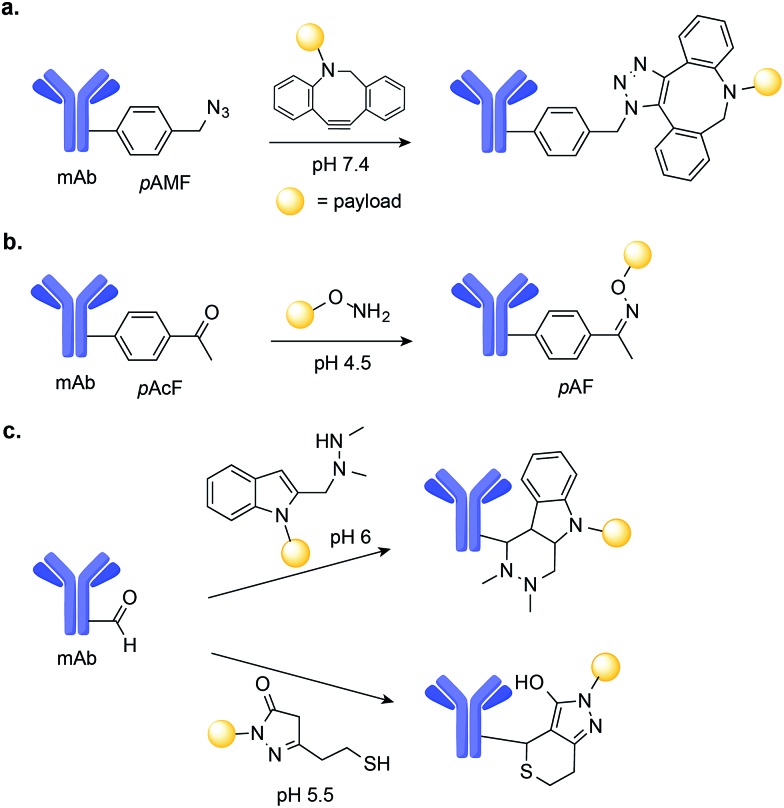
Fig. 7. Chemical site-selective modification of non-canonical amino acids on mAbs. (a) Genetic encoding of p-azidomethyl-l-phenylalanine (pAMF) into a Her2-binding IgG trastuzumab allows for efficient drug conjugation through SPAAC. (b) Chemical site-selective oxime ligation at non-canonical amino p-acetyl-l-phenylalanine (pAcF) tagged mAb. (c) Aldehyde-tagged mAbs may be selectively modified either by (i) Hydrazino-iso-Pictet-Spengler (HIPS) or (ii) trapped-Knoevenagel ligation.
Fig. 8
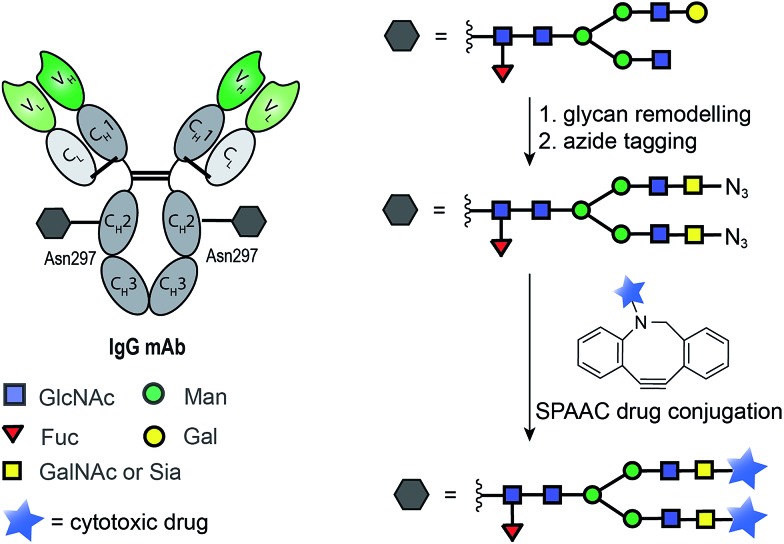
Fig. 8. General chemoenzymatic strategy for drug conjugation to the conserved glycan of mAbs for the construction of homogenous ADCs. The strategy consists of glycan remodelling that allows the incorporation of non-natural azide-tagged carbohydrate motif (GalNAc or Sia93) followed by SPAAC ligation with a suitable payload.

References

    1. Sievers E. L., Senter P. D. Annu. Rev. Med. 2013;64:15–29. - PubMed
    1. Chari R. V., Miller M. L., Widdison W. C. Angew. Chem., Int. Ed. 2014;53:3796–3827. - PubMed
    1. Polakis P. Pharmacol. Rev. 2015;68:3–19. - PubMed
    1. Senter P. D., Sievers E. L. Nat. Biotechnol. 2012;30:631–637. - PubMed
    1. Lambert J. M., Chari R. V. J. J. Med. Chem. 2014;57:6949–6964. - PubMed