


Directed nickel-catalyzed 1,2-dialkylation of alkenyl carbonyl compounds
- PMID: 29997883
- PMCID: PMC6001383
- DOI: 10.1039/c8sc01735b
Directed nickel-catalyzed 1,2-dialkylation of alkenyl carbonyl compounds
Abstract
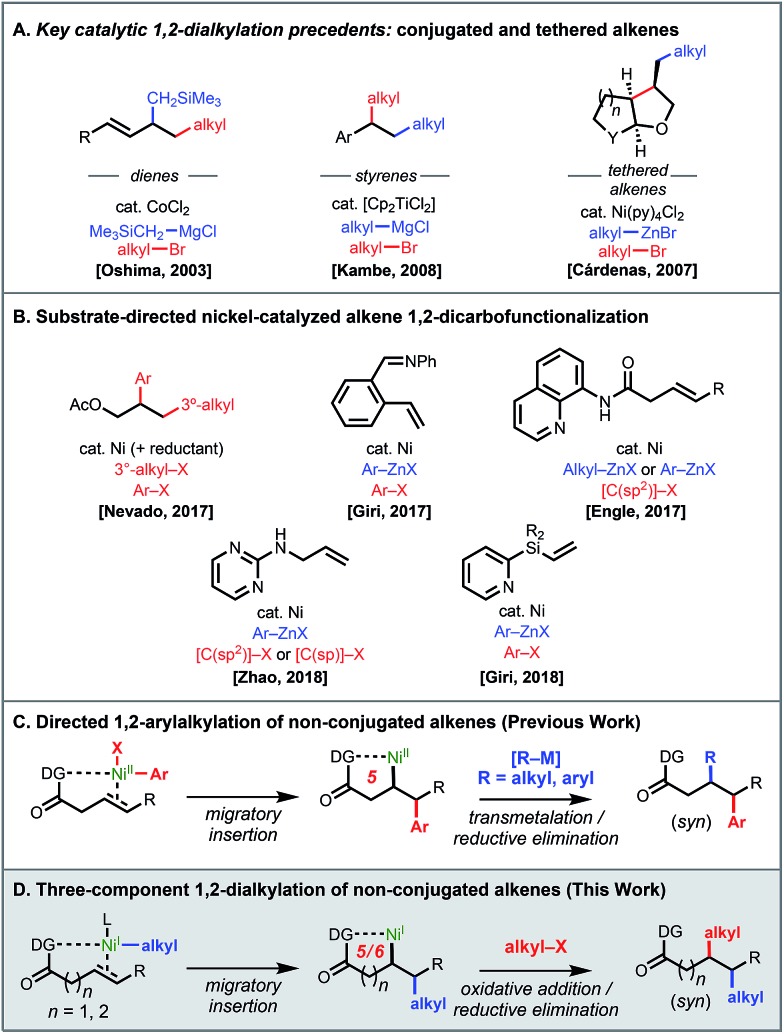
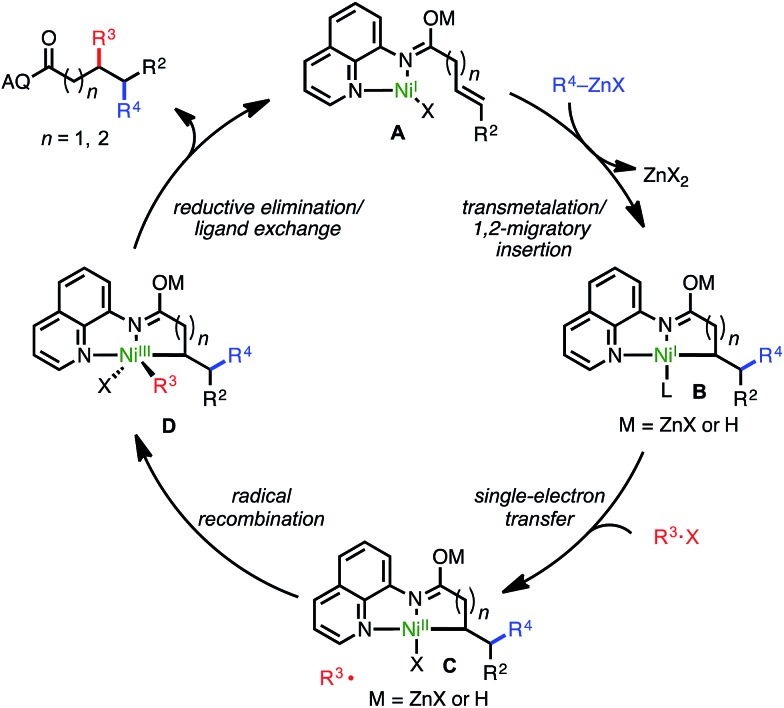
A nickel-catalyzed conjunctive cross-coupling of non-conjugated alkenes, alkyl halides, and alkylzinc reagents is reported. Regioselectivity is controlled by chelation of a removable bidentate 8-aminoquinoline directing group. Under optimized conditions, a wide range of 1,2-dialkylated products can be accessed in moderate to excellent yields. To the best of our knowledge, this report represents the first example of three-component 1,2-dialkylation of non-conjugated alkenes to introduce differentiated alkyl fragments.
Figures

References
-
- Lovering F., Bikker J., Humblet C. J. Med. Chem. 2009;52:6752–6756. - PubMed
-
-
For reviews on transition-metal-catalyzed two-component cross-coupling reactions, see: . For reviews on transition-metal-catalyzed three-component cross-coupling reactions, see:
- Johansson Seechurn C. C. C., Kitching M. O., Colacot T. J., Snieckus V. Angew. Chem., Int. Ed. 2012;51:5062–5085. - PubMed
- Tasker S. Z., Standley E. A., Jamison T. F. Nature. 2014;509:299–309. - PMC - PubMed
- Giri R., KC S. J. Org. Chem. 2018;83:3013–3022. - PubMed
- Dhungana R. K., KC S., Basnet P., Giri R. Chem. Rec. 2018 doi: 10.1002/tcr.201700098. - DOI - PubMed
- Derosa J., Tran V. T., van der Puyl V. A., Engle K. M. Aldrichimica Acta. 2018;51:21–32.
-
-
-
For representative examples of conjunctive coupling using allenes, 1,3-dienes, styrenes, or acrylates, see: . For early work on 1,2-alkylation of styrenes and dienes with organometallic nucleophiles and alkyl electrophiles, see:
- Huang T.-H., Chang H.-M., Wu M.-Y., Cheng C.-H. J. Org. Chem. 2002;67:99–105. - PubMed
- Liao L., Jana R., Urkalan K. B., Sigman M. S. J. Am. Chem. Soc. 2011;133:5784–5787. - PMC - PubMed
- Qin T., Cornella J., Li C., Malins L. R., Edwards J. T., Kawamura S., Maxwell B. D., Eastgate M. D., Baran P. S. Science. 2016;352:801–805. - PMC - PubMed
- Logan K. M., Smith K. B., Brown M. K. Angew. Chem., Int. Ed. 2015;54:5228–5231. - PubMed
- Terao J., Kato Y., Kambe N. Chem.–Asian J. 2008;3:1472–1478. - PubMed
- Mizutani K., Shinokubo H., Oshima K. Org. Lett. 2003;5:3959–3961. - PubMed
-
-
-
. For a recent example of Ni-catalyzed 1,2-dicarbofunctionalization involving alkyl electrophiles via a metalate rearrangement, see:
- Zhang L., Lovinger G. J., Edelstein E. K., Szymaniak A. A., Chierchia M. P., Morken J. P. Science. 2016;351:70–74. - PMC - PubMed
- Lovinger G. J., Morken J. P. J. Am. Chem. Soc. 2017;139:17293–17296. - PMC - PubMed
-
Grants and funding
LinkOut - more resources
Full Text Sources
Other Literature Sources
