A Swedish Nationwide Adoption Study of the Heritability of Heart Failure
- PMID: 29998296
- PMCID: PMC6583873
- DOI: 10.1001/jamacardio.2018.1919
A Swedish Nationwide Adoption Study of the Heritability of Heart Failure
Abstract
Importance: Heart failure (HF) aggregates in families, but the heritability of HF has not been determined. Discerning the genetic and environmental contributions to HF risk is important to further helping to identify individuals at risk. Adoption studies may establish the genetic contribution to HF.
Objective: This nationwide adoption study aimed to determine the heritability of HF.
Design, setting, and participants: This case-control study and cohort study design used logistic regression for calculating risks of HF in adoptees. Adoptees who were born in Sweden between 1942 and 1990 were linked to their adoptive parents and biological parents. The Swedish Multi-Generation Register was linked to the Swedish Patient Register for information on hospital inpatient and outpatient admissions and to the Swedish Cause of Death Register for the period 1964 through 2015. Heritability (h2 with a standard error) for HF was determined both with Falconer regression and with tetrachoric correlation. Data analysis was completed from July 2017 to April 2018.
Exposures: Heart failure in biological parents and/or adoptive parents.
Main outcomes and measures: Heritability; risk of HF, expressed as odds ratios.
Results: A total of 21 643 adoptees were included (of whom 10 626 [49.1%] were female), as well as 35 016 adoptive parents (14 872 [42.5%] female) and 43 286 biological parents (21 643 [50.0%] female). There were 194 cases of HF in adoptees, 3972 cases of HF in adoptive parents, and 3657 cases of HF in biological parents. The cohort study odds ratio (OR) for heart failure was 1.45 in adoptees (95% CI, 1.04-2.03) for biological parents with HF, compared with those without an affected biological parent. If cardiomyopathies were excluded, this OR was 1.58 (95% CI, 1.03-2.42). The corresponding OR associated with an affected adoptive parent were nonsignificant, both with cardiomyopathies included (OR, 0.83 [95% CI, 0.57-1.20]) and with cardiomyopathies excluded (OR, 0.79 [95% CI, 0.49-1.29]). The heritability of HF per Falconer regression (h2) was 26% (SE, 14%). With exclusion of cardiomyopathies the heritability using Falconer regression was 34% (SE, 18%).
Conclusions and relevance: Heart failure in a biological parent is an HF risk factor that is worth clinical consideration. The increased heritability of HF suggests that genetic factors are important in HF pathogenesis.
Conflict of interest statement
Figures
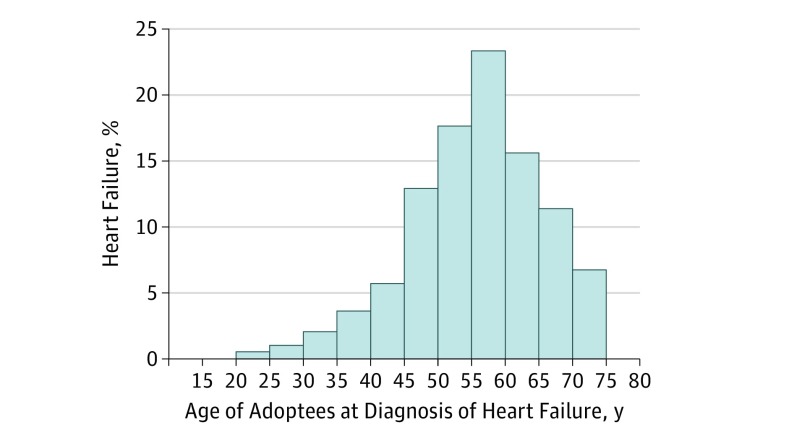
Comment in
-
Is Heart Failure Inherited?: Beyond the Cardiomyopathies, Genetics Do Matter.JAMA Cardiol. 2018 Aug 1;3(8):710-711. doi: 10.1001/jamacardio.2018.1918. JAMA Cardiol. 2018. PMID: 29998295 No abstract available.
References
-
- Ponikowski P, Voors AA, Anker SD, et al. ; Authors/Task Force Members; Document Reviewers . 2016 ESC Guidelines for the diagnosis and treatment of acute and chronic heart failure: The Task Force for the diagnosis and treatment of acute and chronic heart failure of the European Society of Cardiology (ESC). Developed with the special contribution of the Heart Failure Association (HFA) of the ESC. Eur J Heart Fail. 2016;18(8):891-975. doi:10.1002/ejhf.592 - DOI - PubMed
-
- Benjamin EJ, Blaha MJ, Chiuve SE, et al. ; American Heart Association Statistics Committee and Stroke Statistics Subcommittee . Heart disease and stroke statistics—2017 update: a report from the American Heart Association. Circulation. 2017;135(10):e146-e603. doi:10.1161/CIR.0000000000000485 - DOI - PMC - PubMed
Publication types
MeSH terms
LinkOut - more resources
Full Text Sources
Other Literature Sources
Medical
Research Materials
Miscellaneous