Review
. 2019 Mar;225(3):e13163.
doi: 10.1111/apha.13163. Epub 2018 Aug 12.

Intestinal macrophages and their interaction with the enteric nervous system in health and inflammatory bowel disease

Affiliations
Review

Intestinal macrophages and their interaction with the enteric nervous system in health and inflammatory bowel disease

Elisa Meroni et al. Acta Physiol (Oxf). 2019 Mar.

Abstract

Over the past decades, there has been an increasing understanding of cellular and molecular mechanisms that mediate modulation of the immune system by the autonomic nervous system. The discovery that vagal nerve stimulation (VNS) attenuates endotoxin-induced experimental sepsis paved the way for further studies investigating neuro-immune interaction. In particular, great attention is now given to intestinal macrophages: several studies report the existence of both intrinsic and extrinsic neural mechanisms by which intestinal immune homoeostasis can be regulated in different layers of the intestine, mainly by affecting macrophage activation through neurotransmitter release. Given the important role of inflammation in numerous disease processes, such as inflammatory bowel disease (IBD), cholinergic anti-inflammatory mechanisms are under intense investigation both from a basic and clinical science perspective in immune-mediated diseases such as IBD. This review discusses recent insights on the cross-talk between enteric neurons and the immune system, especially focusing on macrophages, and provides an overview of basic and translational aspects of the cholinergic anti-inflammatory response as therapeutic alternative to reinstall immune homoeostasis in intestinal chronic inflammation.

Keywords: cholinergic anti-inflammatory pathway; enteric nervous system; inflammatory bowel disease; macrophages; vagal nerve stimulation.


Conflict of interest statement

None.

Figures
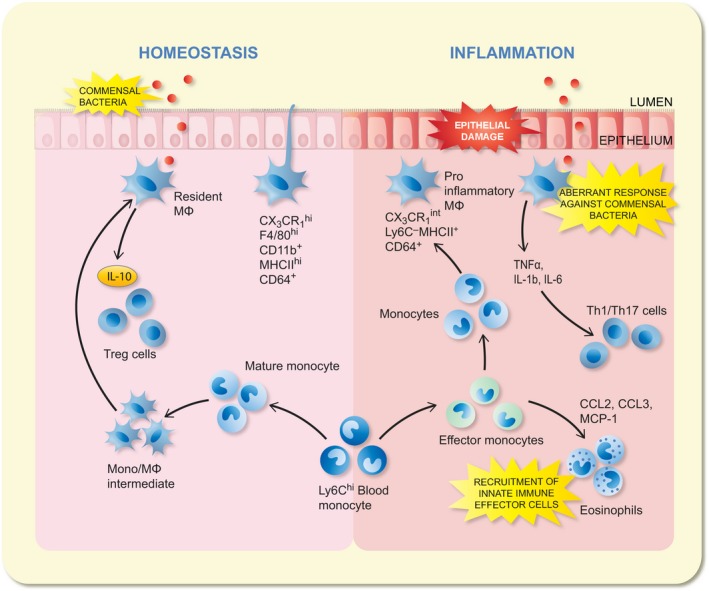
Figure 1
Figure 1
Macrophage differentiation under steady state and disease conditions. Under steady state conditions, Ly6Chi monocytes constitutively enter the intestinal mucosa and differentiate into mature CX3CR1hi F4/80 + Mϕ. These CX3CR1hi Mϕ are found beneath the epithelial barrier where they capture and neutralize invading commensals or pathogens and clear apoptotic cells. Moreover, they are capable of directly sampling the luminal contents; thanks to their extending processes through the epithelial barrier: once the antigen is trapped, it is passed to the CD103+ dendtritic cell (DC) which have migratory property. This population is capable to enter in the lymph and reach the mesenteric lymph node (MLN) where can prime T cell. The constitutive production of IL‐10 by the CX3CR1hi Mϕ facilitates secondary expansion of regulatory T cells in the mucosa. When homoeostasis is perturbed by inflammation or infection, Ly6Chi monocytes and CX3CR1int Mϕ accumulate and display pro‐inflammatory characteristics. They produce pro‐inflammatory cytokines (eg TNFα, IL‐1β, IL‐6) which may support the maintenance of other effector cells such as IL‐1/IL‐17‐producing T cells. Moreover, they also orchestrate the recruitment of other innate effector cells such as neutrophils and eosinophils through secretion of inflammatory chemokines (eg CCL2, CCL3)
Figure 2
Figure 2
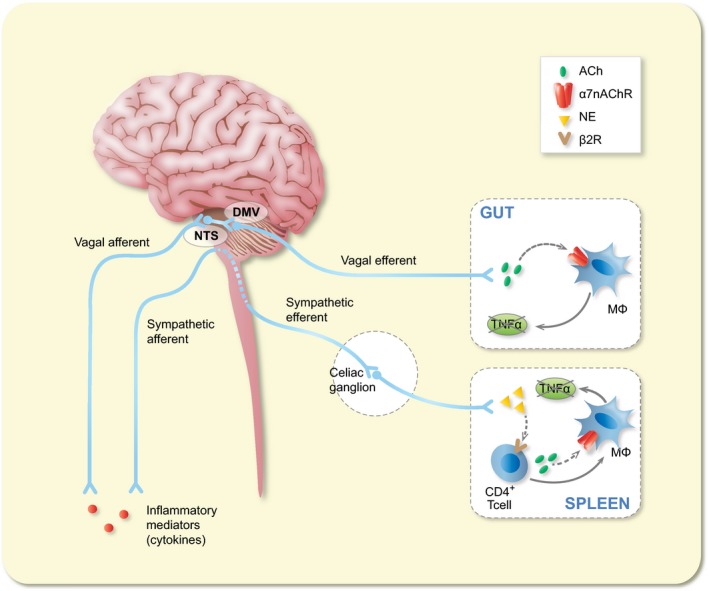
Schematic representation of the cholinergic anti‐inflammatory pathway. Inflammatory mediators, such as cytokines, are released by activated macrophages and other immune cells upon immune challenge. These mediators are detected by the afferent arm of the inflammatory reflex. Efferent vagus nerve cholinergic output to the spleen and gastrointestinal tract regulates immune activation and suppresses pro‐inflammatory cytokine release. Vagal nerve stimulation of the intact vagus nerve stimulates both afferent and efferent fibres. Electrical stimulation of afferent nerve fibres activates neurons in the nucleus of the tractus solitarius, leading to activation of not only efferent vagus nerves but most likely also of an adrenergic pathway resulting in the release of noradrenaline (NA) in the spleen, the major organ source of TNF and other pro‐inflammatory cytokines during endotoxemia and other inflammatory conditions. Here, NE reduces TNF production by splenic macrophages via activation of T cells releasing acetylcholine (ACh) and binding the α7nAChR
Figure 3
Figure 3
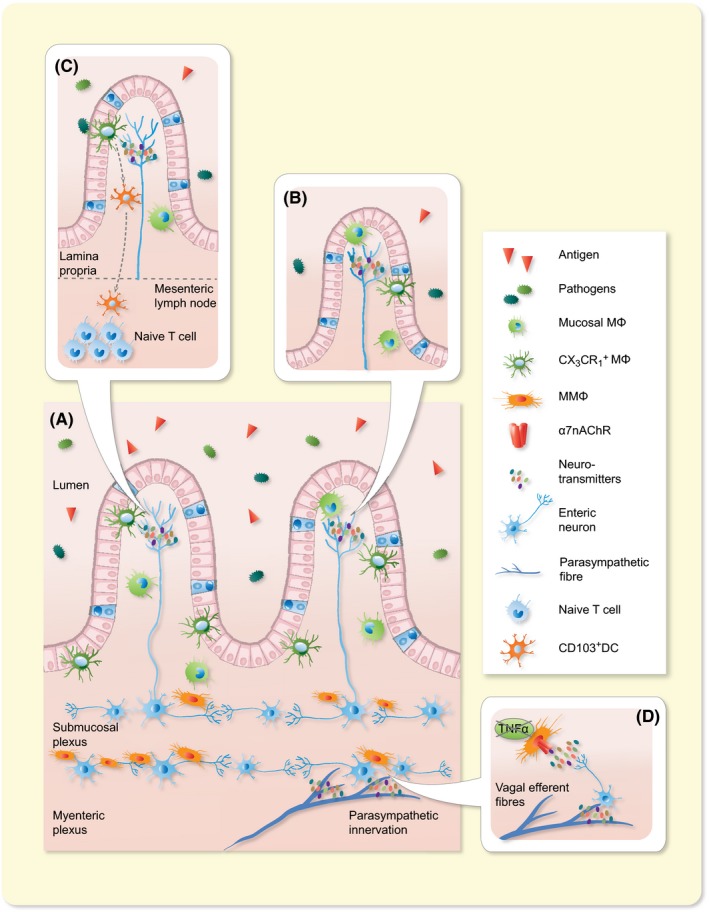
Schematic overview of the cross‐talk between the nervous and the immune system in the GI tract. The gastrointestinal tract is highly innervated by the autonomic nervous system and the enteric nervous system. A, Schematic representation of the intestinal wall with its different layers, showing the distribution of the intrinsic and extrinsic innervation and their relationship with the immune cells. Parasympathetic efferent fibres innervate the intestinal wall by contacting the enteric neurons located in the myenteric plexus region. B, In the mucosal villi immune cells, such as MMϕ and CX3CR1+ Mϕ, are instructed by neurotransmitters, like Ach, released by neuronal fibres. C, When the epithelial barrier is crossed by pathogens, CX3CR1+ Mϕ are able to migrate into the intestinal lumen in order to rapidly fight the infection and limit the number of bacteria entering in contact with the Lp. Once the antigen is trapped, it is passed to the CD103+ dendtritic cell (DC) which have migratory property. This population is capable to enter in the lymph and reach the mesenteric lymph node (MLN) where can prime T cell. D, In the myenteric plexus, close proximity between enteric neurons and resident Mϕ allow these cells to intercommunicate by secretion of neurotransmitters which influence the immune cells’ phenotype, mainly inhibiting TNFα production

References

    1. Kaser A, Zeissig S, Blumberg RS. Inflammatory bowel disease. Annu Rev Immunol. 2010;28:573‐621. - PMC - PubMed
    1. Danese S, Fiocchi C. Etiopathogenesis of inflammatory bowel diseases. World J Gastroenterol. 2006;12(30):4807‐4812. - PMC - PubMed
    1. Xavier RJ, Podolsky DK. Unravelling the pathogenesis of inflammatory bowel disease. Nature. 2007;448(7152):427‐434. - PubMed
    1. Nishino K, Nishida A, Inoue R, et al. Analysis of endoscopic brush samples identified mucosa‐associated dysbiosis in inflammatory bowel disease. J Gastroenterol. 2018;53(1):95‐106. - PubMed
    1. Hart AL, Al‐Hassi HO, Rigby RJ, et al. Characteristics of intestinal dendritic cells in inflammatory bowel diseases. Gastroenterology. 2005;129(1):50‐65. - PubMed

Publication types

MeSH terms

Substances