. 2018 Jul 11;24(1):146-154.e4.
doi: 10.1016/j.chom.2018.06.007.

Strain-Level Analysis of Mother-to-Child Bacterial Transmission during the First Few Months of Life

Affiliations

Strain-Level Analysis of Mother-to-Child Bacterial Transmission during the First Few Months of Life

Moran Yassour et al. Cell Host Microbe. .

Abstract

Bacterial community acquisition in the infant gut impacts immune education and disease susceptibility. We compared bacterial strains across and within families in a prospective birth cohort of 44 infants and their mothers, sampled longitudinally in the first months of each child's life. We identified mother-to-child bacterial transmission events and describe the incidence of family-specific antibiotic resistance genes. We observed two inheritance patterns across multiple species, where often the mother's dominant strain is transmitted to the child, but occasionally her secondary strains colonize the infant gut. In families where the secondary strain of B. uniformis was inherited, a starch utilization gene cluster that was absent in the mother's dominant strain was identified in the child, suggesting the selective advantage of a mother's secondary strain in the infant gut. Our findings reveal mother-to-child bacterial transmission events at high resolution and give insights into early colonization of the infant gut.


Conflict of interest statement

Declaration of Interests

The authors declare no competing interests

Figures
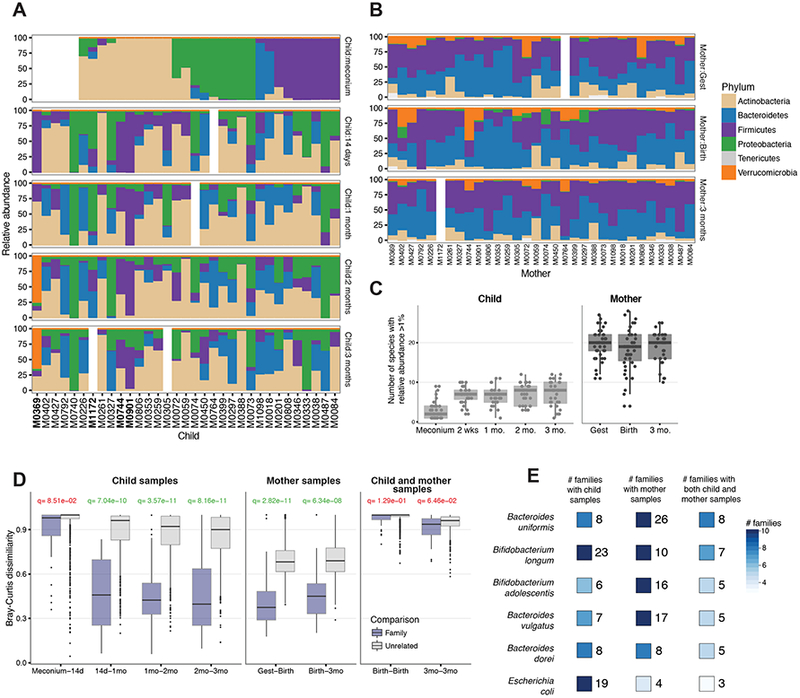
Figure 1:
Figure 1:. Gut microbiome trajectories of mother and child in the first 3 months of life.
(A–B) Relative phylum-level relative abundance profiles for the child (A) and mother (B) samples. Children born by C-section are highlighted in bold. (C) Microbial community complexity over time as estimated by the number of species occurring in a given sample above 1% relative abundance. (D) Stability of species-level composition profiles over time as measured by Bray-Curtis dissimilarity of individual children (left), mothers (center), and child-mother paired samples collected at birth and 3 months (right). The FDR-corrected q-value is shown for each comparison (calculated with a t-test) and colored green if q<0.05. (E) Species observed across multiple families, enumerating how many families have these species present in children (left), mothers (center), or both (right), with relevant abundance of >=5%.
Figure 2:
Figure 2:. Patterns of dominant and secondary strains shared in mother-child pairs.
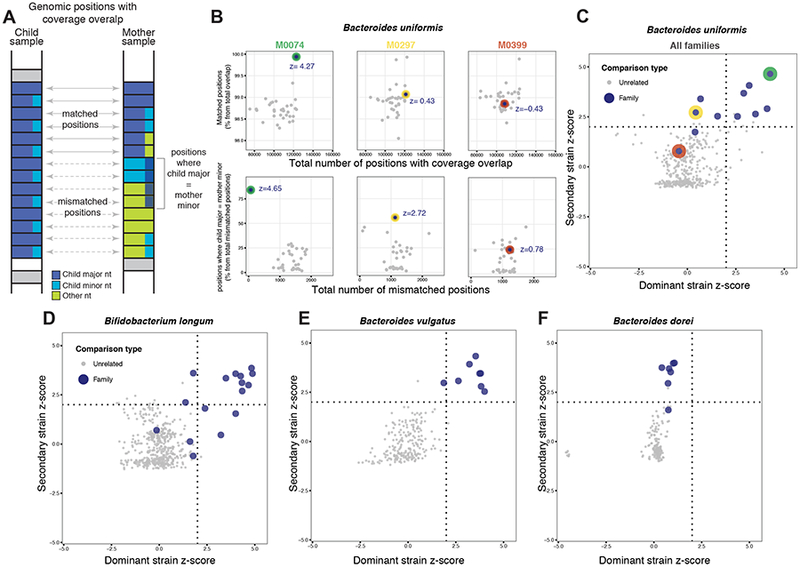
(A) Schematic view of matched and mismatched nucleotides counts based on reads aligning to species-specific marker genes. At each position of shared coverage, counts of major nucleotide matched positions are enumerated relative to those positions where the child’s major nucleotide matches the mother’s minor nucleotide. (B) Data from three mother-child pairs. Relative counts of major (top) and minor (bottom) nucleotide match events are shown together with their z-scores. (C–F) Plots depicting the distribution of dominant- and secondary-strain z-scores for individual species. Families occuring in the upper right, upper left, or bottom left quadrants show evidence of maternal transmission of dominant strain, secondary strain, or none, respectively, for that species (see Methods). Red, green, and yellow dots represent families shown in panel B.
Figure 3:
Figure 3:. Antibiotic resistance gene profiles show family-specific patterns
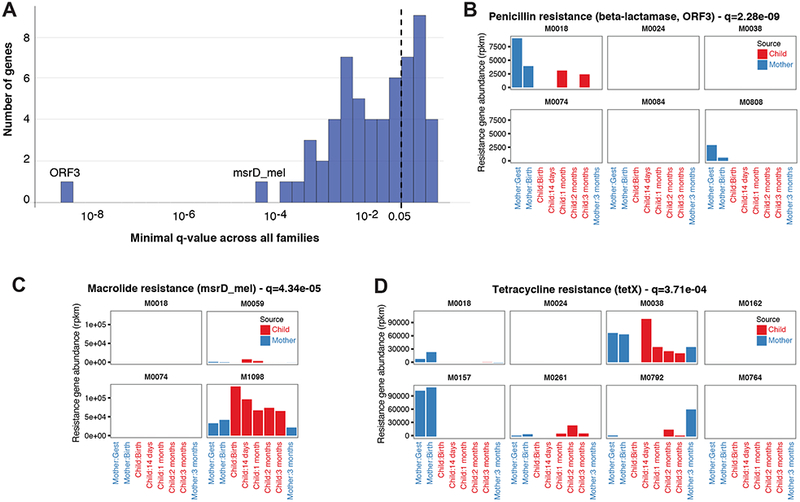
(A) Enrichment pattern of AR genes in at least one family relative to background. (B–D) These genes were identified as highly-associated with only one or two families in the cohort: (B) Penicillin resistance gene (ORF3), and (C) Macrolide resistance gene (msrD). (D) Tetracycline resistance gene (tetX) shows specific mother-only or mother-and-child family patterns.
Figure 4:
Figure 4:. B. uniformis starch utilization system
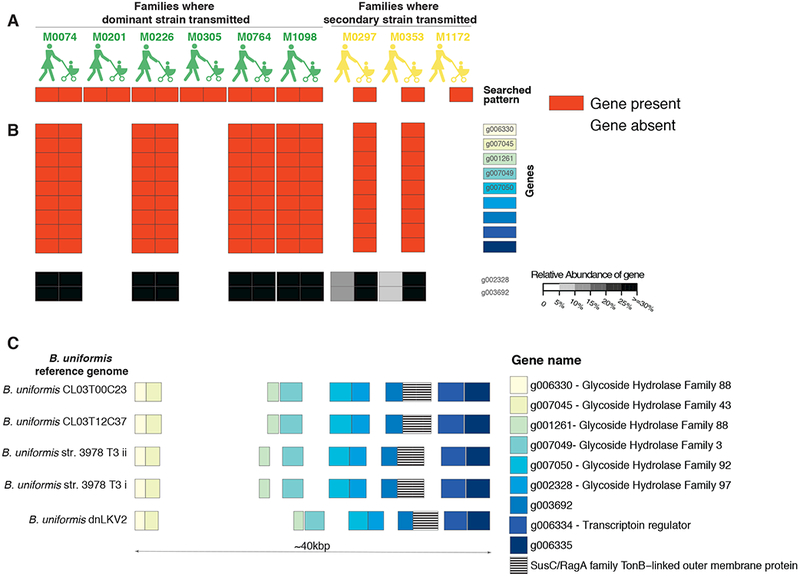
(A) A schematic showing the gene presence/absence (red/gray) patterns we inspected to identify functions that potentially drive the secondary strain inheritance. (B) Presence/absence profiles of nine B. uniformis genes that differ based on their inheritance patterns in a majority of mothers (red/white), together with qPCR results for two of the nine genes (grayscale). (C) The genomic location of the nine differential genes (yellow to blue) in five B. uniformis reference genomes, together with the SusC gene found in that location (stripes). White boxes are other genes.

Comment in

  • Delivery of the gut microbiome.
    York A. York A. Nat Rev Microbiol. 2018 Sep;16(9):520-521. doi: 10.1038/s41579-018-0059-3. Nat Rev Microbiol. 2018. PMID: 30018358 No abstract available.

References

    1. Asnicar F, Manara S, Zolfo M, Truong DT, Scholz M, Armanini F, Ferretti P, Gorfer V, Pedrotti A, Tett A, et al. (2017). Studying Vertical Microbiome Transmission from Mothers to Infants by Strain-Level Metagenomic Profiling. mSystems 2. - PMC - PubMed
    1. Bäckhed F, Roswall J, Peng Y, Feng Q, Jia H, Kovatcheva-Datchary P, Li Y, Xia Y, Xie H, Zhong H, et al. (2015). Dynamics and Stabilization of the Human Gut Microbiome during the First Year of Life. Cell Host Microbe 17, 690–703. - PubMed
    1. Biasucci G, Rubini M, Riboni S, Morelli L, Bessi E, and Retetangos C (2010). Mode of delivery affects the bacterial community in the newborn gut. Early Hum. Dev 86 Suppl 1, 13–15. - PubMed
    1. Cahenzli J, Köller Y, Wyss M, Geuking MB, and McCoy KD (2013). Intestinal microbial diversity during early-life colonization shapes long-term IgE levels. Cell Host Microbe 14, 559–570. - PMC - PubMed
    1. Chu DM, Ma J, Prince AL, Antony KM, Seferovic MD, and Aagaard KM (2017). Maturation of the infant microbiome community structure and function across multiple body sites and in relation to mode of delivery. Nat. Med 23, 314–326. - PMC - PubMed

Publication types