. 2018 Jul 12;9(1):2688.
doi: 10.1038/s41467-018-05040-8.

Domino-like multi-emissions across red and near infrared from solid-state 2-/2,6-aryl substituted BODIPY dyes

Affiliations

Domino-like multi-emissions across red and near infrared from solid-state 2-/2,6-aryl substituted BODIPY dyes

Dan Tian et al. Nat Commun. .

Abstract

Considerable achievements on multiple emission capabilities and tunable wavelengths have been obtained in inorganic luminescent materials. However, the development of organic counterparts remains a grand challenge. Herein we report a series of 2-/2,6-aryl substituted boron-dipyrromethene dyes with wide-range and multi-fluorescence emissions across red and near infrared in their aggregation states. Experimental data of X-ray diffraction, UV-vis absorption, and room temperature fluorescence spectra have proved the multiple excitation and easy-adjustable emission features in aggregated boron-dipyrromethene dyes. Temperature-dependent and time-resolved fluorescence studies have indicated a successive energy transfer from high to step-wisely lower-located energy levels that correspond to different excitation states of aggregates. Consistent quantum chemical calculation results have proposed possible aggregation modes of boron-dipyrromethene dyes to further support the above-described scenario. Thus, this study greatly enriches the fundamental recognition of conventional boron-dipyrromethene dyes by illustrating the relationships between multiple emission behaviors and the aggregation states of boron-dipyrromethene molecules.


Conflict of interest statement

The authors declare no competing interests.

Figures
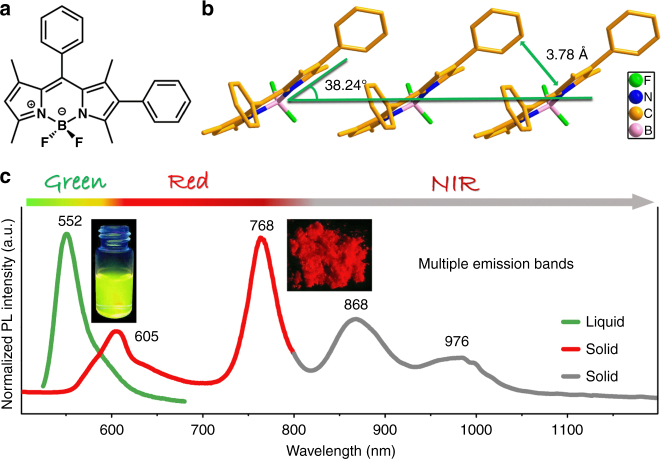
Fig. 1
Fig. 1
Structural details and fluorescent properties of BDP1. a Molecular structure of BDP1. b Molecular packing diagrams of BDP1 at room temperature extracted from single crystal XRD data. c Normalized photoluminescence (PL) spectra of BDP1 in solution (green curve) and microcrystalline powder state (red and gray curves)
Fig. 2
Fig. 2
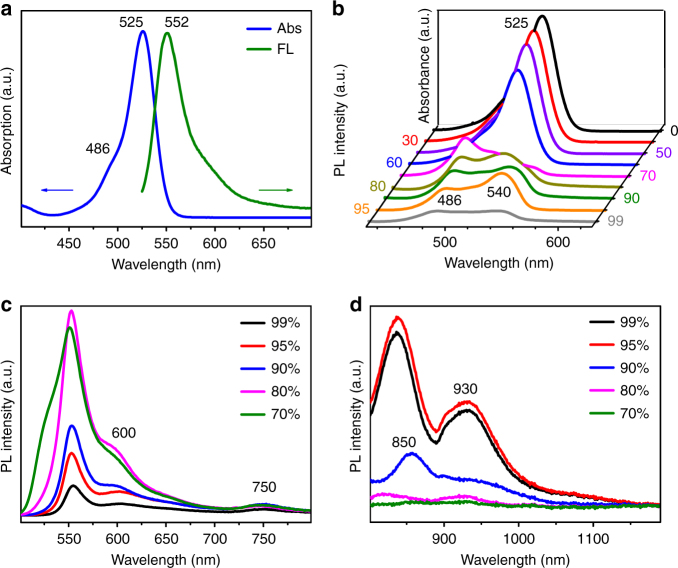
Photophysical properties of BDP1 in THF and THF/water mixtures. a Absorption and emission spectra of BDP1 in THF at 1 × 10−5 mol L−1. b Absorption and c, d emission spectra of BDP1 in THF/water mixtures with varied volumetric fractions of water (fw)
Fig. 3
Fig. 3
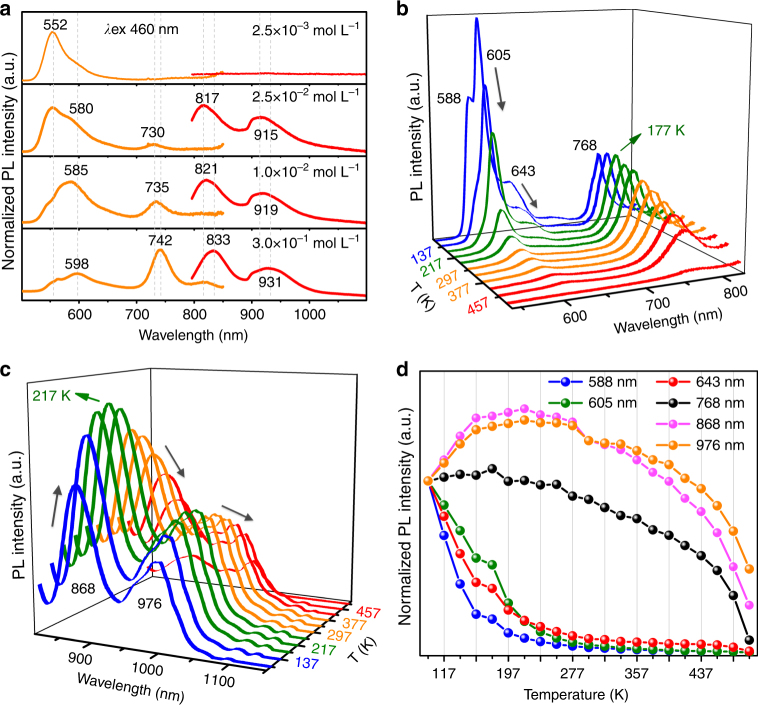
Fluorescent properties of aggregation-state BDP1. a Normalized fluorescence emission spectra of PMMA films prepared at different doping concentrations of BDP1. b, c Temperature-dependent emission spectra of microcrystalline powder state BDP1 collected from 97 to 497 K, excited at 480 nm. d Plots of normalized emission intensity changes of the multi-emissions at varying temperatures
Fig. 4
Fig. 4
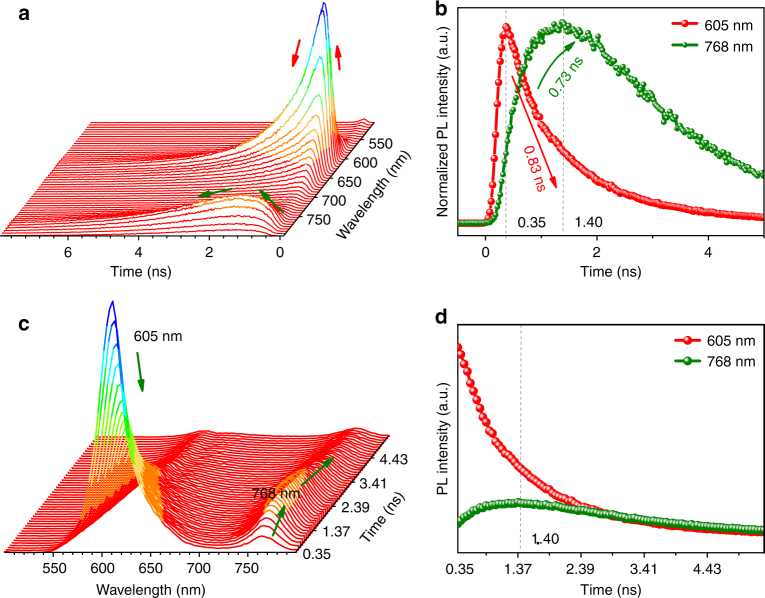
Time-resolved fluorescence properties of microcrystalline state BDP1. a Time-resolved fluorescence decay curves of BDP1 at emission wavelength (λem) of 500–800 nm. b Fluorescence decay curves of BDP1 at emission wavelengths of 605 and 768 nm. c Time-resolved emission spectra of BDP1 at the detection time from 0.35 to 5.45 ns d Time-resolved emission intensity variation of BDP1 at 605 and 768 nm. All samples measured were in microcrystalline powder state
Fig. 5
Fig. 5
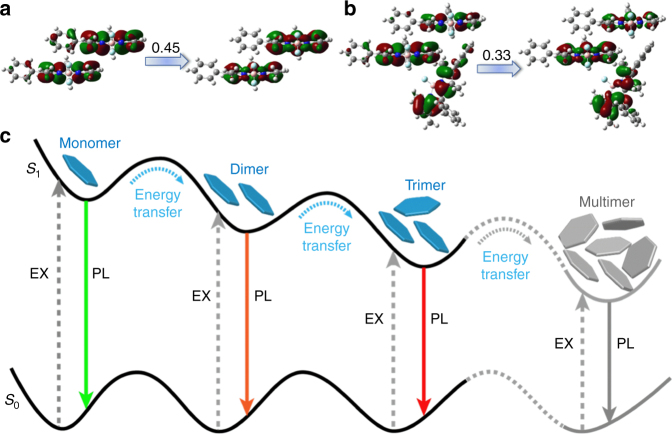
Theoretical calculations for mechanistic investigation. Calculated NTOs of BDP1 a dimer-1 and b trimer-1. c Schematic illustration of the proposed Domino-like energy transfer and subsequent multiple emissions in solid state BDP1
Fig. 6
Fig. 6
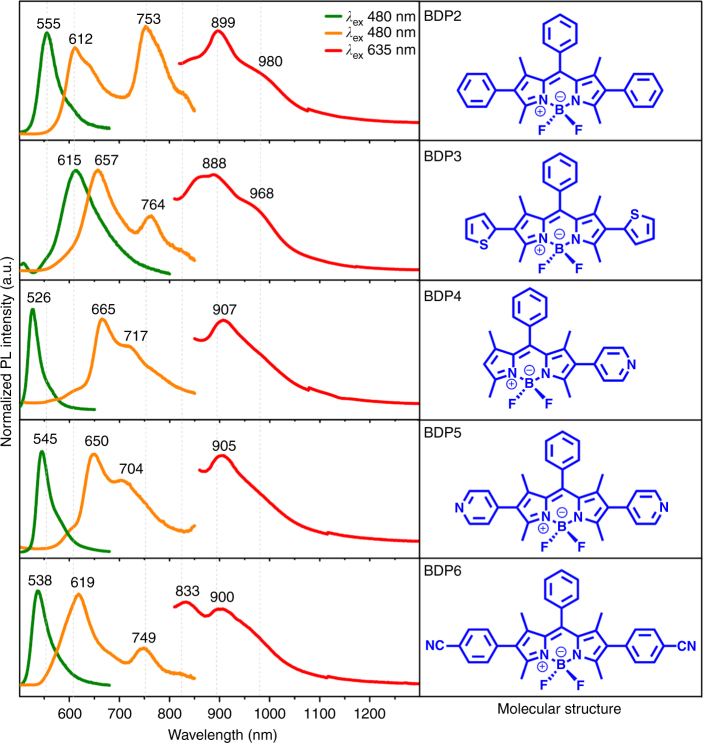
Photophysical properties of microcrystalline state BDP2 to BDP6. Normalized fluorescence emissions (left column) of BDP2 to BDP6 in solution (green lines) and microcrystalline powder state (orange and red lines) with corresponding molecular structures in the right column

References

    1. Saito S, et al. Light-melt adhesive based on dynamic carbon frameworks in a columnar liquid-crystal phase. Nat. Commun. 2016;7:12094. doi: 10.1038/ncomms12094. - DOI - PMC - PubMed
    1. Zhang X, Rehm S, Safont-Sempere MM, Wurthner F. Vesicular perylene dye nanocapsules as supramolecular fluorescent pH sensor systems. Nat. Chem. 2009;1:623–629. doi: 10.1038/nchem.368. - DOI - PubMed
    1. He G, et al. A color-tunable europium complex emitting three primary colors and white light. Angew. Chem., Int. Ed. 2009;48:6132–6135. doi: 10.1002/anie.200901266. - DOI - PubMed
    1. Mo HW, et al. Color tuning of avobenzone boron difluoride as an emitter to achieve full-color emission. Adv. Funct. Mater. 2016;26:6703–6710. doi: 10.1002/adfm.201601257. - DOI
    1. Wang X, et al. Recent developments in lanthanide-based luminescent probes. Coord. Chem. Rev. 2014;273−274:201–212. doi: 10.1016/j.ccr.2014.02.001. - DOI

Publication types