. 2018 Jul 12;8(1):10589.
doi: 10.1038/s41598-018-28838-4.

Plant-expressed bacteriophage lysins control pathogenic strains of Clostridium perfringens

Affiliations

Plant-expressed bacteriophage lysins control pathogenic strains of Clostridium perfringens

Vaiva Kazanavičiūtė et al. Sci Rep. .

Abstract

The anaerobic spore-forming bacterium Clostridium perfringens is a source of one of the most common food-borne illnesses in the United States and Europe. The costs associated with disease management are high and interventions are limited; therefore, effective and safe antimicrobials are needed to control food contamination by C. perfringens. A viable solution to this problem could be bacteriophage lysins used as food additives or food processing aids. Such antimicrobials could be produced cost-effectively and in ample supply in green plants. By using edible plant species as production hosts the need for expensive product purification can be reduced or obviated. We describe the first successful expression in plants of C. perfringens-specific bacteriophage lysins. We demonstrate that six lysins belonging to two different families (N-acetylmuramoyl-L-alanine amidase and glycosyl hydrolase 25) are active against a panel of enteropathogenic C. perfringens strains under salinity and acidity conditions relevant to food preparation environments. We also demonstrate that plant-expressed lysins prevent multiplication of C. perfringens on cooked meat matrices far better than nisin, the only currently approved bacteriocin food preservative to control this pathogen.


Conflict of interest statement

The authors declare no competing interests.

Figures

Figure 1
Figure 1
Alignment of PlyCM, psm, ZP173, ZP278 and Ply3626 amino acid sequences. Alignment of amino acid sequences was completed using Clustal W in Geneious and shading represents conserved identical residues shared among proteins.
Figure 2
Figure 2
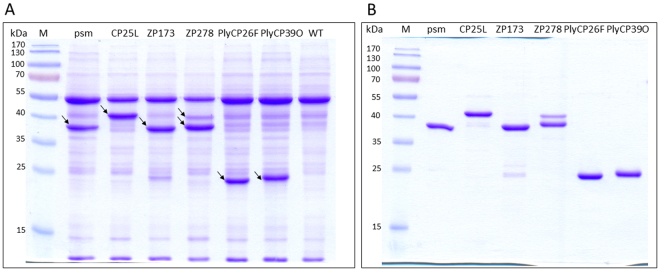
Expression of Clostridium perfringens bacteriophage lysins. Coomasie stained SDS-PAGE of crude plant extracts (A) and purified lysins (B). (A) Plant material (50 mg) was harvested at 5 or 7 days post spraying (psm, CP25L, ZP173, ZP278) or post infiltration (PlyCP26F, PlyCP39O), ground in liquid nitrogen and extracted with 50 mM sodium phosphate, 5 mM DTT, 150 mM NaCl, (pH 7.5). 4 µl of plant extract was resolved in 12.5% polyacrylamide gel for Coomassie staining. M – PageRuler Prestained protein ladder (Thermo Fisher Scientific Baltics), psm, CP25L, ZP173, ZP278, PlyCP26F, PlyCP39O – extracts of N. benthamiana leaves, transfected with lysins expression constructs, WT – crude extract of non - sprayed N. benthamiana leaves. Bands corresponding to recombinant lysins are marked by arrows. (B) Lysins were purified by two-step chromatography as described in Purification section of Methods and Suppl. Text S1, and resolved in 12.5% polyacrylamide gel for Coomassie staining.
Figure 3
Figure 3
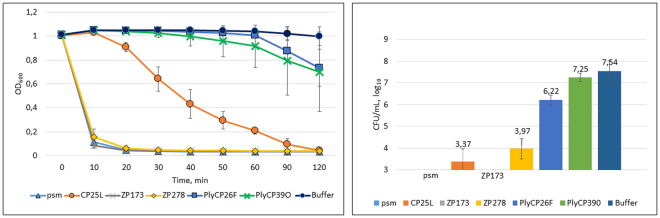
Bacteriolytic activity of N. benthamiana–expressed lysins against C. perfringens NCTC8237. C. perfringens NCTC8237 was suspended in citrate-phosphate buffer supplemented with 50 mM NaCl, pH 5.5 and treated with 10 µg/ml of lysin. Left panel: the turbidity reduction of the bacterial suspension after incubation with lysins. Right panel: C. perfringens cfu counts after 60 min. of co-incubation with lysins. Data are the mean ± SD of three independent experiments.
Figure 4
Figure 4
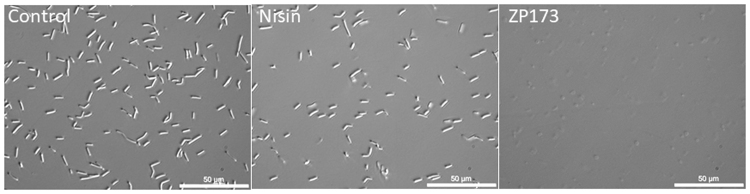
The morphology of untreated, ZP173-treated and nisin-treated NCTC8237. C. perfringens was incubated with 5.5 µg/ml of nisin or with 5 µg/ml of ZP173 in citrate-phosphate buffer with 50 mM NaCl (pH 5.5). The microscopy images (x1,000 magnification, phase contrast) were taken after 90 min of incubation at RT.
Figure 5
Figure 5
Activity of plant – expressed lysins at different concentration of NaCl and at different pH. Left panel, NaCl. C. perfringens NCT8237 was grown in TSB under anaerobic conditions to OD600 = 0.6-0.7, centrifuged and suspended in citrate-phosphate buffer of pH 5.5 with different NaCl concentrations. 1 ml of bacterial suspension was mixed with 3 µg of purified ZP173, 34 µg of ZP278 or 7.5 µg of CP25L and incubated at RT for 60 min. Right panel, pH. C. perfringens NCT8237 was suspended in citrate-phosphate buffer with 100 mM NaCl (buffer pH from 4.5 to 8.0). 1 ml of bacterial suspension was mixed with 4 µg of ZP173, 27 µg of ZP278 or 5 µg of CP25L and incubated at RT for 1 h.
Figure 6
Figure 6
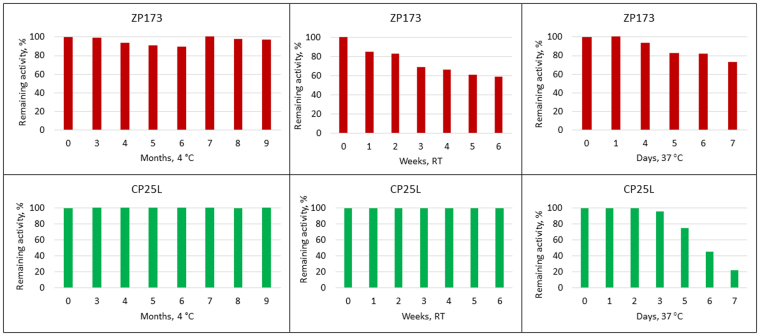
Remaining activity (%) of lysins after incubation at 4 °C, RT and 37 °C. Left panel: the purified lyophilized lysins were dissolved in milli-Q water and stored at 4 °C for up to 9 months. For activity assays, C. perfringens NCTC8237 was grown to OD600 = 0.8 in TSB anaerobically. Following centrifugation, bacteria were suspended in citrate-phosphate buffer with 50 mM NaCl, pH 5.5. 1 ml of bacteria was combined with 2 µg of purified lysin and incubated at RT for 1 hour. Middle panel: The lysins activity after long-term storage at room temperature. The purified lysins were incubated at RT for 1 to 6 weeks. C. perfringens NCT8237 was suspended in 1xPBS, pH 7.3 (CP25L) or citrate-phosphate buffer with 100 mM NaCl, pH 5.5 (ZP173). Bacterial suspension was mixed with 2 µg/ml of ZP173 or CP25L and incubated at RT for 1 hour. Right panel: the purified lysins were incubated at 37 °C for 1 to 7 days. C. perfringens NCT8237 was suspended in PBS, pH 7.3, mixed with 2 µg/ml of ZP173 or CP25L and incubated at RT for 1 hour. Remaining activity percent was calculated by taking activity of freshly solubilized lysins (from purified lyophilized stock) Δlog10 CFU/mL value as 100%.
Figure 7
Figure 7
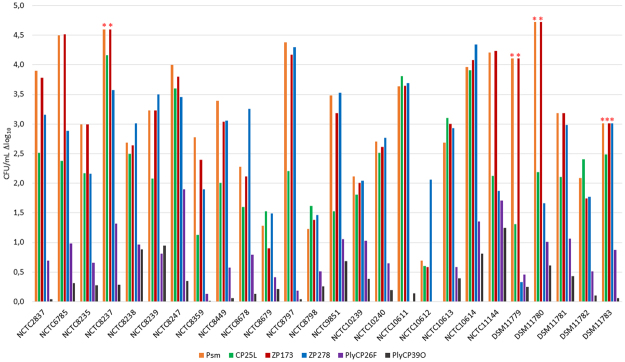
Killing of C. perfringens food strains by N. benthamiana – expressed lysins. CFU/mL Δlog10 of different C. perfringens strains treated with each lysin separately. C. perfringens strains were grown in TSB under anaerobic conditions to OD600 appr. 0.8 and suspended in citrate-phosphate buffer, 50 mM NaCl, pH 5.5. Lysins were added to bacterial suspension at final concentration of 10 µg/ml. Serial dilutions for cfu counts were done in PBS, pH 7.3 after 60 min. of co-incubation with lysins. *- no colonies were detected on plates.
Figure 8
Figure 8
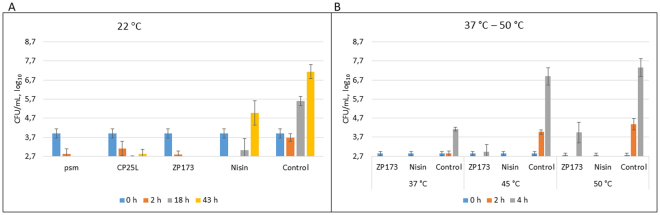
Activity of purified lysins in C. perfringens-contaminated turkey. (A) Activity of purified lysins in C. perfringens-contaminated turkey at room temperature. C. perfringens NCTC8237 bacteria were mixed with 10 g of minced cooked turkey meat at 4 log10 cfu/ml, 3 ml of citrate-phosphate buffer supplemented with NaCl (final concentration of 1.5%), pH 5.5 and 2.5 µg/ml of purified lysin or 5 µg/ml of nisin. 0 h – cfu counts of samples before addition of lysins or nisin. 2 h, 18 h and 43 h – cfu counts of samples, incubated at RT anaerobically for the indicated time. Data are the mean ± SD of four independent experiments. (B) Activity of ZP173 and nisin in C. perfringens-contaminated turkey at 37 °C–50 °C. C. perfringens NCTC8237 bacteria were mixed with 10 g of minced cooked turkey meat at 3 log10 cfu/ml, 3 ml of citrate-phosphate buffer with NaCl (final concentration of 1.5%), pH 5.5 and 5 µg/ml of purified lysin or 5 µg/ml of nisin and incubated at 37 °C, 45 °C and 50 °C anaerobically. 0 h – cfu counts of samples before addition of lysins or nisin. 2 h and 4 h – cfu counts of samples, incubated for the indicated time. Data are the mean ± SD of three independent experiments.

References

    1. Xiao Y, Wagendorp A, Moezelaar R, Abee T, Wells-Bennik MH. A wide variety of Clostridium perfringens type A food-borne isolates that carry a chromosomal cpe gene belong to one multilocus sequence typing cluster. Appl Environ Microbiol. 2012;78:7060–7068. doi: 10.1128/AEM.01486-12. - DOI - PMC - PubMed
    1. Li J, McClane BA. Further comparison of temperature effects on growth and survival of Clostridium perfringens type A isolates carrying a chromosomal or plasmid-borne enterotoxin gene. Appl Environ Microbiol. 2006;72:4561–4568. doi: 10.1128/AEM.00177-06. - DOI - PMC - PubMed
    1. Lindstrom M, Heikinheimo A, Lahti P, Korkeala H. Novel insights into the epidemiology of Clostridium perfringens type A food poisoning. Food Microbiol. 2011;28:192–198. doi: 10.1016/j.fm.2010.03.020. - DOI - PubMed
    1. Mangen MJ, et al. Cost-of-illness and disease burden of food-related pathogens in the Netherlands, 2011. Int J Food Microbiol. 2015;196:84–93. doi: 10.1016/j.ijfoodmicro.2014.11.022. - DOI - PubMed
    1. Economic Research Service (ERS), U. S. D. o. A. U. Cost Estimates of Foodborne Illnesses. http://ers.usda.gov/data-products/cost-estimates-of-foodborne-illnesses (2014).

MeSH terms

LinkOut - more resources