


Predicting seizure outcome of vagus nerve stimulation using MEG-based network topology
- PMID: 30003036
- PMCID: PMC6039837
- DOI: 10.1016/j.nicl.2018.06.017
Predicting seizure outcome of vagus nerve stimulation using MEG-based network topology
Abstract
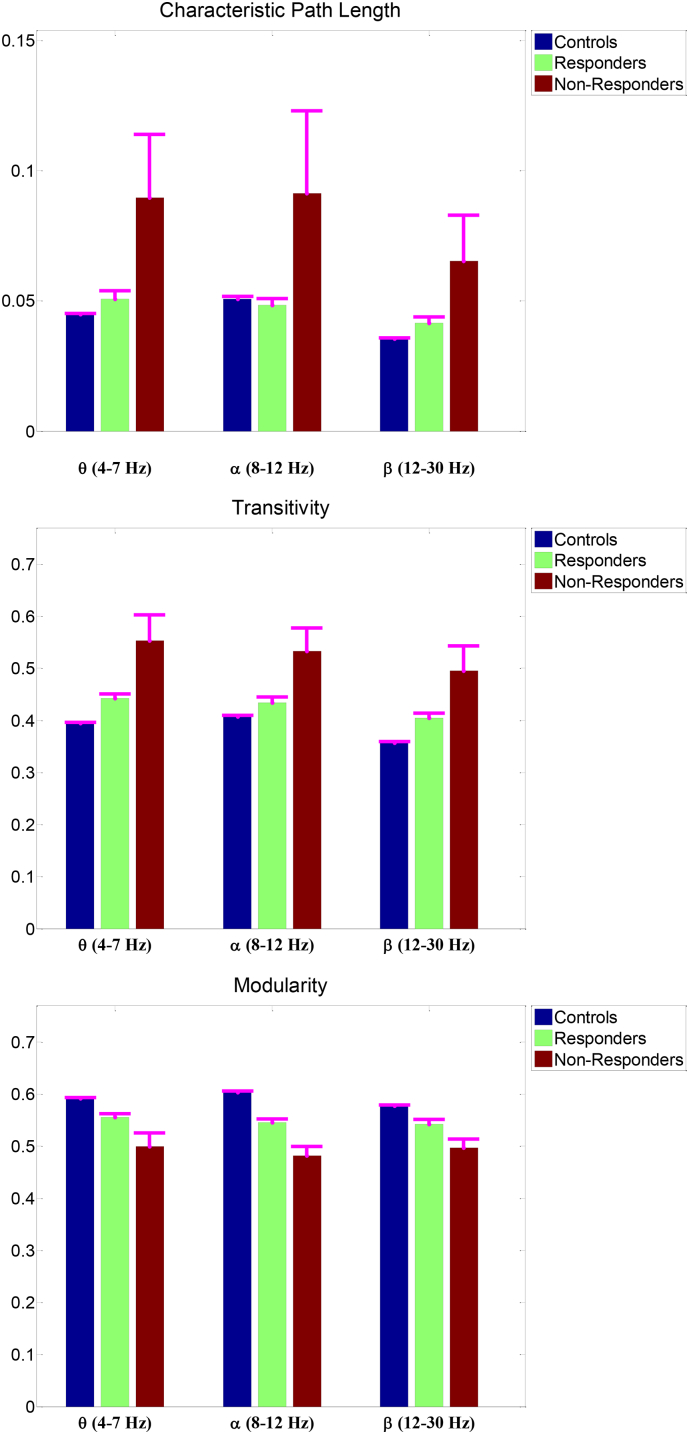
Vagus nerve stimulation (VNS) is a low-risk surgical option for patients with drug resistant epilepsy, although it is impossible to predict which patients may respond to VNS treatment. Resting-state magnetoencephalography (rs-MEG) connectivity analysis has been increasingly utilized to investigate the impact of epilepsy on brain networks and identify alteration of these networks after different treatments; however, there is no study to date utilizing this modality to predict the efficacy of VNS treatment. We investigated whether the rs-MEG network topology before VNS implantation can be used to predict efficacy of VNS treatment. Twenty-three patients with epilepsy who had MEG before VNS implantation were included in this study. We also included 89 healthy control subjects from the Human Connectome Project. Using the phase-locking value in the theta, alpha, and beta frequency bands as a measure of rs-MEG functional connectivity, we calculated three global graph measures: modularity, transitivity, and characteristic path length (CPL). Our results revealed that the rs-MEG graph measures were significantly heritable and had an overall good test-retest reliability, and thus these measures may be used as potential biomarkers of the network topology. We found that the modularity and transitivity in VNS responders were significantly larger and smaller, respectively, than those observed in VNS non-responders. We also observed that the modularity and transitivity in three frequency bands and CPL in delta and beta bands were significantly different in controls than those found in responders or non-responders, although the values of the graph measures in controls were closer to those of responders than non-responders. We used the modularity and transitivity as input features of a naïve Bayes classifier, and achieved an accuracy of 87% in classification of non-responders, responders, and controls. The results of this study revealed that MEG-based graph measures are reliable biomarkers, and that these measures may be used to predict seizure outcome of VNS treatment.
Keywords: Functional connectivity; Graph measures; Human connectome project (HCP); Magnetoencephalography (MEG); Phase-locking value (PLV); Seizure outcome; VNS efficacy; Vagus nerve stimulation (VNS).
Figures
References
-
- Anguita D., Ghio A., Ridella S., Sterpi D. K-fold cross validation for error rate estimate in support vector machines. DMIN. 2009:291–297.
-
- Babajani-Feremi A. Neural mechanism underling comprehension of narrative speech and its heritability: study in a large population. Brain Topogr. Sep 2017;30:592–609. - PubMed
-
- Benjamini Y., Hochberg Y. Controlling the false discovery rate - a practical and powerful approach to multiple testing. J. R. Stat. Soc. Series B. 1995;57:289–300.
Publication types
MeSH terms
LinkOut - more resources
Full Text Sources
Other Literature Sources
Miscellaneous
