


Immigrant health trajectories in historical context: Insights from European immigrant childhood mortality in 1910
- PMID: 30003134
- PMCID: PMC6040110
- DOI: 10.1016/j.ssmph.2018.06.004
Immigrant health trajectories in historical context: Insights from European immigrant childhood mortality in 1910
Erratum in
-
Erratum regarding missing Declaration of Competing Interest statements in previously published articles.SSM Popul Health. 2020 Dec 10;12:100711. doi: 10.1016/j.ssmph.2020.100711. eCollection 2020 Dec. SSM Popul Health. 2020. PMID: 33381634 Free PMC article.
Abstract
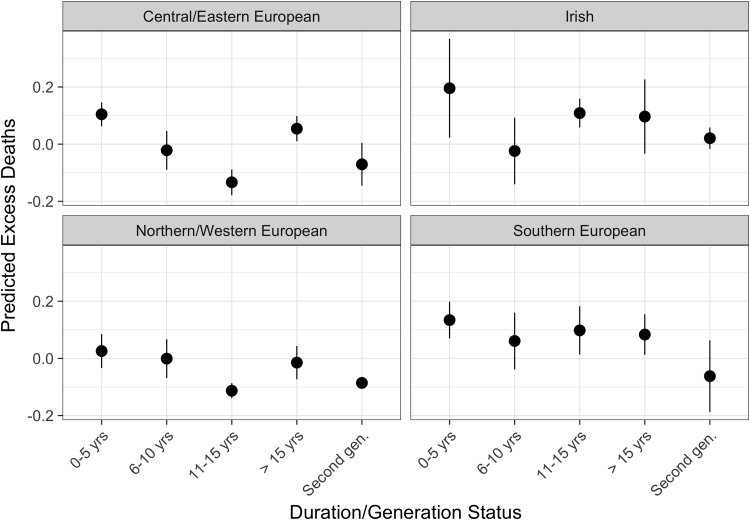
Recent studies of immigrant health have focused on an apparent paradox in which some new immigrants arrive healthier than expected but exhibit poorer health outcomes with duration of residence. Although a variety of explanations have been put forth for this epidemiological pattern, questions remain about the socio-historical generalizability of the empirical findings and accompanying theoretical explanations. By examining childhood mortality patterns of European immigrants to the United States in the early 20th century, this study tests hypotheses from current immigrant health literature in a previous era of immigration. In contrast with post-1965 immigrant groups, European arrivals did not have better outcomes than their U.S.-born white counterparts. Rather, their rates corresponded to a "middle tier" status in between U.S.-born black and white populations. Analysis of post-migration trajectories returned mixed results that similarly differ from contemporary patterns. Many new immigrant groups had higher rates of excess childhood mortality than their U.S-born counterparts, but outcomes appear to have improved with duration of residence or among the second generation. These findings suggest socio-historical variation in the context of reception may act as a "fundamental cause" of immigrant health and mortality outcomes.
Keywords: Assimilation; Epidemiological paradox; European immigration; Immigrant health.
Figures

References
-
- Abdulrahim S., Baker W. Differences in self-rated health by immigrant status and language preference among Arab Americans in the Detroit Metropolitan Area. Social Science & Medicine. 2009;68(12):2097–2103. - PubMed
-
- Acevedo-Garcia D., Sanchez-Vaznaugh E.V., Viruell-Fuentes E.A., Almeida J. Integrating social epidemiology into immigrant health research: A cross-national framework. Social Science & Medicine. 2012;75(12):2060–2068. - PubMed
-
- Akresh I.R., Do D.P., Frank R. Segmented assimilation, neighborhood disadvantage, and Hispanic immigrant health. SocialScience & Medicine. 2016;149:114–121. - PubMed
-
- Alba R.D., Logan J.R., Stults B.J., Marzan G., Zhang W. Immigrant groups in the suburbs: A reexamination of suburbanization and spatial assimilation. American Sociological Review. 1999;64(3):446–460.
-
- Allen J.D., Caspi C., Yang M., Leyva B., Stoddard A.M., Tamers S.…Sorensen G.C. Pathways between acculturation and health behaviors among residents of low-income housing: the mediating role of social and contextual factors. Social Science & Medicine. 2014;123:26–36. doi: 10.1016/j.socscimed.2014.10.034. - DOI - PMC - PubMed
LinkOut - more resources
Full Text Sources
Other Literature Sources
