


Time course of panic disorder and posttraumatic stress disorder onsets
- PMID: 30003310
- PMCID: PMC6509003
- DOI: 10.1007/s00127-018-1559-1
Time course of panic disorder and posttraumatic stress disorder onsets
Abstract
Purpose: Posttraumatic stress disorder (PTSD) often co-occurs with panic disorder (PD), with some etiological models positing a causal role of panic reactivity in PTSD onset; however, data addressing the temporal ordering of these conditions are lacking. The aim of this study was to examine the bi-directional associations between PD and PTSD in a nationally representative, epidemiologic sample of trauma-exposed adults.
Methods: Participants were community-dwelling adults (62.6% women; Mage = 48.9, SD 16.3) with lifetime DSM-IV PTSD criterion A trauma exposure drawn from the 2001/2 National Epidemiologic Survey on Alcohol and Related Conditions (NESARC) and re-interviewed in 2004/5 (N = 12,467). Cox discrete-time proportional hazards models with time-varying covariates were used to investigate the bi-directional associations between lifetime PD and PTSD, accounting for demographic characteristics, trauma load, and lifetime history of major depression, generalized anxiety disorder, and social anxiety disorder.
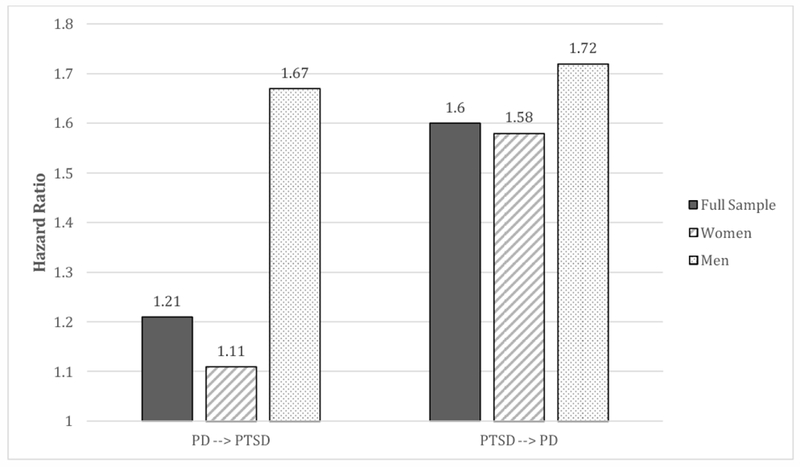
Results: PD was significantly associated with subsequent onset of PTSD (HR 1.210, 95%CI = 1.207-1.214, p < .001), and PTSD was significantly associated with onset of PD (HR 1.601, 95% CI 1.597-1.604, p < .001). The association between PTSD and subsequent PD was stronger in magnitude than that between PD and subsequent PTSD (Z = - 275.21, p < .01). Men evidenced stronger associations between PD and PTSD compared to women.
Conclusions: Results were consistent with a bidirectional pathway of risk, whereby PD significantly increased risk for the development of PTSD, and PTSD significantly increased risk for PD. Given the association between PTSD and subsequent PD, particularly among men, clinicians may consider supplementing PTSD treatment with panic-specific interventions, such as interoceptive exposure, to prevent or treat this disabling comorbidity.
Keywords: Epidemiology; Panic attack; Panic disorder; Posttraumatic stress disorder; Trauma.
Conflict of interest statement
Figures
References
-
- American Psychiatric Association. Diagnostic and Statistical Manual of Mental Disorders: Fourth Edition Washington, D.C.: Author; 1994.
-
- Kilpatrick DG, Ruggiero KJ, Acierno R et al. Violence and risk of PTSD, major depression, substance abuse/dependence, and comorbidity: results from the National Survey of Adolescents. J Consult Clin Psychol 2003;71(4):692–700. - PubMed
-
- Pietrzak RH, Goldstein RB, Southwick SM, Grant BF. Prevalence and Axis I comorbidity of full and partial posttraumatic stress disorder in the United States: results from Wave 2 of the National Epidemiologic Survey on Alcohol and Related Conditions. J Anxiety Disord 2011;25(3):456–465. - PMC - PubMed
-
- McFarlane AC, Van Hooff M. Impact of childhood exposure to a natural disaster on adult mental health: 20-year longitudinal follow-up study. Br J Psychiatry 2009;195(2):142–148. - PubMed
-
- Kessler RC, Sonnega A, Bromet E et al. . Posttraumatic stress disorder in the National Comorbidity Survey. Arch Gen Psychiatry 1995;52(12):1048–1060. - PubMed
MeSH terms
Grants and funding
LinkOut - more resources
Full Text Sources
Other Literature Sources
Medical
