


Adaptation to poststroke visual field loss: A systematic review
- PMID: 30004186
- PMCID: PMC6086007
- DOI: 10.1002/brb3.1041
Adaptation to poststroke visual field loss: A systematic review
Abstract
Aim: To provide a systematic overview of the factors that influence how a person adapts to visual field loss following stroke.
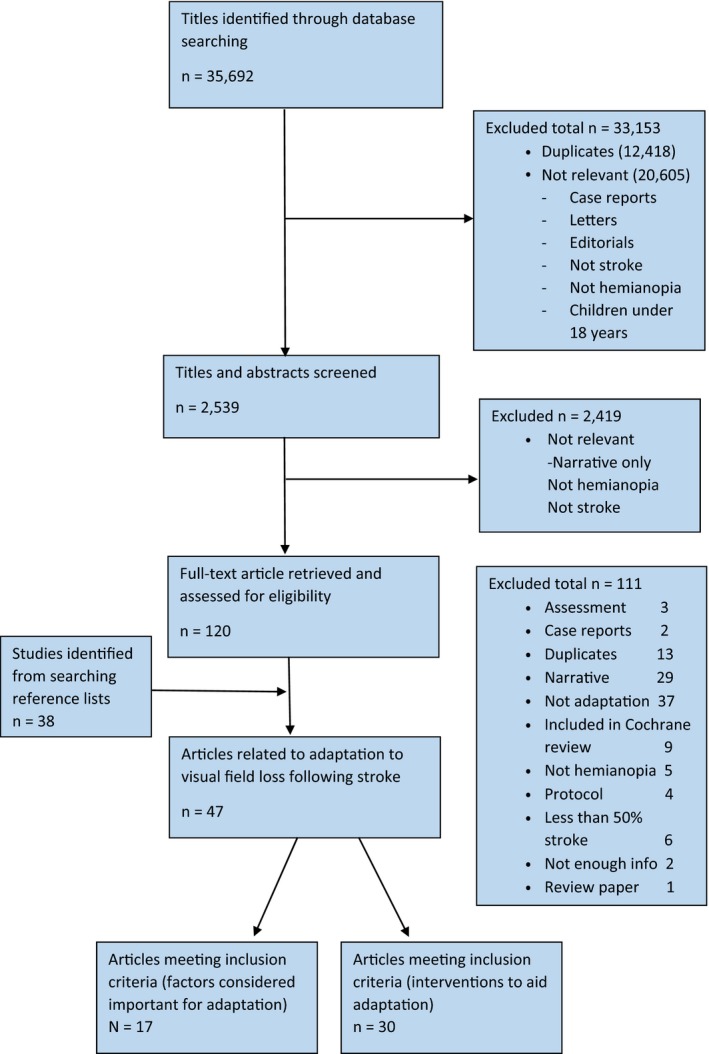
Method: A systematic review was undertaken (data search period 1861-2016) inclusive of systematic reviews, randomized controlled trials, controlled trials, cohort studies, observational studies, and case controlled studies. Studies including adult subjects with hemifield visual field loss, which occured as a direct consequence of stroke, were included. Search terms included a range of MESH terms as well as alternative terms relating to stroke, visual field loss, visual functions, visual perception, and adaptation. Articles were selected by two authors independently, and data were extracted by one author, being verified by the second. All included articles were assessed for risk of bias and quality using checklists appropriate to the study design.
Results: Forty-seven articles (2,900 participants) were included in the overall review, categorized into two sections. Section one included seventeen studies where the reviewers were able to identify a factor they considered as likely to be important for the process of adaptation to poststroke visual field loss. Section two included thirty studies detailing interventions for visual field loss that the reviewers deemed likely to have an influence on the adaptation process. There were no studies identified which specifically investigated and summarized the factors that influence how a person adapts to visual field loss following stroke.
Conclusion: There is a substantial amount of evidence that patients can be supported to compensate and adapt to visual field loss following stroke using a range of strategies and methods. However, this systematic review highlights the fact that many unanswered questions in the area of adaptation to visual field loss remain. Further research is required on strategies and methods to improve adaptation to aid clinicians in supporting these patients along their rehabilitation journey.
Keywords: adaptation; hemianopia; intervention; rehabilitation; stroke; visual field.
© 2018 The Authors. Brain and Behavior published by Wiley Periodicals, Inc.
References
-
- Bainbridge, W. , & Reding, M. (1994). Full‐field prisms for hemi‐field visual impairment following stroke‐A controlled trial. Neurology, 44(Suppl 2), A312–A313.
-
- Bergsma, D. P. , Leenders, M. J. A. , Verster, J. C. , van der Wildt, G. J. , & van den Berg, A. V. (2011). Oculomotor behavior of hemianopic chronic stroke patients in a driving simulator is modulated by vision training. Restorative Neurology and Neuroscience, 29(5), 347–359. - PubMed
Publication types
MeSH terms
LinkOut - more resources
Full Text Sources
Other Literature Sources
Medical
Molecular Biology Databases
