


Beyond binary retention in HIV care: predictors of the dynamic processes of patient engagement, disengagement, and re-entry into care in a US clinical cohort
- PMID: 30005018
- PMCID: PMC6136972
- DOI: 10.1097/QAD.0000000000001936
Beyond binary retention in HIV care: predictors of the dynamic processes of patient engagement, disengagement, and re-entry into care in a US clinical cohort
Abstract
Objectives: Studies examining engagement in HIV care often capture cross-sectional patient status to estimate retention and identify predictors of attrition, which ignore longitudinal patient care-seeking behaviors. We describe the cyclical nature of (dis)engagement and re-entry into HIV care using the state transition framework.
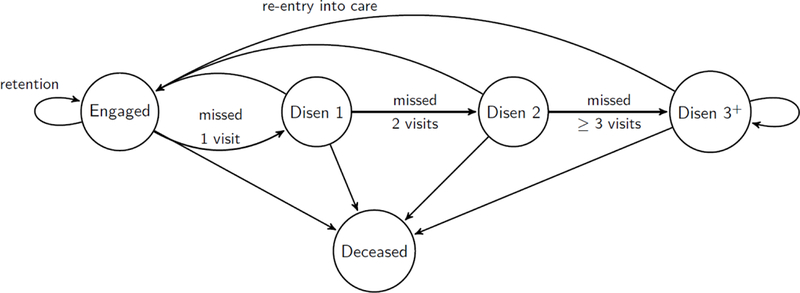
Design: We represent the dynamic patterns of patient care-retention using five states: engaged in care, missed one, two, three, or more expected visits, and deceased. Then we describe various care-seeking behaviors in terms of transitioning from one state to another (e.g. from disengaged to engaged). This analysis includes 31 009 patients enrolled in the Center for AIDS Research Network of Integrated Systems (CNICS) in the United States from 1996 to 2014.
Method: Multistate models for longitudinal data were used to identify barriers to retention and subgroups at higher risk of falling out of care.
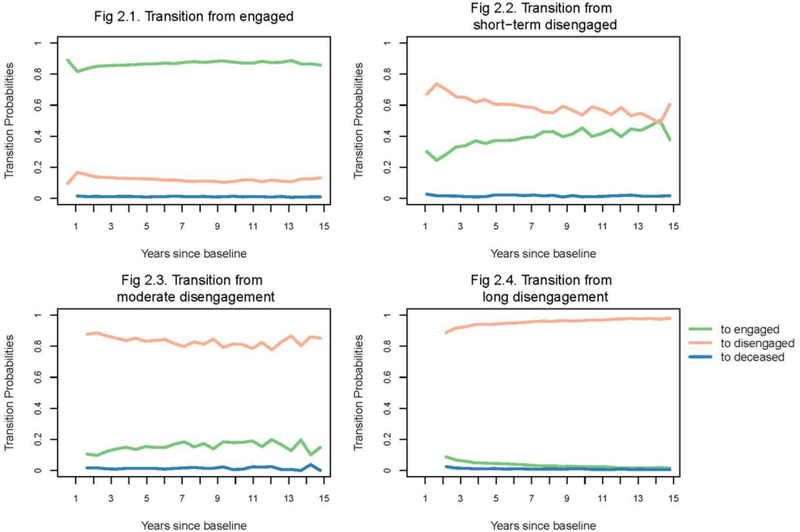
Results: The initial 2 years following primary engagement in care were a crucial time for improving retention. Patients who had not initiated antiretroviral therapy, with lower CD4 cell counts, higher viral load, or not having an AIDS-defining illness were less likely to be retained in care.
Conclusion: Beyond the individual patient characteristics typically used to characterize retention in HIV care, we identified specific periods of time and points in the care continuum associated with elevated risk of transitioning out of care. Our findings can contribute to evidence-based recommendations to enhance long-term retention in CNICS. This approach can also be applied to other cohort data to identify retention strategies tailored to each population.
Figures
References
-
- The White House, O.o.N.A.P., National HIV/AIDS Strategy, Improving Outcomes: Accelerating Progress Along the HIV Care Continuum. 2013.
-
- The White House, O.o.t.P.S., FACT SHEET: Accelerating Improvements in HIV Prevention and Care in the United States through the HIV Care Continuum Initiative. 2013.
-
- Centers for Disease Control and Prevention, C., Understanding the HIV Care Continuum. 2017.
-
- Giordano TP, et al. , Predictors of retention in HIV care among a national cohort of US veterans. HIV Clin Trials, 2009. 10(5): p. 299–305. - PubMed
Publication types
MeSH terms
Grants and funding
LinkOut - more resources
Full Text Sources
Other Literature Sources
Medical
Research Materials
