


[Comparison of King Vision video laryngoscope and Macintosh laryngoscope: a prospective randomized controlled clinical trial]
- PMID: 30005810
- PMCID: PMC9391737
- DOI: 10.1016/j.bjan.2018.04.003
[Comparison of King Vision video laryngoscope and Macintosh laryngoscope: a prospective randomized controlled clinical trial]
Abstract
Background and objectives: We compared the efficiency of the King Vision video laryngoscope and the Macintosh laryngoscope, when used by experienced anesthesiologists on adult patients with varying intubating conditions, in a prospective randomized controlled clinical trial.
Methods: A total of 388 patients with an American Society of Anesthesiologists physical status of I or II, scheduled for general anesthesia with endotracheal intubation. Each patient was intubated with both laryngoscopes successively, in a randomized order. Intubation success rate, time to best glottic view, time to intubation, time to ventilation, Cormack–Lehane laryngoscopy grades, and complications related to the laryngoscopy and intubation were analyzed.
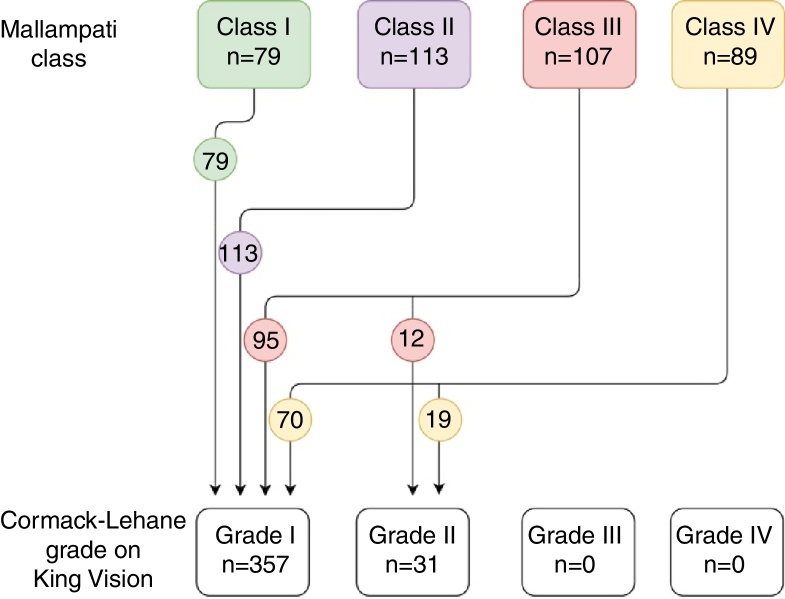
Results and conclusions: First pass intubation success rates were similar for the King Vision and the Macintosh (96.6% vs. 94.3%, respectively, p > 0.05). King Vision resulted in a longer average time to glottic view (95% CI 0.5–1.4 s, p < 0.001), and time to intubation (95% CI 3–4.6 s, p < 0.001). The difference in time to intubation was similar when unsuccessful intubation attempts were excluded (95% CI 2.8–4.4 s, p < 0.001). Based on the modified Mallampati class at the preoperative visit, the King Vision improved the glottic view in significantly more patients (220 patients, 56.7%) compared with the Macintosh (180 patients, 46.4%) (p < 0.001). None of the patients had peripheral oxygen desaturation below 94%. Experienced anesthesiologists may obtain similar rates of first pass intubation success and airway trauma with both laryngoscopes. King Vision requires longer times to visualize the glottis and to intubate the trachea, but does not cause additional desaturation.
Keywords: Airway management; Anestesia geral; Direct laryngoscopy; Endotracheal intubation; General anesthesia; Intubação endotraqueal; Laringoscopia direta; Manejo de vias aéreas; Video laryngoscopy; Videolaringoscopia.
Copyright © 2018 Sociedade Brasileira de Anestesiologia. Publicado por Elsevier Editora Ltda. All rights reserved.
Figures



References
-
- Cook T.M., Woodall N., Harper J., et al. Major complications of airway management in the UK: results of the Fourth National Audit Project of the Royal College of Anaesthetists and the Difficult Airway Society. Part 2: intensive care and emergency departments. Br J Anaesth. 2011;106:632–642. - PubMed
-
- Woodall N.M., Benger J.R., Harper J.S., et al. Airway management complications during anaesthesia, in intensive care units and in emergency departments in the UK. Curr Anaesth Crit Care. 2012;2:58–64.
-
- Metzner J., Posner K.L., Lam M.S., et al. Closed claims’ analysis. Best Pract Res Clin Anaesthesiol. 2011;25:263–276. - PubMed
-
- Aziz M.F., Dillman D., Fu R., et al. Comparative effectiveness of the C-MAC video laryngoscope versus direct laryngoscopy in the setting of the predicted difficult airway. Anesthesiology. 2012;116:629–636. - PubMed
Publication types
LinkOut - more resources
Full Text Sources
Other Literature Sources
