. 2019 Jun:183:29-37.
doi: 10.1016/j.exer.2018.07.013. Epub 2018 Jul 10.

Fixation instability during binocular viewing in anisometropic and strabismic children

Affiliations

Fixation instability during binocular viewing in anisometropic and strabismic children

Krista R Kelly et al. Exp Eye Res. 2019 Jun.

Abstract

Purpose: Strabismus or anisometropia disrupts binocularity and results in fixation instability, which is increased with amblyopia. Fixation instability has typically been assessed for each eye individually. Recently, vergence instability was reported in exotropic adults and monkeys during binocular viewing. We evaluated fixation instability during binocular viewing in children treated for anisometropia and/or strabismus.

Methods: 160 children age 4-12 years with treated esotropia and/or anisometropia (98 amblyopic, 62 nonamblyopic) were compared to 46 age-similar controls. Fixation instability was recorded during binocular fixation of a 0.3 deg diameter dot for 20 s using a 500 Hz remote video binocular eye tracker (EyeLink 1000; SR Research). The bivariate contour ellipse area (BCEA; log deg2) for fixation instability was calculated for each eye (nonpreferred, preferred) and for vergence instability (left eye position - right eye position). Best-corrected visual acuity, Randot Preschool stereoacuity, and extent of suppression scotoma (Worth 4-Dot) were also obtained.

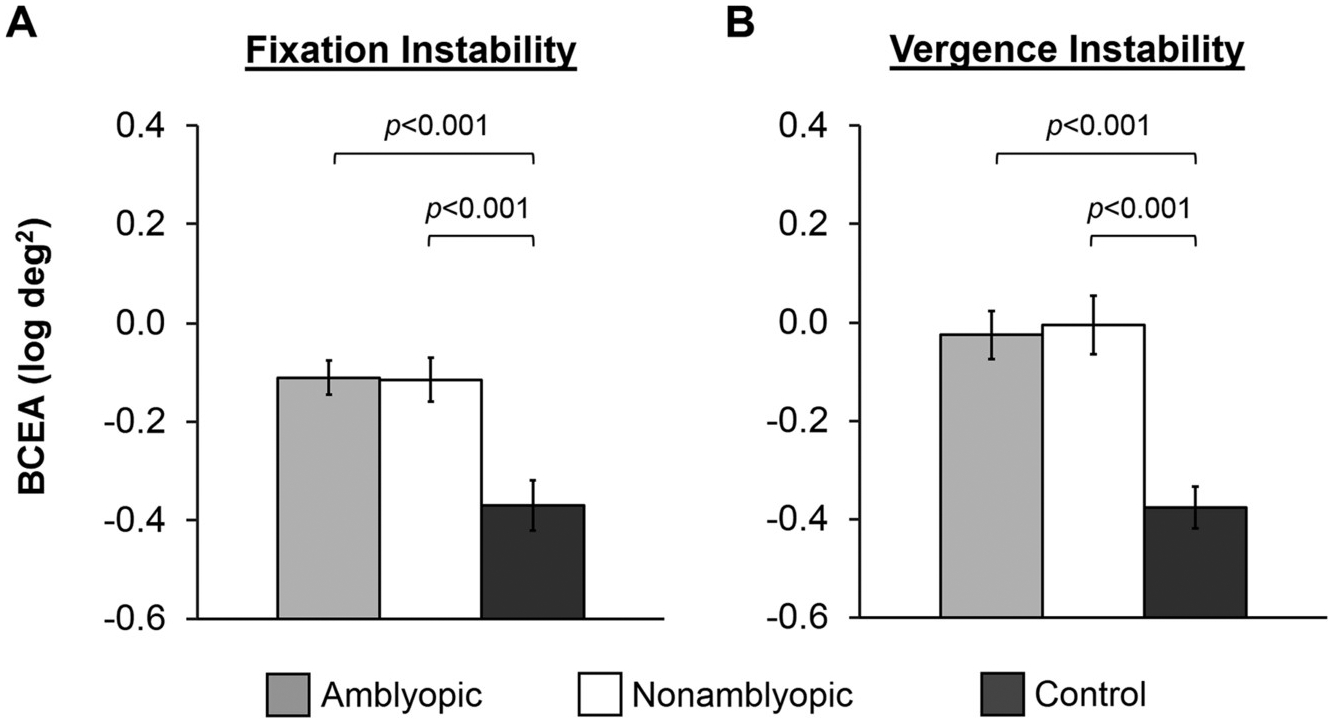
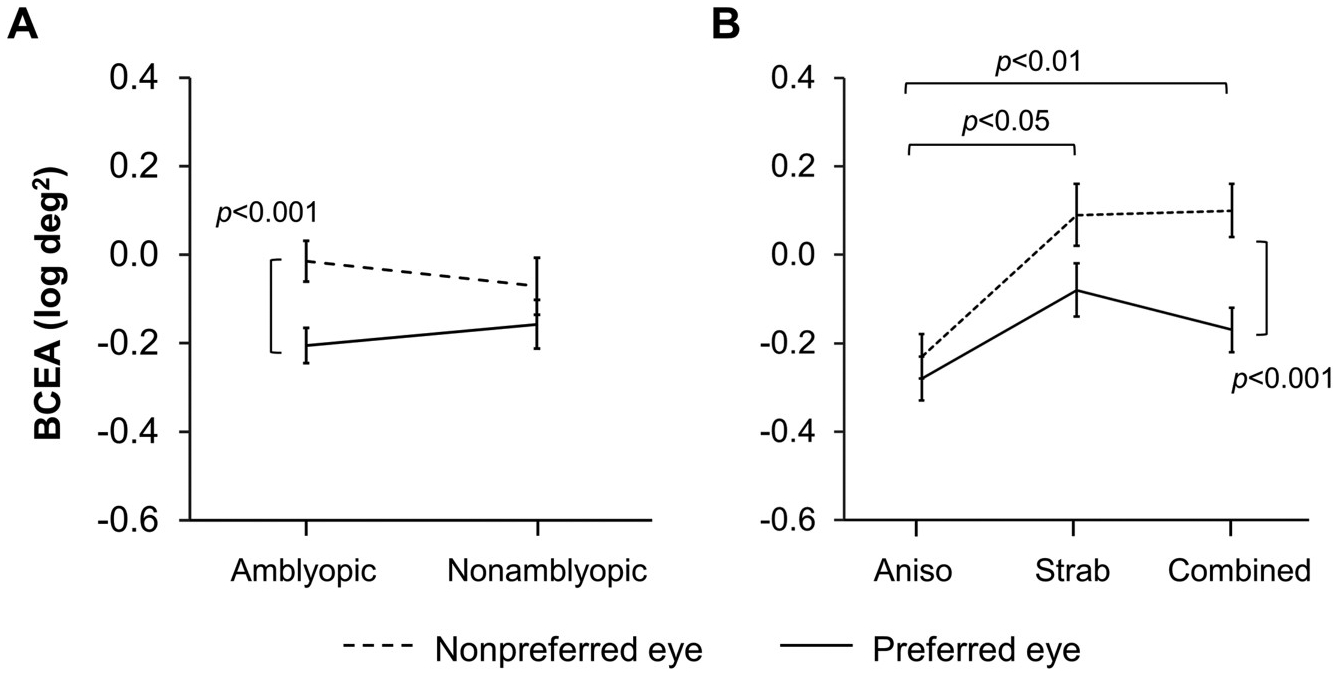
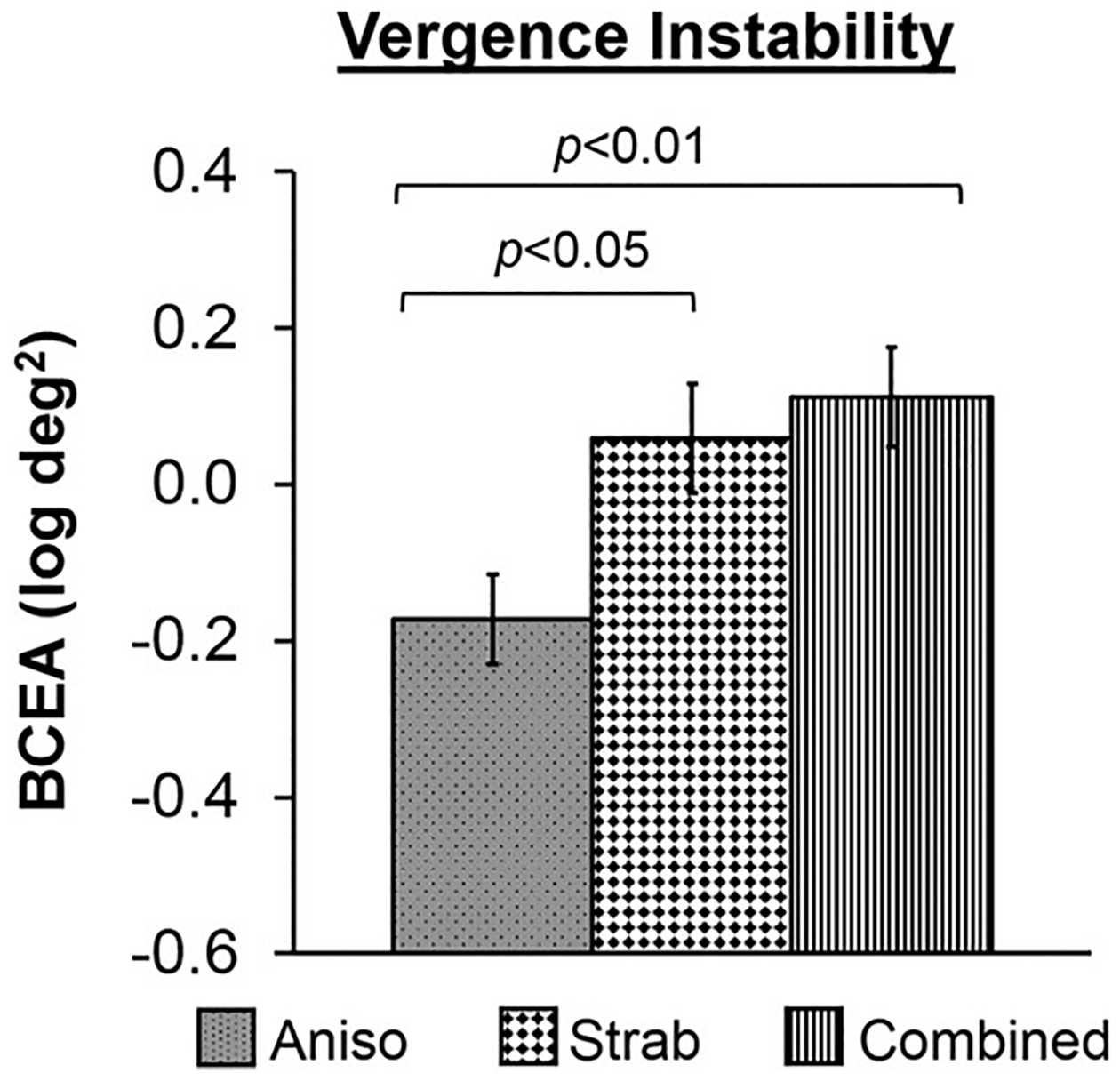
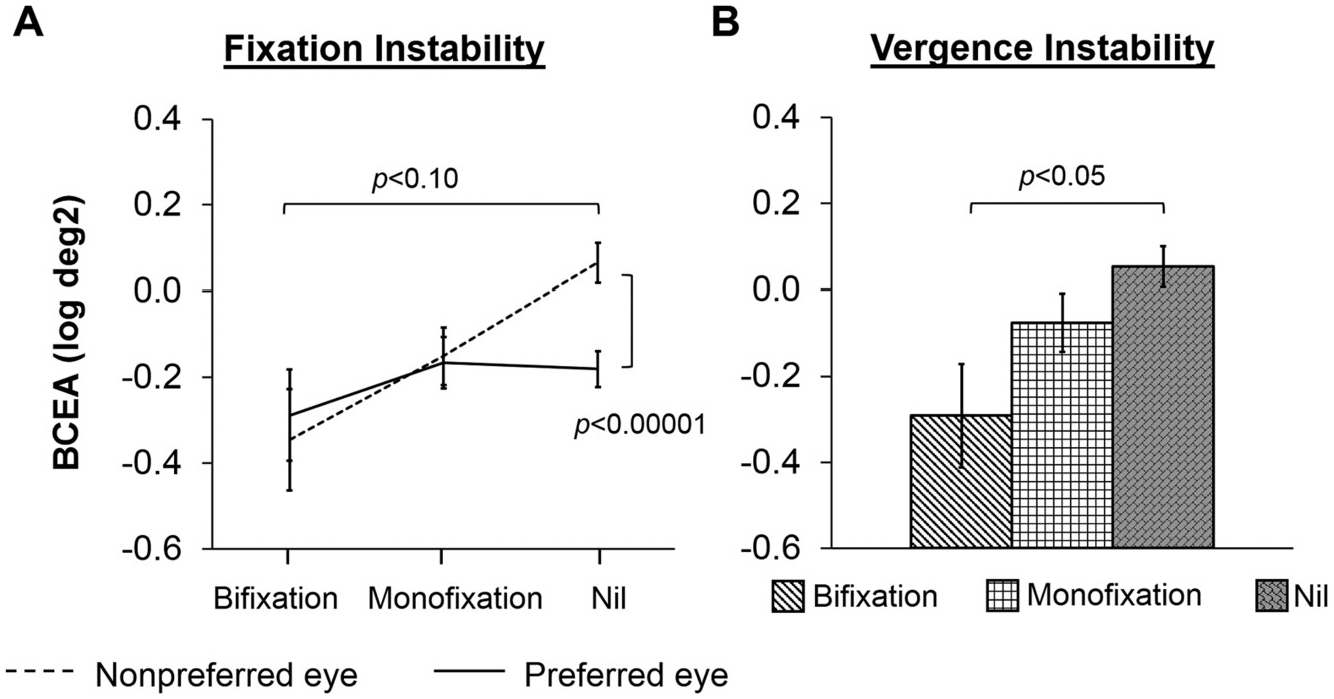
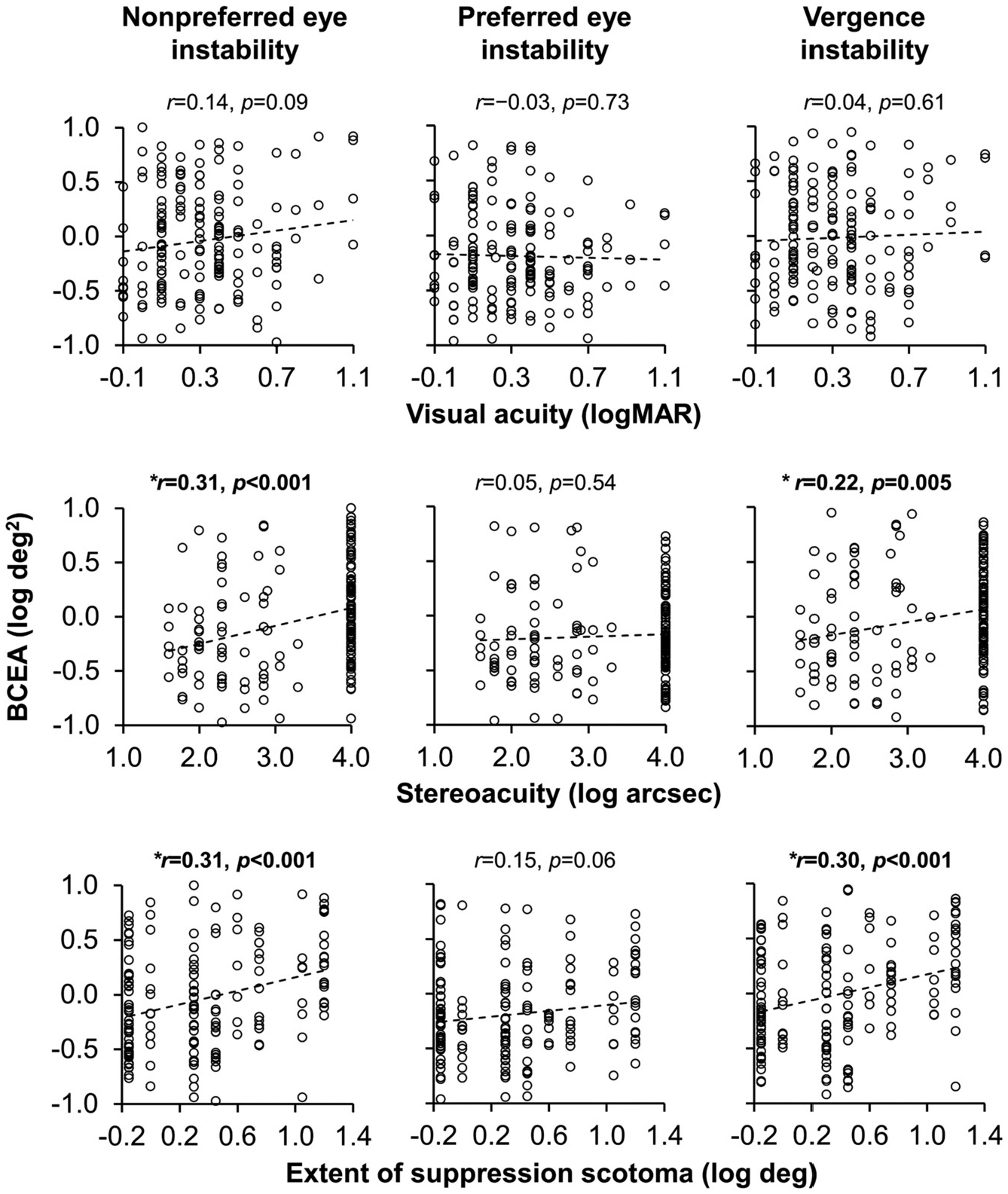
Results: When binocularly viewing, both amblyopic and nonamblyopic children treated for anisometropia and/or strabismus had larger fixation instability and vergence instability than controls. Amblyopia primarily added to the instability of the nonpreferred eye. Anisometropic children had less nonpreferred eye instability and vergence instability than those with strabismus or combined mechanism. Nonpreferred eye instability and vergence instability were related to poorer stereoacuity and a larger suppression scotoma. Preferred eye instability was not related to any visual outcome measure. No relationships were found with visual acuity.

Conclusions: Fixation instability and vergence instability during binocular viewing suggests that discordant binocular visual experience during childhood, especially strabismus, interferes with ocular motor development. Amblyopia adds to instability of the nonpreferred eye. Vergence instability may limit potential for recovery of binocular vision in these children.

Keywords: Amblyopia; Anisometropia; Fixation instability; Ocular motor development; Strabismus; Vergence.


Conflict of interest statement

Conflicts of interest

None of the authors have a financial conflict of interest with any of the material presented in the manuscript. This work was supported by the National Eye Institute (EY02313 and K99EY028224).

Figures
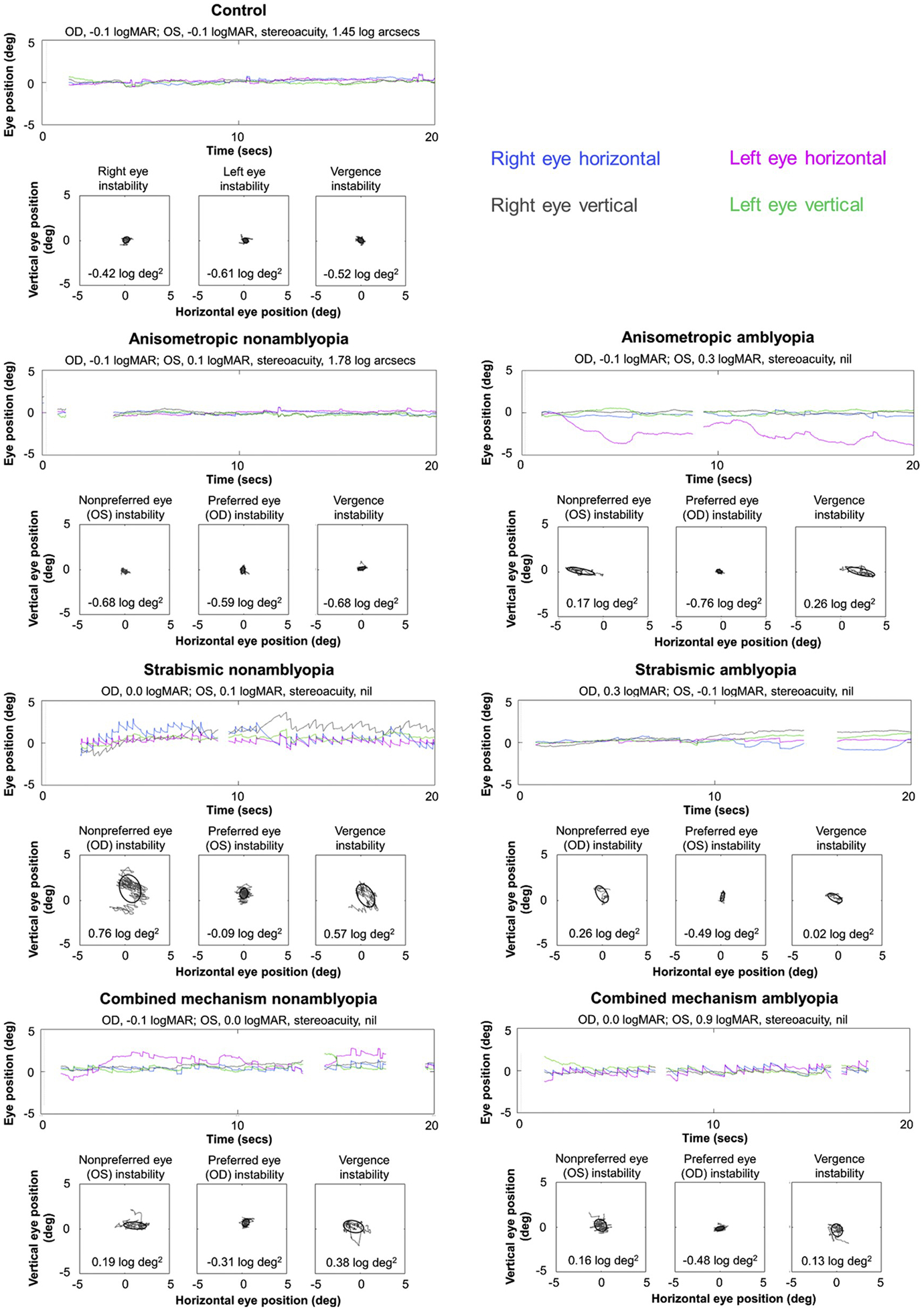
Fig. 1.
Fig. 1.
Examples of fixation instability and vergence instability. Representative eye position traces, fixation BCEAs (log deg2; nonpreferred eye, preferred eye) and vergence BCEAs (log deg2) from one child per group (A, control; B, anisometropic nonamblyopia; C, anisometropic amblyopia; D, strabismic nonamblyopia; E, strabismic amblyopia; F, combined mechanism nonamblyopia; G, combined mechanism amblyopia). While the two children with anisometropia (B, C) show little instability and no difference between eyes, children with strabismus and combined menchanism, regardless of amblyopia, have larger instability due to FMNS (D,G), saccadic oscillations (F), dissociated vertical deviation (D), and drift (E).
Fig. 2.
Fig. 2.
Amblyopia and instability. Bar graphs depicting main effects of group for A) fixation instability (collapsed across eye) and B) vergence instability for amblyopic children (light gray bars), nonamblyopic children (white bars), and normal control children (dark grey bars). Amblyopic and nonamblyopic children exhibited larger fixation and vergence instability compared to controls. Amblyopic and nonamblyopic children did not differ. Error bars represent ± standard error of the mean (SEM).
Fig. 3.
Fig. 3.
Factors affecting fixation instability; amblyopia and etiology. A) An interaction between eye (nonpreferred eye, dotted line; preferred eye, solid line) and amblyopic category (amblyopic, nonamblyopic) for fixation instability shows that nonpreferred eye instability was larger than preferred eye instability for amblyopic children, but not for nonamblyopic children. B) An interaction between eye (nonpreferred eye, dotted line; preferred eye, solid line) and etiology (anisometropia, strabismus, combined mechanism) for fixation instability shows that children with anisometropia had less nonpreferred eye instability than children with strabismus and children with combined mechanism. Children with combined mechanism had larger nonpreferred eye instability than preferred eye instability. Error bars represent ± SEM.
Fig. 4.
Fig. 4.
Vergence instability and etiology. Bar graphs depicting group differences in vergence instability for etiology (anisometropia, grey bar with black dots; strabismus, white bar with black diamonds; combined mechanism, white bar with vertical stripes). Children with anisometropia had less vergence instability than children with strabismus and children with combined mechanism. Error bars represent ± SEM.
Fig. 5.
Fig. 5.
Stereoacuity and instability. A) An interaction between eye (nonpreferred eye, dotted line; preferred eye, solid line) and stereoacuity category (bifxation, monofixation, nil) for fixation instability shows that nonpreferred eye instability was larger than preferred eye instability for children with nil stereoacuity, and that children with nil stereoacuity had larger nonpreferred eye instability than children with bifixation. B) Bar graphs depicting group differences in vergence instability for stereoacuity category (bifxation, white bar with diagonal stripes; monofixation, white bar with squares; nil, grey bar with bricks). Children with nil stereoacuity had larger vergence instability than children with bifxation. Error bars represent ± SEM.
Fig. 6.
Fig. 6.
Correlations with instability. Scatterplots depicting correlations between instability (nonpreferred eye, preferred eye, vergence) and visual assessment measures (nonpreferred eye visual acuity, stereoacuity, extent of suppression). Nonpreferred eye instability and vergence instability were associated with worse stereoacuity and larger extent of suppression scotoma. Nil stereoacuity was arbitrarily assigned a value of 4 log arsec. Suppression (no fusion) for the extent of suppression scotoma was arbitrarily assigned a value of 1.2 log deg *denotes a significant correlation p < 0.05.

References

    1. Beck R, Moke P, Turpin A, et al. , 2003. A computerized method of visual acuity testing: adaptation of the early treatment of diabetic retinopathy study testing protocol. Am. J. Ophthalmol 135 (2), 194–205. - PubMed
    1. Birch EE, 2003. Marshall Parks lecture. Binocular sensory outcomes in accommodative ET. J AAPOS 7 (6), 369–373. - PubMed
    1. Birch EE, 2013. Amblyopia and binocular vision. Prog. Retin. Eye Res 33, 67–84. - PMC - PubMed
    1. Birch EE, Stager DR, 2006. Long-term motor and sensory outcomes after early surgery for infantile esotropia. J AAPOS 10 (5), 409–413. - PubMed
    1. Birch EE, Wang J, Felius J, Stager DR, Hertle RW, 2012. Fixation control and eye alignment in children treated for dense congenital or developmental cataracts. J AAPOS 16 (2), 156–160. - PMC - PubMed

Publication types