


Effectiveness of a Blended Care Self-Management Program for Caregivers of People With Early-Stage Dementia (Partner in Balance): Randomized Controlled Trial
- PMID: 30006327
- PMCID: PMC6064039
- DOI: 10.2196/10017
Effectiveness of a Blended Care Self-Management Program for Caregivers of People With Early-Stage Dementia (Partner in Balance): Randomized Controlled Trial
Abstract
Background: The benefits of electronic health support for dementia caregivers are increasingly recognized. Reaching caregivers of people with early-stage dementia could prevent high levels of burden and psychological problems in the later stages.
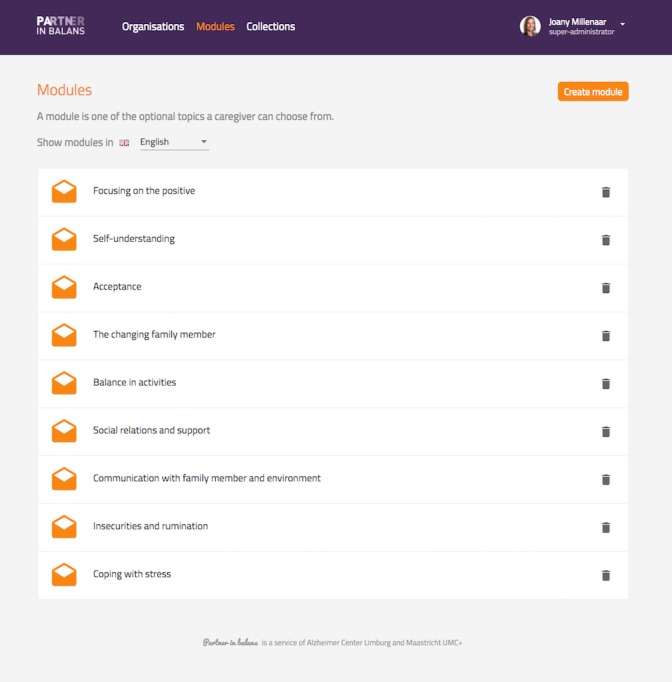
Objective: The current study evaluates the effectiveness of the blended care self-management program, Partner in Balance, compared to a control group.
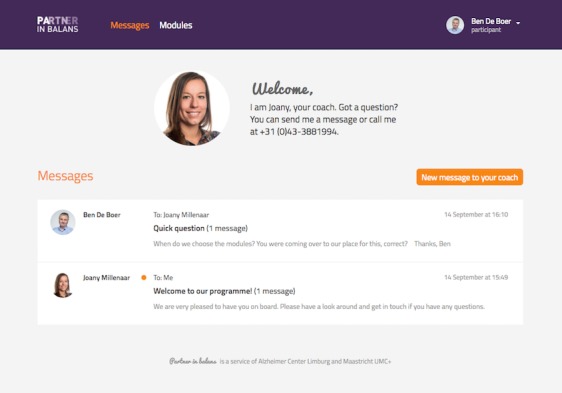
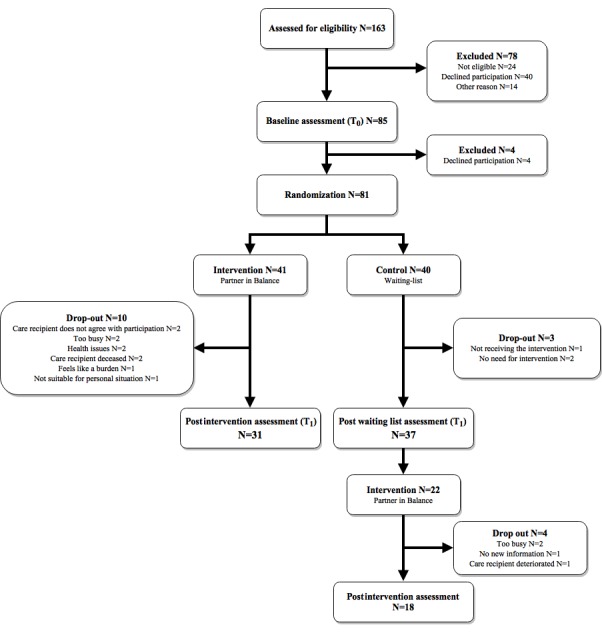
Methods: A single-blind randomized controlled trial with 81 family caregivers of community-dwelling people with mild dementia was conducted. Participants were randomly assigned to either the 8-week, blended care self-management Partner in Balance program (N=41) or a waiting-list control group (N=40) receiving usual care (low-frequent counseling). The program combines face-to-face coaching with tailored Web-based modules. Data were collected at baseline and after 8 weeks in writing by an independent research assistant who was blinded to the treatment. The primary proximal outcome was self-efficacy (Caregiver Self-Efficacy Scale) and the primary distal outcome was symptoms of depression (Center for Epidemiological Studies Depression Scale). Secondary outcomes included mastery (Pearlin Mastery Scale), quality of life (Investigation Choice Experiments for the Preferences of Older People), and psychological complaints (Hospital Anxiety and Depression Scale-Anxiety and Perceived Stress Scale).
Results: A significant increase in favor of the intervention group was demonstrated for self-efficacy (care management, P=.002; service use P=.001), mastery (P=.001), and quality of life (P=.032). Effect sizes were medium for quality of life (d=0.58) and high for self-efficacy care management and service use (d=0.85 and d=0.93, respectively) and mastery (d=0.94). No significant differences between the groups were found on depressive symptoms, anxiety, and perceived stress.
Conclusions: This study evaluated the first blended-care intervention for caregivers of people with early-stage dementia and demonstrated a significant improvement in self-efficacy, mastery, and quality of life after receiving the Partner in Balance intervention, compared to a waiting-list control group receiving care as usual. Contrary to our expectations, the intervention did not decrease symptoms of depression, anxiety, or perceived stress. However, the levels of psychological complaints were relatively low in the study sample. Future studies including long-term follow up could clarify if an increase in self-efficacy results in a decrease or prevention of increased stress and depression. To conclude, the program can provide accessible preventative care to future generations of caregivers of people with early-stage dementia.
Trial registration: Netherlands Trial Register NTR4748; http://www.trialregister.nl/trialreg/admin/rctview.asp?TC=4748 (Archived by WebCite at http://www.webcitation.org/6vSb2t9Mg).
Keywords: caregivers; internet; technology; therapeutics.
©Lizzy MM Boots, Marjolein E de Vugt, Gertrudis IJM Kempen, Frans RJ Verhey. Originally published in the Journal of Medical Internet Research (http://www.jmir.org), 13.07.2018.
Conflict of interest statement
Conflicts of Interest: None declared.
Figures
References
-
- Alzheimer's Disease International. London: ADI; 2013. [2018-04-26]. Policy Brief for Heads of Government: The Global Impact of Dementia 2013-2050 https://www.alz.co.uk/research/GlobalImpactDementia2013.pdf .
-
- Brodaty H, Donkin M. Family caregivers of people with dementia. Dialogues Clin Neurosci. 2009;11(2):217–28. http://www.dialogues-cns.com/publication/family-caregivers-of-people-wit... - PMC - PubMed
-
- Olazarán J, Reisberg B, Clare L, Cruz I, Peña-Casanova J, Del ST, Woods B, Beck C, Auer S, Lai C, Spector A, Fazio S, Bond J, Kivipelto M, Brodaty H, Rojo JM, Collins H, Teri L, Mittelman M, Orrell M, Feldman HH, Muñiz R. Nonpharmacological therapies in Alzheimer's disease: a systematic review of efficacy. Dement Geriatr Cogn Disord. 2010;30(2):161–78. doi: 10.1159/000316119. https://www.karger.com?DOI=10.1159/000316119 000316119 - DOI - PubMed
-
- Gaugler JE, Kane RL, Kane RA, Newcomer R. Early community-based service utilization and its effects on institutionalization in dementia caregiving. Gerontologist. 2005 Apr;45(2):177–85.45/2/177 - PubMed
Publication types
MeSH terms
LinkOut - more resources
Full Text Sources
Other Literature Sources
Medical
