. 2018 Aug 31;293(35):13566-13577.
doi: 10.1074/jbc.RA118.004172. Epub 2018 Jul 13.

Chlorpyrifos oxon promotes tubulin aggregation via isopeptide cross-linking between diethoxyphospho-Lys and Glu or Asp: Implications for neurotoxicity

Affiliations

Chlorpyrifos oxon promotes tubulin aggregation via isopeptide cross-linking between diethoxyphospho-Lys and Glu or Asp: Implications for neurotoxicity

Lawrence M Schopfer et al. J Biol Chem. .

Abstract

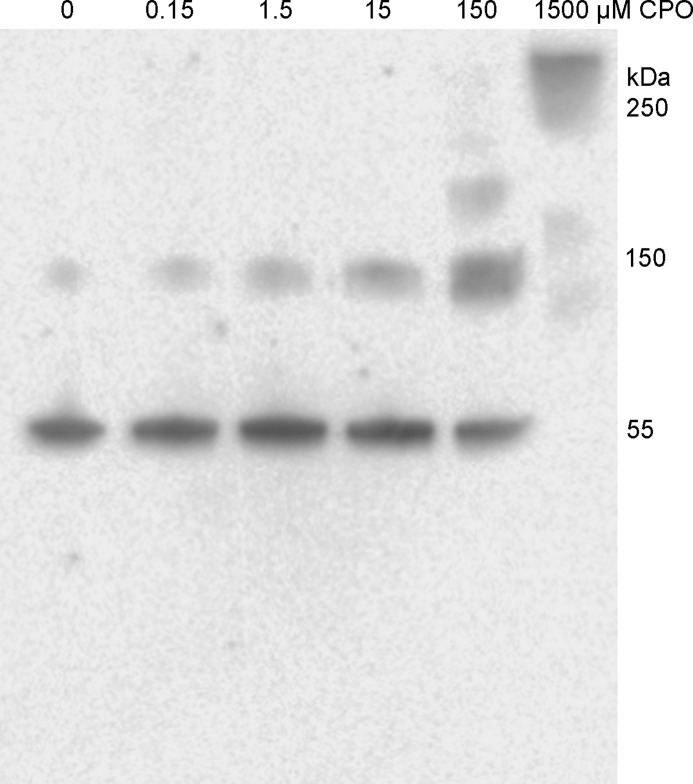
Exposure to organophosphorus toxicants (OP) can have chronic adverse effects that are not explained by inhibition of acetylcholinesterase, the cause of acute OP toxicity. We therefore hypothesized that OP-induced chronic illness is initiated by the formation of organophosphorus adducts on lysine residues in proteins, followed by protein cross-linking and aggregation. Here, Western blots revealed that exposure to the OP chlorpyrifos oxon converted porcine tubulin from its original 55-kDa mass to high-molecular-weight aggregates. Liquid chromatography-tandem MS analysis of trypsin-digested samples identified several diethoxyphospho-lysine residues in the OP-treated tubulin. Using a search approach based on the Batch Tag program, we identified cross-linked peptides and found that these chemically activated lysines reacted with acidic amino acid residues creating γ-glutamyl-ϵ-lysine or aspartyl-ϵ-lysine isopeptide bonds between β- and α-tubulin. Of note, these cross-linked tubulin molecules accounted for the high-molecular-weight aggregates. To the best of our knowledge, this is the first report indicating that chlorpyrifos oxon-exposed tubulin protein forms intermolecular cross-links with other tubulin molecules, resulting in high-molecular-weight protein aggregates. It is tempting to speculate that chronic illness from OP exposure may be explained by a mechanism that starts with OP adduct formation on protein lysines followed by protein cross-linking. We further speculate that OP-modified or cross-linked tubulin can impair axonal transport, reduce neuron connections, and result in neurotoxicity.

Keywords: Western blot; crosslink; isopeptide; mass spectrometry (MS); neurotoxicity; neurotoxin; organophosphate; protein aggregation; protein misfolding; tubulin.


Conflict of interest statement

The authors declare that they have no conflicts of interest with the contents of this article

Figures
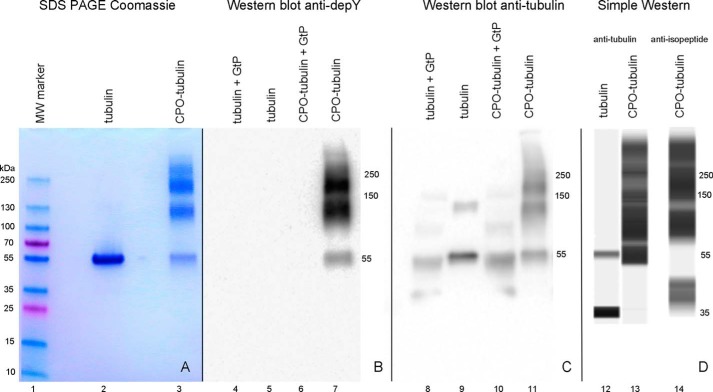
Figure 1.
Figure 1.
SDS-PAGE stained with Coomassie Blue (lanes 1–3), Western blotting on PVDF membrane probed with anti-diethoxyphosphotyrosine antibody depY (lanes 4–7), Western blotting probed with anti-tubulin antibody (lanes 8–11), and a capillary electrophoresis Simple Western image (lanes 12–14) probed with anti-tubulin antibody (lanes 12 and 13) or anti-isopeptide antibody (lane 14). All samples were reduced with DTT prior to electrophoresis. The band at 35 kDa for untreated tubulin (lane 12) was an artifact of the Simple Western procedure.
Figure 2.
Figure 2.
Western blotting on PVDF membrane probed with anti-tubulin antibody. Tubulin (0.25 mg/ml) was treated with 0 to 1500 μm CPO. Each lane of the SDS gel was loaded with 1 μg of tubulin after the sample was reduced with DTT and denatured in the presence of SDS in a boiling water bath.
Figure 3.
Figure 3.
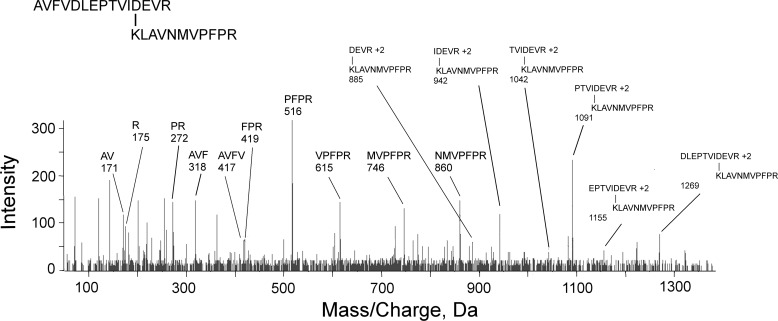
A mass spectral fragmentation spectrum for the cross-linked peptides AVFVDLEPTVIDEVR from tubulin α1A (P02550) and KLAVNMVPFPR from tubulin β (P02554). Parent ion 739.4 [M + 4H]+4 was not detected in the fragmentation spectrum. Unlabeled masses correspond to internal fragments, immonium ions, and b- or y-ions minus water and/or amine. The mass of cross-linked peptides is decreased by 18 Da due to loss of a water molecule upon formation of the isopeptide bond.
Figure 4.
Figure 4.
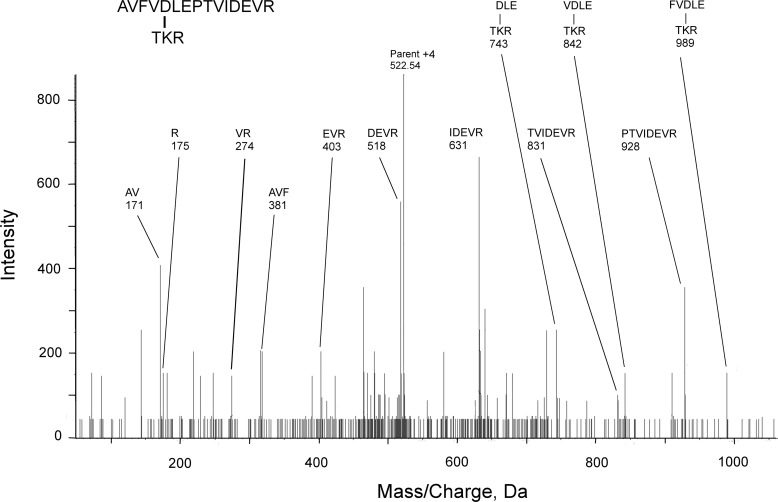
A mass spectral fragmentation spectrum for the cross-linked peptides AVFVDLEPTVIDEVR from tubulin α1A (P02550) and TKR from tubulin α1A (P02550). Most unlabeled masses correspond to internal fragments, immonium ions, and b- or y-ions minus water and/or amine.
Figure 5.
Figure 5.
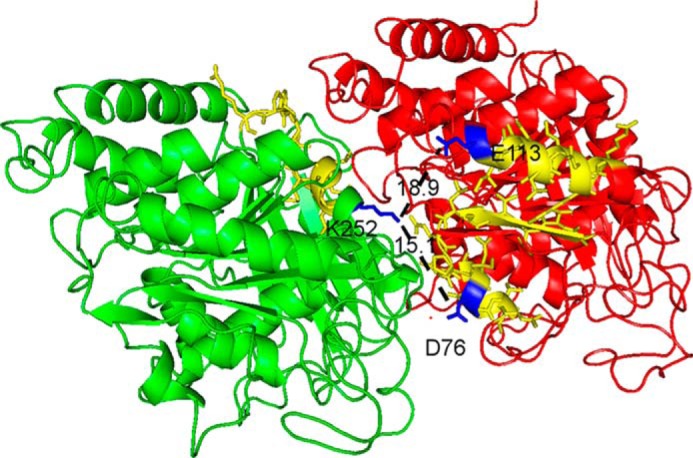
Crystal structure showing the cross-link between Lys-252 on tubulin β and Asp-76 on tubulin α1A, and the cross-link between Lys-252 on tubulin β and Glu-113 on tubulin α1A. β-Tubulin is shown in green, α1A in red. The cross-linked peptides are shown in yellow. Lysine 252, aspartate 76, and glutamate 113 are shown in blue. The distance between Lys-252 and Asp-76 is 15.1 Å and between Lys-252 and Glu-113 is 18.9 Å, indicated by dashed lines.
Figure 6.
Figure 6.
Autocatalytic isopeptide bond formation mechanism, where X is an amine or a hydroxyl (43).
Figure 7.
Figure 7.
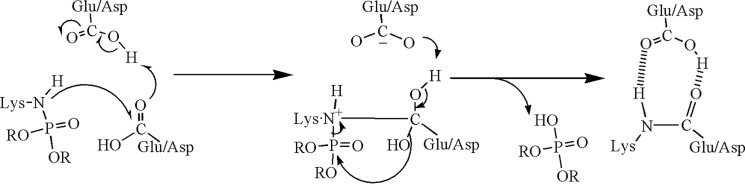
Organophosphate-promoted isopeptide bond formation between lysine and glutamate or aspartate. A nearby acidic residue serves as a proton shuttle.

References

    1. Casida J. E., and Quistad G. B. (2004) Organophosphate toxicology: safety aspects of nonacetylcholinesterase secondary targets. Chem. Res. Toxicol. 17, 983–998 10.1021/tx0499259 - DOI - PubMed
    1. Richardson R. J., Hein N. D., Wijeyesakere S. J., Fink J. K., and Makhaeva G. F. (2013) Neuropathy target esterase (NTE): overview and future. Chem. Biol. Interact. 203, 238–244 10.1016/j.cbi.2012.10.024 - DOI - PubMed
    1. Lotti M., and Moretto A. (2005) Organophosphate-induced delayed polyneuropathy. Toxicol. Rev. 24, 37–49 10.2165/00139709-200524010-00003 - DOI - PubMed
    1. Brown M. A., and Brix K. A. (1998) Review of health consequences from high-, intermediate- and low-level exposure to organophosphorus nerve agents. J. Appl. Toxicol. 18, 393–408 10.1002/(SICI)1099-1263(199811/12)18:6%3C393::AID-JAT528%3E3.0.CO%3B2-0 - DOI - PubMed
    1. Ross S. M., McManus I. C., Harrison V., and Mason O. (2013) Neurobehavioral problems following low-level exposure to organophosphate pesticides: a systematic and meta-analytic review. Crit. Rev. Toxicol. 43, 21–44 10.3109/10408444.2012.738645 - DOI - PubMed

Publication types

MeSH terms

Associated data

LinkOut - more resources