. 2018 Aug 15;201(4):1315-1326.
doi: 10.4049/jimmunol.1800323. Epub 2018 Jul 13.

Qualified Biolayer Interferometry Avidity Measurements Distinguish the Heterogeneity of Antibody Interactions with Plasmodium falciparum Circumsporozoite Protein Antigens

Affiliations

Qualified Biolayer Interferometry Avidity Measurements Distinguish the Heterogeneity of Antibody Interactions with Plasmodium falciparum Circumsporozoite Protein Antigens

S Moses Dennison et al. J Immunol. .

Abstract

Ab avidity is a measure of the overall strength of Ab-Ag interactions and hence is important for understanding the functional efficiency of Abs. In vaccine evaluations, Ab avidity measurements can provide insights into immune correlates of protection and generate hypotheses regarding mechanisms of protection to improve vaccine design to achieve higher levels of efficacy. The commonly used Ab avidity assays require the use of chaotropic reagents to measure avidity index. In this study, using real-time detection of Ab-Ag binding by biolayer interferometry (BLI) technique, we have developed a qualified assay for measuring avidity of vaccine-induced Abs specific for Plasmodium falciparum circumsporozoite protein (CSP) Ags. Human mAb derived from plasmablasts of recipients of RTS,S/AS01 (RTS,S), the most advanced malaria vaccine candidate, were used in the assay development to measure Ag-specific binding responses and rate constants of association and dissociation. The optimized BLI binding assay demonstrated 1) good precision (percentage of coefficient of variation <20), 2) high specificity, 3) a lower limit of detection and quantitation in the 0.3-3.3 nM range, and 4) a range of linearity up to 50-100 nM for the CSP Ags tested. Analysis of polyclonal sera of malaria vaccinees demonstrated the suitability of this method to distinguish among vaccinees and rank Ab responses by avidity. These results demonstrate that precise, specific, and sensitive BLI measurements of Ab avidity in polyclonal sera from malaria vaccinees can map Ab response heterogeneity and potentially help to determine the role of Ab avidity as an immune correlate of protection for vaccines.


Figures

FIGURE 1.
FIGURE 1.
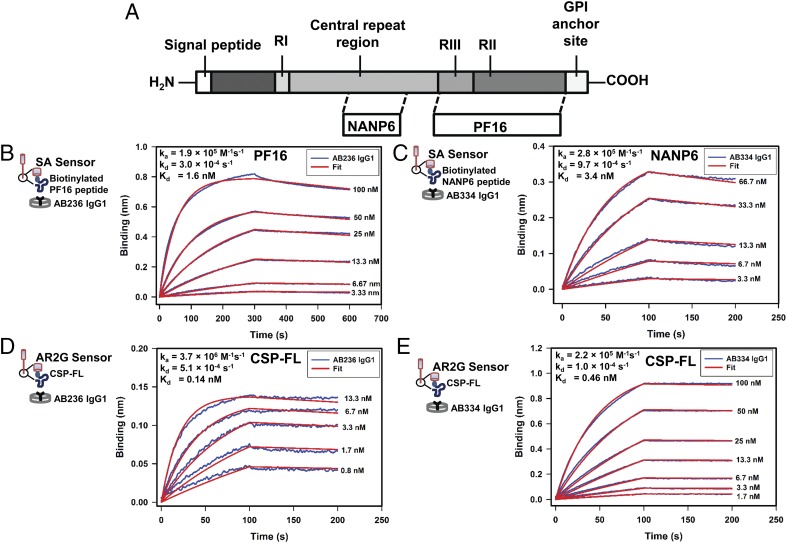
Avid binding of human mAbs to CSP constructs. (A) Schematic representation of CSP and the peptides NANP6 and PF16 corresponding to the central repeat and C-terminal regions of CSP, respectively. (B and D) Specific binding of C-terminal region targeting human mAb AB236 IgG1 to C-terminal region peptide PF16 (B) and CSP-FL (D), respectively, is shown. (C and E) The NANP repeat–targeting mAb AB334 IgG1 binding to NANP6 peptide (C) and rCSP-FL (E), respectively, is displayed. Blue lines in the panels indicate the association and dissociation of Abs at various indicated concentrations, which were globally fitted (red lines) to obtain association rate, dissociation rate, and Kd values shown in (B)–(E). In (B)–(E), cartoons display the BLI assay configuration of CSP Ag constructs loaded onto biosensors that were dipped into Abs placed in wells of a 384-well microplate. Ag immobilization levels were 1 nm for PF16 (B), 0.01 nm for NANP6 (C), and 0.1 nm for CSP-FL (D and E). Abs were diluted into kinetics buffer for measuring binding to NANP6 and CSP-FL Ags (C–E). PBS buffer was used to record AB236 binding to PF16.
FIGURE 2.
FIGURE 2.
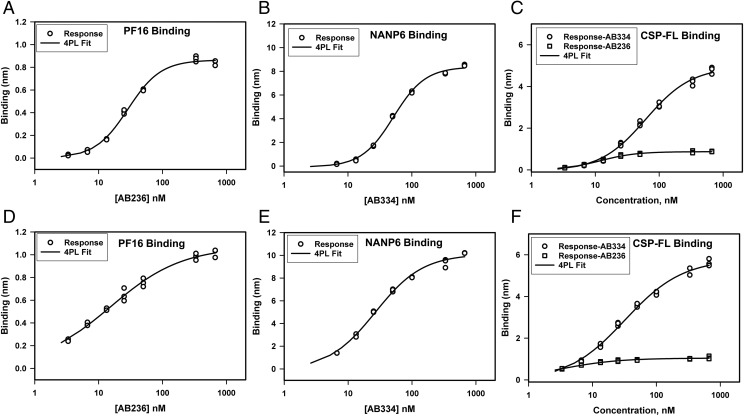
Repeatability of specific binding responses of anti-CSP mAbs binding to CSP Ags. (AC) Triplicate measurements of specific binding responses in PBS of AB236 IgG1 binding to PF16 (A), AB334 IgG1 binding to NANP6 (B), and both of these mAbs binding to CSP-FL (C) are shown. (DF) Specific binding responses of the same series of mAbs in 1:50-diluted NHS binding to PF16 (D), NANP6 (E), and CSP-FL (F) Ags are shown.
FIGURE 3.
FIGURE 3.
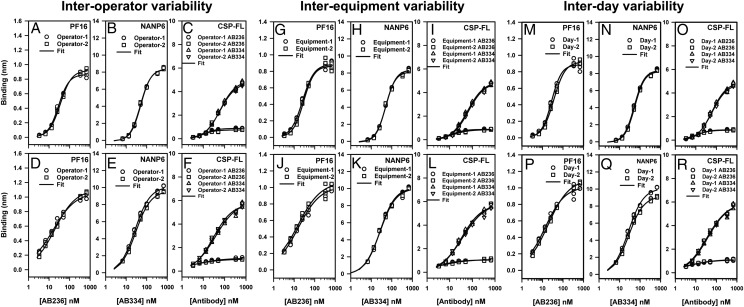
Intermediate precision of CSP Ags–specific binding responses of mAbs. Specific binding responses obtained in triplicate by different operators on a single instrument (interoperator variability) (AF), by an operator on different BLI instruments (interequipment variability) (GL), and by an operator using the same instrument on different days (interday variability) (MR) are shown for the binding of AB236 mAb to PF16 (A, D, G, J, M, and P), AB334 mAb binding to NANP6 (B, E, H, K, N, and Q), and both these mAbs binding to CSP-FL (C, F, I, L, O, and R). Binding was carried out for different concentrations of the mAbs both in PBS (A–C, G–I, and M–O) and in 1:50-diluted NHS (D–F, J–L, and P–R).
FIGURE 4.
FIGURE 4.
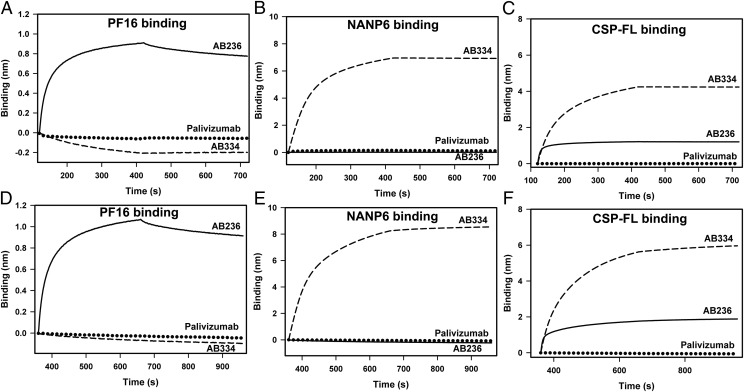
Specific recognition of CSP Ags by anti-CSP mAbs. (AC) Avid binding of AB236 (solid line) specific to CSP C-term peptide PF16 (A), AB334 (dashed line) specific to NANP6 repeat (B), and both of these mAbs binding to CSP-FL protein (C) are shown. The RSV-specific mAb palivizumab does not recognize CSP Ags (dotted lines) (A–C). Absence of cross-reactivity of AB334 (dashed line) to PF16 (A) and AB236 (solid line) to NANP6 (B) is shown. (DF) Robust binding of the same series of mAbs and minimal binding of palivizumab spiked in 1:50-diluted NHS binding to PF16 (D), NANP6 (E), and CSP-FL (F) Ags is displayed. All Abs were tested at 25 μg/ml concentration.
FIGURE 5.
FIGURE 5.
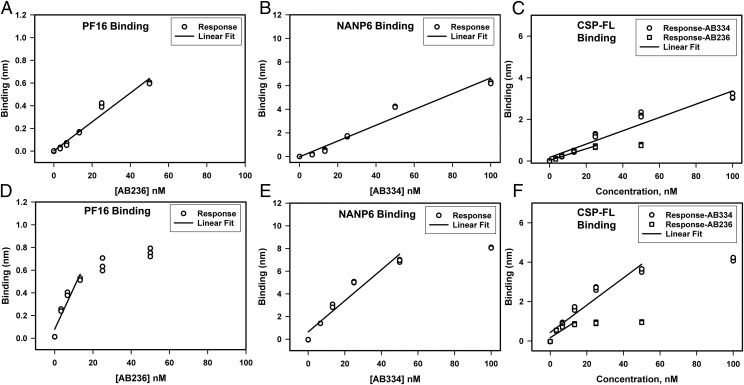
Range and linearity of specific binding responses of anti-CSP mAbs binding to CSP Ags. (AC) Triplicate measurements of specific binding responses in PBS buffer of AB236 binding to PF16 (A), AB334 binding to NANP6 (B), and both of these mAbs binding to CSP-FL (C) are shown. The solid lines are the best fit of the data to a linear equation. (DF) Specific binding responses of the same series of mAbs in 1:50-diluted NHS binding to PF16 (D), NANP6 (E), and CSP-FL (F) Ags are shown along with the linear fit of the data.
FIGURE 6.
FIGURE 6.
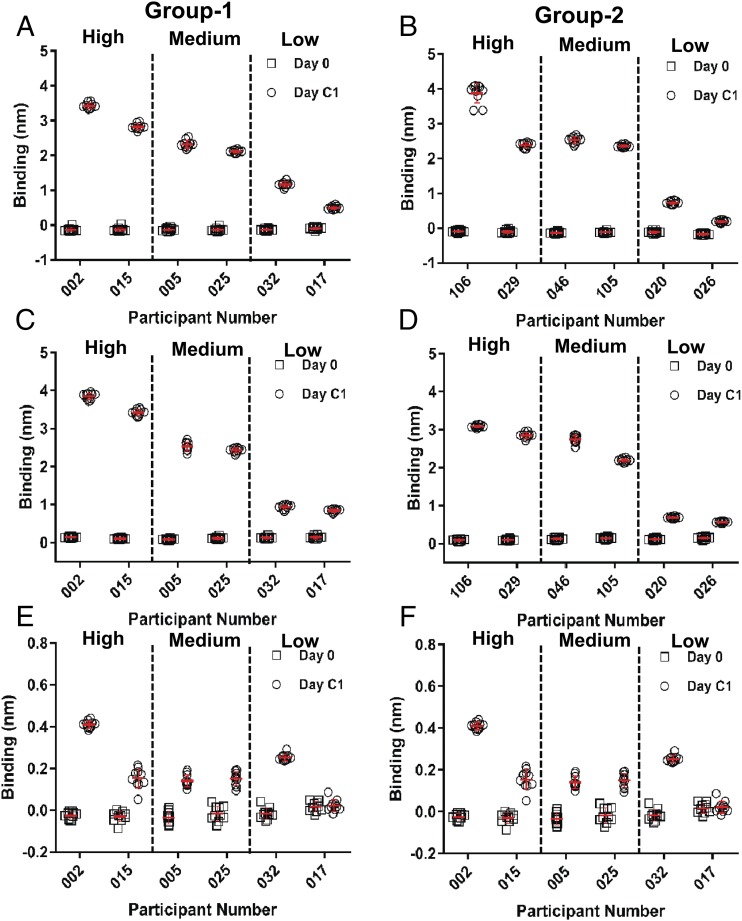
BLI measurement of Ag-specific binding responses of malaria vaccine recipients’ serum. Preimmune (day 0) and postvaccination (day C1) serum of group 1 (A, C, and E) and group 2 (B, D, and F) VAC055 study participants at a 1:50 dilution in PBS buffer binding to CSP-FL (A and B), NANP6 (C and D), and PF16 (E and F) Ags measured in the BLI assay are shown. The mean (horizontal red lines) and SD (vertical error bar in red) of 10 replicates of each serum binding to CSP Ags are indicated. In all panels, vaccinees previously observed to have high-, medium-, and low-Ab titers against CSP Ags are separated by vertical dashed lines as indicated.
FIGURE 7.
FIGURE 7.
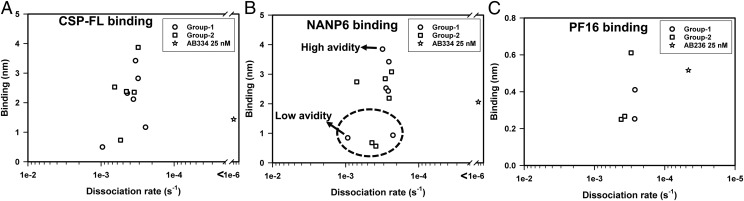
Avidity chart of malaria vaccinee serum binding to CSP Ags. (AC) The mean binding responses of mAbs AB334 and AB236 at 25-nM concentration (star) and postvaccination (day C1) serum (at 1:50 dilution) of group 1 (circles) and group 2 (squares) VAC055 study participant interaction with CSP-FL (A), NANP6 (B), and PF16 (C) are plotted against the respective mean dissociation rates. The mean values were calculated from 10 replicate measurements. In (B), dashed circle is shown to emphasize the clustering of low NANP6 binders away from high and medium binders. The arrows shown in (B) indicate the vaccinees in group 1 with low- and high-avidity Ab responses against NANP6.

References

    1. Kappe S. H., Buscaglia C. A., Nussenzweig V. 2004. Plasmodium sporozoite molecular cell biology. Annu. Rev. Cell Dev. Biol. 20: 29–59. - PubMed
    1. Ménard R. 2000. The journey of the malaria sporozoite through its hosts: two parasite proteins lead the way. Microbes Infect. 2: 633–642. - PubMed
    1. Casares S., Brumeanu T. D., Richie T. L. 2010. The RTS,S malaria vaccine. Vaccine 28: 4880–4894. - PubMed
    1. Cohen J., Nussenzweig V., Nussenzweig R., Vekemans J., Leach A. 2010. From the circumsporozoite protein to the RTS, S/AS candidate vaccine. Hum. Vaccin. 6: 90–96. - PubMed
    1. Gordon D. M., McGovern T. W., Krzych U., Cohen J. C., Schneider I., LaChance R., Heppner D. G., Yuan G., Hollingdale M., Slaoui M., et al. 1995. Safety, immunogenicity, and efficacy of a recombinantly produced Plasmodium falciparum circumsporozoite protein-hepatitis B surface antigen subunit vaccine. J. Infect. Dis. 171: 1576–1585. - PubMed

Publication types

MeSH terms