


Self-expandable metallic stenting as a bridge to surgery for malignant colorectal obstruction: pooled analysis of 426 patients from two prospective multicenter series
- PMID: 30006840
- PMCID: PMC6342866
- DOI: 10.1007/s00464-018-6324-8
Self-expandable metallic stenting as a bridge to surgery for malignant colorectal obstruction: pooled analysis of 426 patients from two prospective multicenter series
Abstract
Background: Self-expandable metallic stenting (SEMS) for malignant colorectal obstruction (MCO) as a bridge to elective surgery (BTS) is a widely used procedure. The aim of this study was to assess short-term outcomes of SEMS for MCO as BTS.
Methods: This study analyzed pooled data from BTS patients who were enrolled in two multicenter prospective single-arm observational clinical studies that used different stent types. Both studies were conducted by the Japan Colonic Stent Safe Procedure Research Group (JCSSPRG). The first study evaluated the WallFlex™ colonic stent for BTS or palliative treatment (PAL) from May 2012 to October 2013 and the second evaluated the Niti-S™ colonic stent from October 2013 to May 2014. Fifty-three facilities in Japan participated in the studies. Before each study started, the procedure had been shared with the participating institutions by posting details of the standard methods of SEMS placement on the JCSSPRG website. Patients were followed until discharged after surgery.
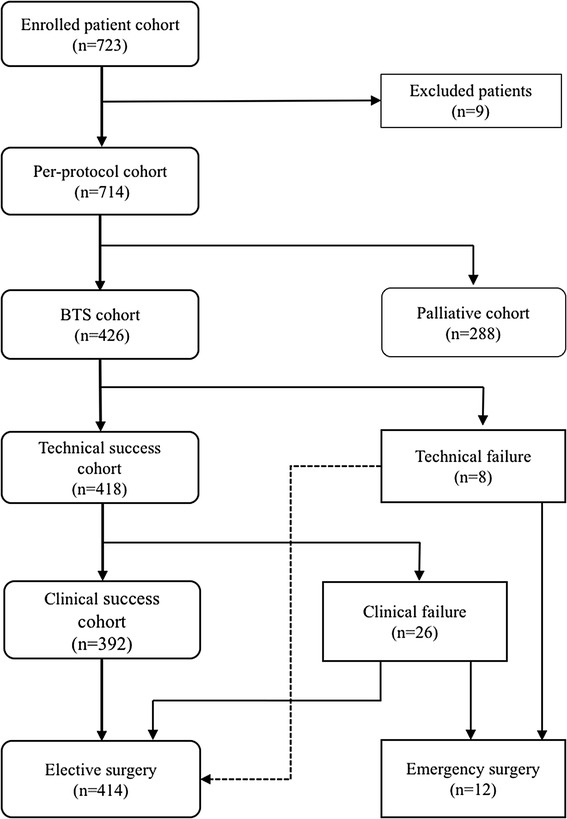
Results: A total of 723 consecutive patients were enrolled in the two studies. After excluding nine patients, the remaining 714 patients were evaluated as a per-protocol cohort. SEMS placement was performed in 426 patients (312 WallFlex and 114 Niti-S) as BTS and in 288 as PAL. In the 426 BTS patients, the technical success rate was 98.1% (418/426). The clinical success rate was 93.8% (392/418). SEMS-related preoperative complications occurred in 8.5% of patients (36/426), perforations in 1.9% (8/426), and stent migration in 1.2% (5/426). Primary anastomosis was possible in 91.8% of patients (391/426), 3.8% of whom (15/393) had anastomosis leakage. The overall stoma creation rate was 10.6% (45/426). The postoperative complication rate was 16.9% (72/426) and mortality rate was 0.5% (2/426).
Conclusions: SEMS placement for MCO as BTS is safe and effective with respect to peri-procedural outcomes. Further investigations are needed to confirm long-term oncological outcomes.
Keywords: Bridge to surgery; Colon and rectal cancer; Intestinal obstruction; Multicenter study; Prospective cohort study; Self-expandable metallic stent.
Conflict of interest statement
Dr. Shuji Saito has received personal fees from Boston Scientific Japan, Century Medical Inc., and Cook Japan Inc.; Dr. Takeaki Matsuzawa has received personal fees from Boston Scientific Japan and Century Medical Inc.; Dr. Toshio Kuwai and Dr. Mamoru Shimada have received personal fees from Boston Scientific Japan; Dr. Tomonori Yamada has received personal fees from Century Medical Inc.; Dr. Shuntaro Yoshida has received personal fees from Boston Scientific Japan, Century Medical Inc., and ZEON Co.; Dr. Hiroyuki Isayama has received donations and personal fees from Boston Scientific Japan, Century Medical Inc., and TaeWoong Medical Devices Inc.; Dr. Koichi Koizumi has received personal fees from Century Medical Inc. and Olympus Medical Systems Corp.; Dr. Yoshihisa Saida has received grants and personal fees from Boston Scientific Japan, Century Medical Inc., and Olympus Medical Systems Corp. Dr. Masafumi Tomita, Dr. Nobuto Hirata, Dr. Toshiyuki Enomoto, Dr. Shinichiro Makimoto, Dr. Rika Kyo, and Dr. Tomio Hirakawa have no conflicts of interest or financial ties to disclose.
Figures
References
-
- Barillari P, Aurello P, De Angelis R, Valabrega S, Ramacciato G, D’Angelo F, Fegiz G. Management and survival of patients affected with obstructive colorectal cancer. Int Surg. 1992;77:251–255. - PubMed
Publication types
MeSH terms
LinkOut - more resources
Full Text Sources
Other Literature Sources
Medical
Molecular Biology Databases
