


Quantification of Torque Teno Virus Viremia as a Prospective Biomarker for Infectious Disease in Kidney Allograft Recipients
- PMID: 30007341
- PMCID: PMC6490304
- DOI: 10.1093/infdis/jiy306
Quantification of Torque Teno Virus Viremia as a Prospective Biomarker for Infectious Disease in Kidney Allograft Recipients
Abstract
Background: Drug-induced immunosuppression following kidney transplantation is crucial to prevent allograft rejection, but increases risk for infectious disease. Tailoring of drug dosing to prevent both rejection and infection is greatly desirable. The apathogenic and ubiquitous torque teno virus (TTV) reflects immunocompetence of the host and might be a potential candidate for immunologic monitoring.
Methods: To assess TTV as an infection biomarker, virus load was prospectively quantified in peripheral blood of 169 consecutive renal allograft recipients at the Medical University Vienna.
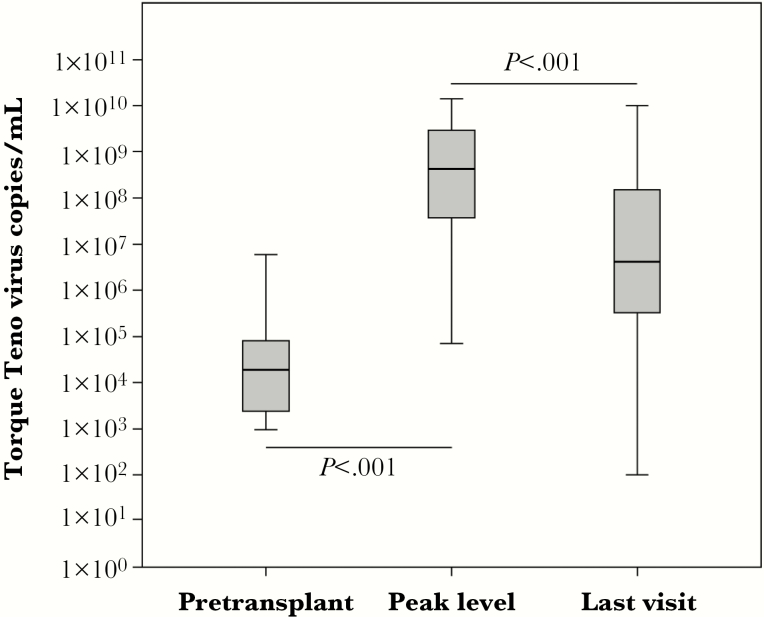
Results: Patients with infection showed higher TTV levels compared to patients without infection (4.2 × 10⁸ copies/mL [interquartile range, IQR, 2.7 × 10⁷-1.9 × 10⁹] vs 2.9 × 10⁷ [IQR 1.0 × 10⁶-7.2 × 10⁸]; P = .006). Differences in TTV load became evident almost 3 months before infection (median 77 days, IQR 19-98). Each log level of TTV copies/mL increased the odds ratio for infection by 23% (95% confidence interval 1.04-1.45; P = .014). TTV >3.1 × 10⁹ copies/mL corresponded to 90% sensitivity to predict infections. Logistic regression demonstrated independent association between TTV levels and infection.
Conclusions: TTV quantification predicts infection after kidney transplantation and might be a potential tool to tailor immunosuppressive drug therapy.
Figures
Comment in
-
Torque Teno Virus: Predictor of Infection After Solid Organ Transplant?J Infect Dis. 2018 Sep 8;218(8):1185-1187. doi: 10.1093/infdis/jiy384. J Infect Dis. 2018. PMID: 30007368 No abstract available.
References
-
- Farrugia D, Cheshire J, Begaj I, Khosla S, Ray D, Sharif A. Death within the first year after kidney transplantation–an observational cohort study. Transpl Int 2014; 27:262–70. - PubMed
-
- Andrews LM, Li Y, De Winter BCM, et al. Pharmacokinetic considerations related to therapeutic drug monitoring of tacrolimus in kidney transplant patients. Expert Opin Drug Metab Toxicol 2017; 13:1225–36. - PubMed
-
- Focosi D, Antonelli G, Pistello M, Maggi F. Torquetenovirus: the human virome from bench to bedside. Clin Microbiol Infect 2016; 22:589–93. - PubMed
-
- Chen T, Väisänen E, Mattila PS, Hedman K, Söderlund-Venermo M. Antigenic diversity and seroprevalences of torque teno viruses in children and adults by ORF2-based immunoassays. J Gen Virol 2013; 94:409–17. - PubMed
Publication types
MeSH terms
Substances
LinkOut - more resources
Full Text Sources
Other Literature Sources
Medical
