


A cluster randomized web-based intervention trial to reduce food neophobia and promote healthy diets among one-year-old children in kindergarten: study protocol
- PMID: 30007401
- PMCID: PMC6046098
- DOI: 10.1186/s12887-018-1206-8
A cluster randomized web-based intervention trial to reduce food neophobia and promote healthy diets among one-year-old children in kindergarten: study protocol
Abstract
Background: A child's first years of life are crucial for cognitive development and future health. Studies show that a varied diet with a high intake of vegetables is positive for both weight and cognitive development. The present low intake of vegetables in children's diets is therefore a concern. Food neophobia can be a barrier for vegetable intake in children. Our hypothesis is that interventions that can increase children's intake of vegetables should be introduced early in life to overcome children's neophobia. This study aims to develop, measure and compare the effect of two different interventions among one-year-old children in kindergartens to reduce food neophobia and promote healthy diets.
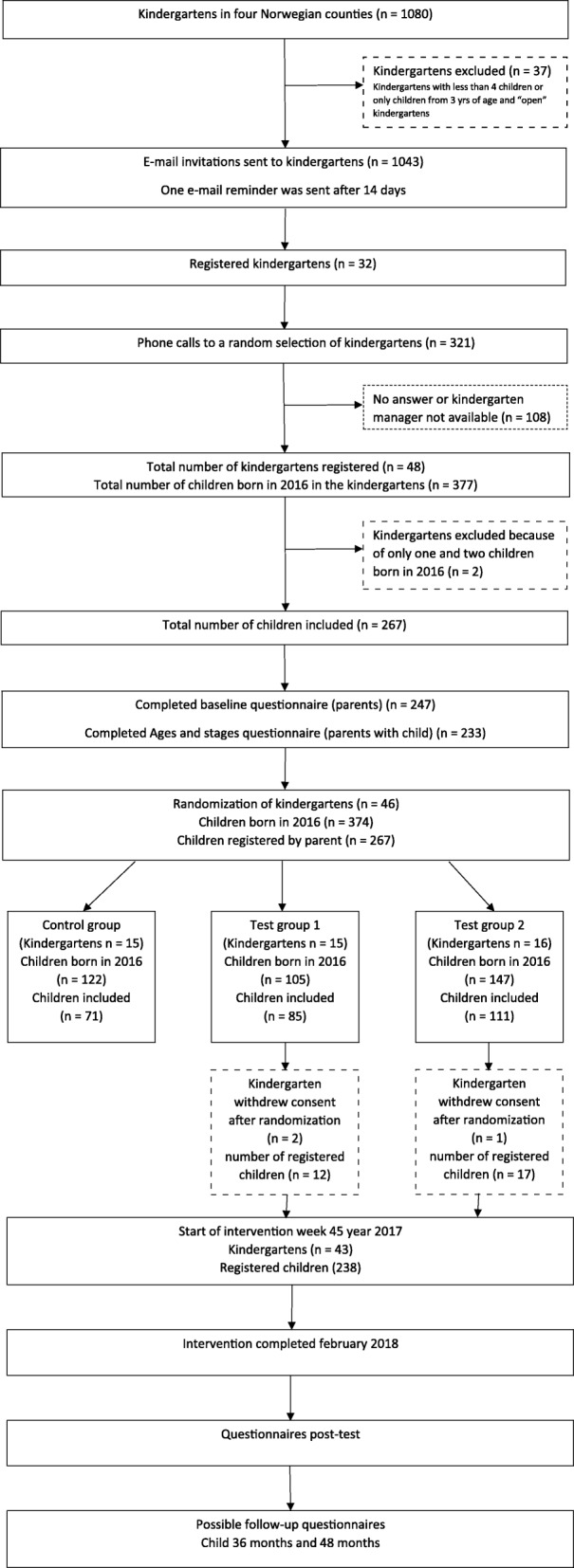
Methods: The kindergartens are randomized to one of three groups: two different intervention groups and one control group. We aimed to include a total of 210 children in the study. The first intervention group will be served a warm lunch meal with a variety of vegetables, 3 days a week during the intervention period of 3 months. The second intervention group will be served the same meals and, in addition, kindergarten staff will be asked to implement pedagogical tools including sensory lessons, adapted from the Sapere method, and advices on meal practice and feeding practices. The control group continues their usual meal practices. Parents and kindergarten staff will complete questionnaires regarding food neophobia, food habits and cognitive development at baseline and post intervention. A similar intervention among 2-year-old children in kindergarten has been implemented and evaluated earlier. We will investigate whether a digital version of this intervention has an effect, because digital interventions can be easily implemented nationwide. We will also investigate whether there are benefits of conducting such interventions in younger children, before the onset of food neophobia. Questionnaires, information videos and recipes will be digitally distributed.
Discussion: Results of this study will provide new knowledge about whether a sensory education and a healthy meal intervention targeting children, kindergarten staff and parents will reduce levels of food neophobia in children, improve parental and kindergarten feeding practices, improve children's dietary variety, improve children's cognitive development and reduce childhood overweight.
Trial registration: ISRCTN98064772 .
Keywords: Children; Cognitive development; Diet variety; Food neophobia; Kindergarten; Overweight; Parental feeding practices; Sapere method; Sensory education.
Conflict of interest statement
Ethics approval and consent to participate
The protocol for the present study was notified to the Norwegian Social Science Data Services, Data Protection Official for Research, 13/09/2016, reference 49951. Informed consent was obtained from parents of all participating children and from all participating kindergartens and kindergarten staff.
Consent for publication
Not applicable.
Competing interests
The authors declare that they have no competing interests.
Publisher’s Note
Springer Nature remains neutral with regard to jurisdictional claims in published maps and institutional affiliations.
References
-
- Lim SS, Vos T, Flaxman AD, Danaei G, Shibuya K, Adair-Rohani H, AlMazroa MA, Amann M, Anderson HR, Andrews KG, et al. A comparative risk assessment of burden of disease and injury attributable to 67 risk factors and risk factor clusters in 21 regions, 1990–2010: a systematic analysis for the global burden of disease study 2010. Lancet. 2012;380(9859):2224–2260. doi: 10.1016/S0140-6736(12)61766-8. - DOI - PMC - PubMed
-
- Knudsen AK, Tollånes MC, Haaland ØA, Kinge JM, Skirbekk V, Vollset SE. Disease Burden in Norway 2015. Results from the Global Burden of Diseases, Injuries, and Risk Factors Study 2015 (GBD 2015). Oslo: Public Health Institute Norway; 2017. https://www.fhi.no/en/publ/2017/sykdomsbyrde-i-norge-2015/#results. Accessed 15.01.2018
-
- Schwingshackl L, Schwedhelm C, Hoffmann G, Lampousi AM, Knuppel S, Iqbal K, Bechthold A, Schlesinger S, Boeing H. Food groups and risk of all-cause mortality: a systematic review and meta-analysis of prospective studies. Am J Clin Nutr. 2017;105(6):1462–1473. - PubMed
-
- WHO. Increasing fruit and vegetable consumption to reduce the risk of noncommunicable diseases. Geneva: World Health Organization; 2014. http://www.who.int/elena/titles/bbc/fruit_vegetables_ncds/en/. Accessed 15.01.2018
Publication types
MeSH terms
Associated data
LinkOut - more resources
Full Text Sources
Other Literature Sources
Medical
