. 2018 Apr 7;6(13):3271-3275.
doi: 10.1039/c8tc00053k. Epub 2018 Jan 16.

Cation, magnetic, and charge ordering in MnFe3O5

Affiliations

Cation, magnetic, and charge ordering in MnFe3O5

K H Hong et al. J Mater Chem C Mater. .

Abstract

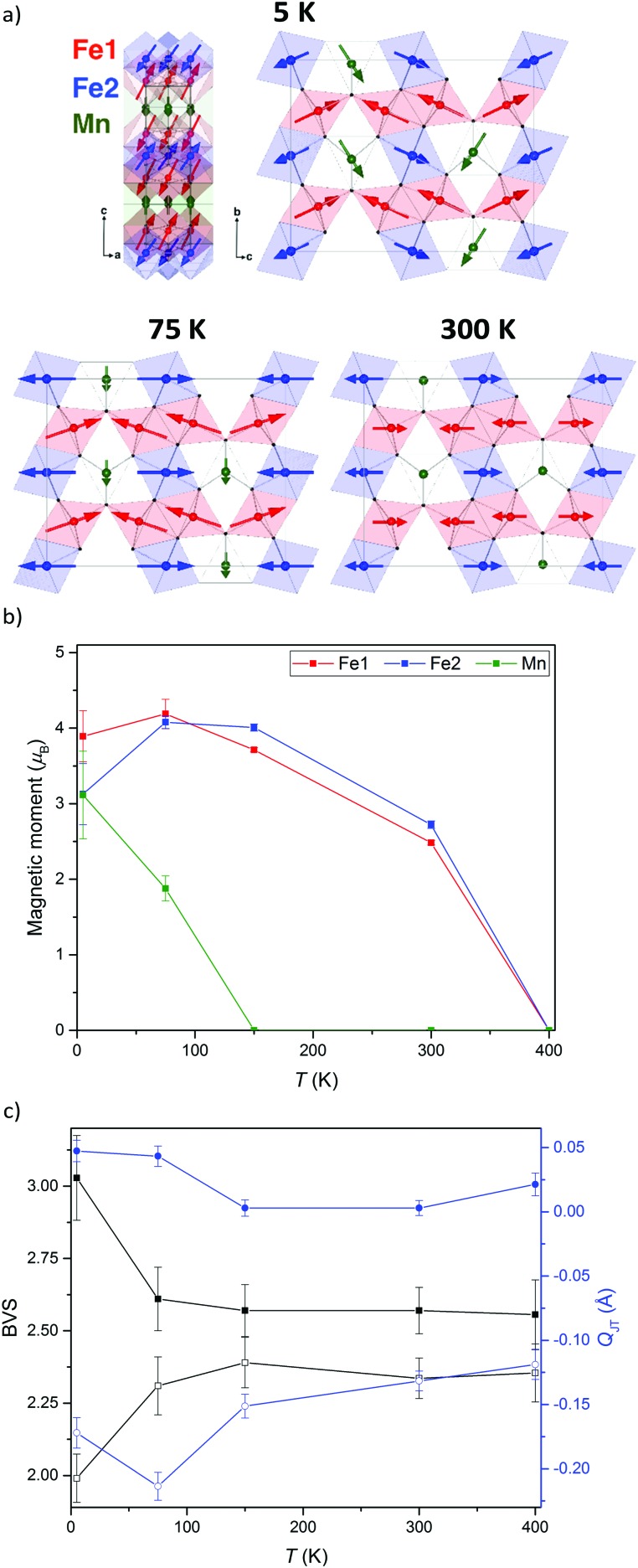
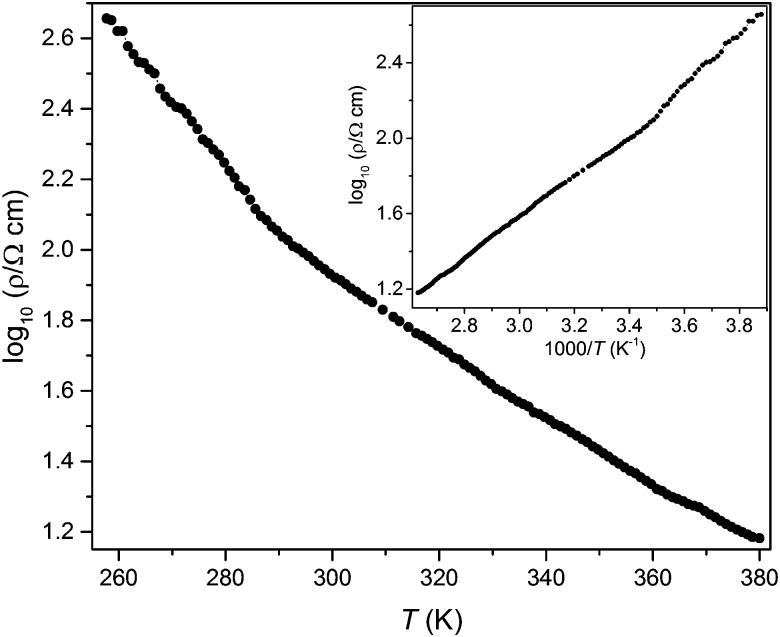
The recently-discovered high pressure material MnFe3O5 displays a rich variety of magnetically ordered states on cooling. Fe spins order antiferromagnetically below a Néel transition at 350 K. A second transition at 150 K marks Mn spin order that leads to spin canting of some of the Fe spins and ferrimagnetism. A further transition at 60 K is driven by charge ordering of Fe2+ and Fe3+ over two inequivalent Fe sites, with further canting of all spins. Electrical resistivity measurements reveal semiconducting behaviour in MnFe3O5 with a change in activation energy at 285 K.


Figures
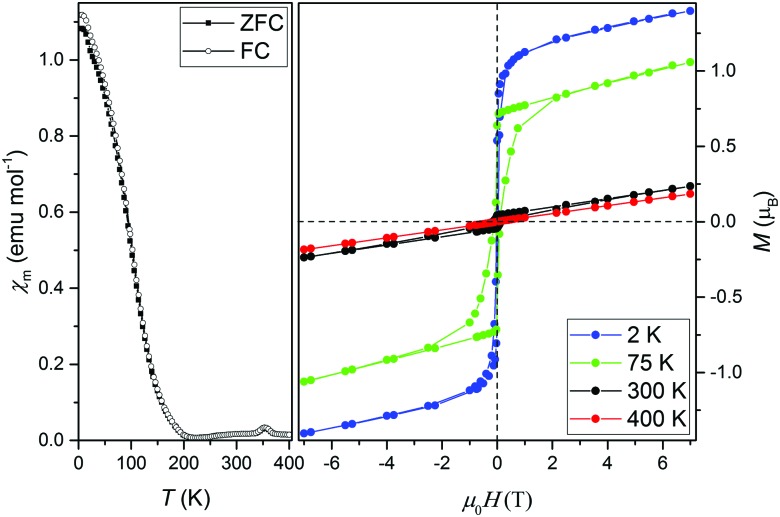
Fig. 1
Fig. 1. (left) Zero-field cooled and field cooled magnetisation measurements between 2 and 400 K. (right) Magnetisation-field hysteresis loops for MnFe3O5 measured at 2, 75, 300 and 400 K.
Fig. 2
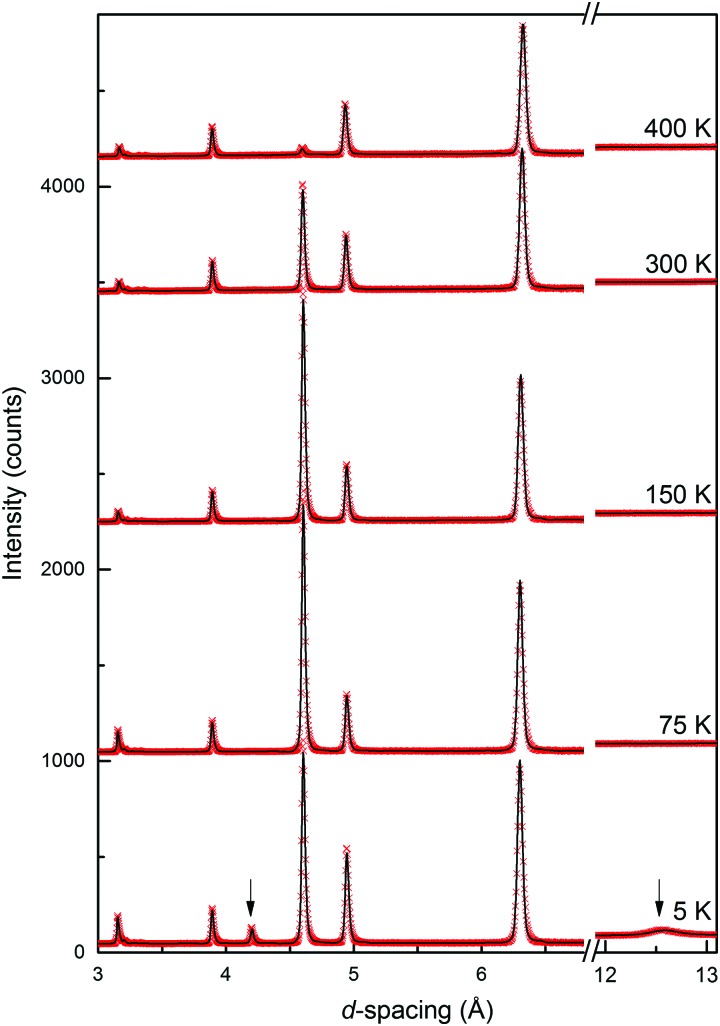
Fig. 2. Temperature evolution of the neutron diffraction pattern of MnFe3O5. Magnetic contributions appear at 300 K, and arrows indicate additional magnetic peaks at 5 K, with hkl = (001) and (003) at d-spacing = 12.6 and 4.2 Å, respectively.
Fig. 3
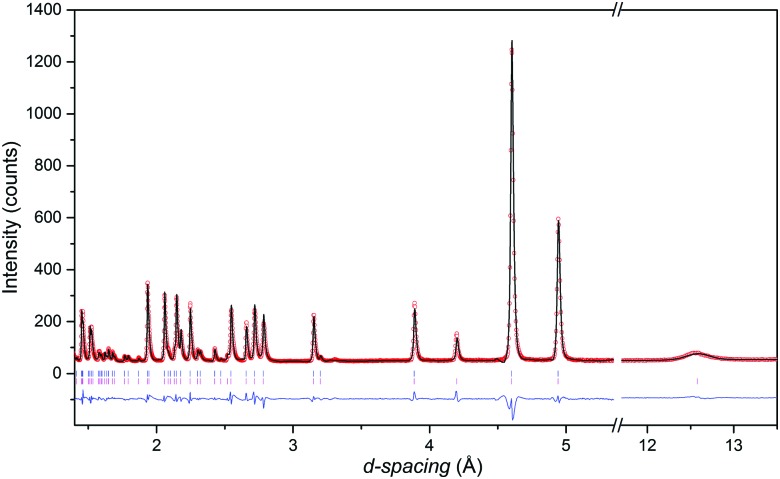
Fig. 3. Rietveld refinement of high resolution neutron diffraction patterns of MnFe3O5 obtained at 5 K, with upper tick marks indicating nuclear peaks and lower presenting magnetic reflections. (Rwp = 12.9% and Rp = 12.6%).
Fig. 4
Fig. 4. (a) Magnetic structures of MnFe3O5 at 5, 75 and 300 K. The network of FeO6 octahedra is shown, with Mn2+ in trigonal prismatic sites within channels parallel to the a-axis. (b) The temperature evolution of the ordered Mn, Fe1 and Fe2 magnetic moments. (c) Temperature evolution of BVS and QJT, with closed/open symbols representing Fe1/Fe2 sites.
Fig. 5
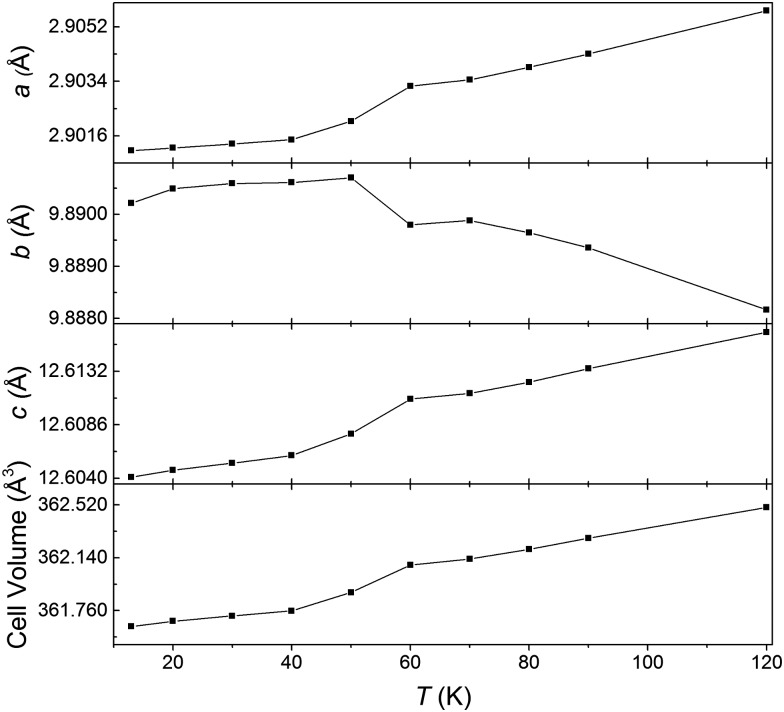
Fig. 5. Changes in the lattice parameters and cell volume obtained from powder synchrotron X-ray diffraction experiments.
Fig. 6
Fig. 6. Log of electrical resistivity of MnFe3O5 measured between 260 and 380 K, with insert showing the plot against reciprocal temperature.

References

    1. Yabuuch N., Komaba S. Sci. Technol. Adv. Mater. 2014;15:043501. - PMC - PubMed
    1. Zhang L., Wu H. B., Lou X. W. Adv. Energy Mater. 2013;4:1300958.
    1. Zhao Q., Yan Z., Chen C., Chen J. Chem. Rev. 2017;117:10121–10211. - PubMed
    1. Verwey E. J. W. Nature. 1939;144:327–328.
    1. Senn M. S., Wright J. P., Attfield J. P. Nature. 2012;481:173–176. - PubMed

LinkOut - more resources